
What if your court’s most efficient clerk never slept, never missed a call, and could resolve routine inquiries in dozens of languages simultaneously? As we move into 2026, judicial leaders face a mounting backlog and a public that expects instant, digital answers at any hour. You likely recognize the daily strain of managing overwhelming phone volumes and high failure to appear rates while your staff resources remain fixed. It’s a difficult balancing act that often leaves both clerks and the public feeling frustrated by the limitations of traditional office hours and manual processes.
This strategic guide shows you how to bridge that gap using advanced court chatbot software to automate judicial administration and enhance access to justice. By integrating 24/7 messaging into your workflow, you can significantly reduce the manual burden on your team while providing the seamless communication modern constituents demand. We’ll examine how these automated tools lower call volumes, drive up public satisfaction scores, and create a more resilient, accessible court system through the power of intelligent, around-the-clock support.
Key Takeaways
- Understand why digital automation has shifted from a luxury to an essential administrative engine for modern courts.
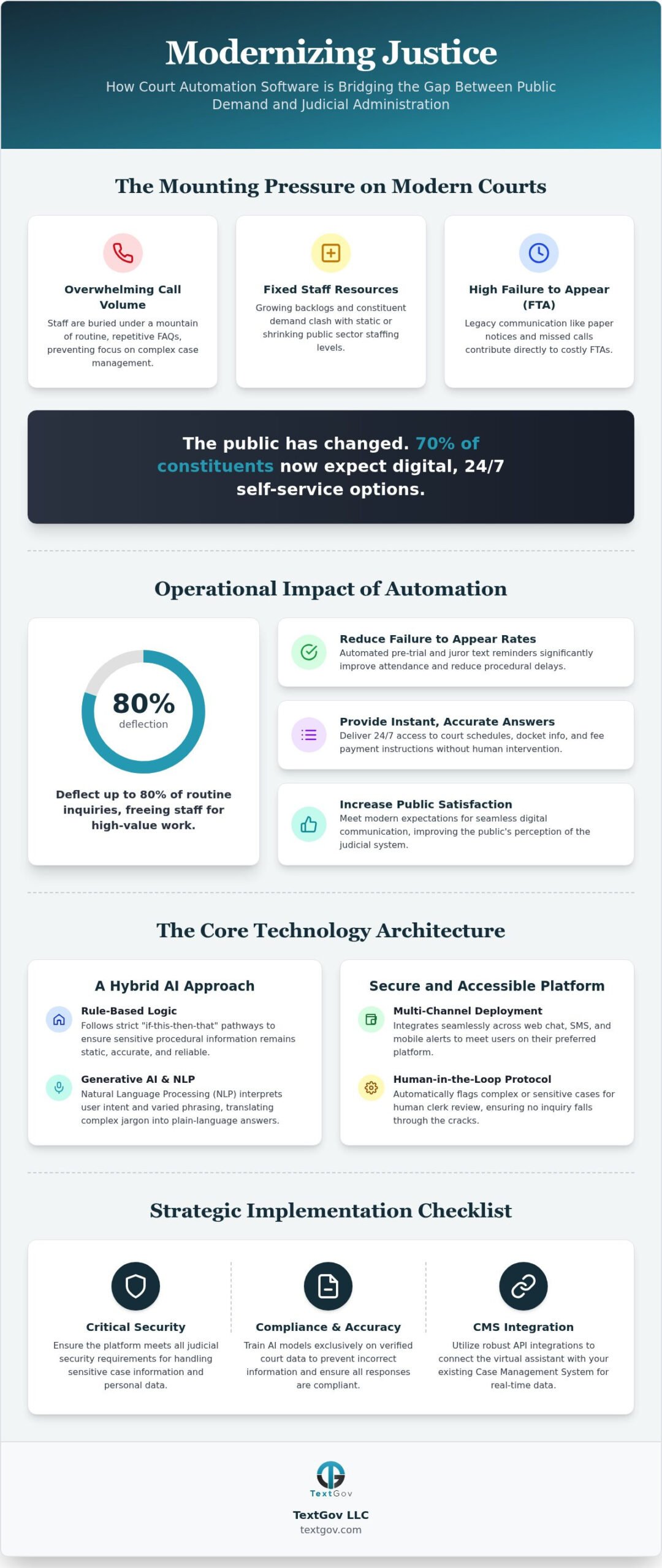
- Learn how implementing court chatbot software can deflect up to 80% of routine inquiries, allowing staff to focus on complex tasks.
- Discover the role of automated pre-trial and juror text reminders in significantly reducing Failure to Appear (FTA) rates.
- Explore the critical security requirements and API integrations needed to link virtual assistants with existing Case Management Systems.
- Identify the strategic advantages of specialized messaging modules designed for the unique complexities of judicial workflows.
The Evolution of Judicial Communication: Why Modern Courts Require Automation
The judicial landscape is undergoing a fundamental transformation that redefines how the public interacts with the legal system. Court chatbot software is a secure, AI-driven interface for public judicial inquiries, serving as a sophisticated virtual administrative layer that operates without the constraints of traditional office hours. What began as a modern convenience has evolved into essential judicial infrastructure. As we approach the complex administrative challenges of 2026, this technology is no longer a peripheral “nice-to-have” feature; it’s a strategic necessity for maintaining operational continuity during a period of unprecedented staffing shortages in the public sector.
Meeting the Expectations of the Digital-First Constituent
Modern constituents bring the same expectations to the courthouse that they have for their private sector interactions. Industry data suggests that approximately 70% of users now prefer digital self-service options over traditional phone inquiries. This preference creates a significant demand for 24/7 access to court schedules, docket information, and fee payment instructions. For pro se litigants, who often find legal terminology intimidating, plain-language automation provides a vital bridge to understanding. This shift aligns with the broader global adoption of Online Dispute Resolution (ODR), where technology facilitates faster, more accessible outcomes by removing the barriers of physical distance and rigid schedules.
The High Cost of Traditional Judicial Communication
Relying on legacy communication methods creates a hidden financial and administrative drain on court resources. Manual call handling and the distribution of paper notices are not just slow; they’re expensive and prone to human error. These outdated systems contribute directly to high Failure to Appear (FTA) rates because constituents often lose physical notices or miss phone calls during working hours. When a clerk’s office is buried under a mountain of routine FAQs, it’s impossible to dedicate time to the complex case management tasks that require human expertise. By deploying court chatbot software, jurisdictions can automate these repetitive interactions, ensuring that every citizen receives an immediate response while simultaneously relieving the heavy burden on court staff. This modernization isn’t just about efficiency; it’s about elevating the standard of public service to meet the needs of a modern society.
Understanding the Architecture of Court Chatbot Software
Modern court chatbot software relies on a sophisticated dual-engine architecture to balance procedural precision with conversational flexibility. Decision-makers must choose between rule-based logic, which follows strict “if-this-then-that” pathways, and Generative AI, which uses large language models to interpret intent. For judicial environments, a hybrid approach often proves most effective. Rule-based systems ensure that sensitive procedural information remains static and accurate, while AI layers allow the system to understand varied phrasing from the public. This structural balance ensures the platform remains a reliable virtual assistant that provides administrative information without ever crossing the line into providing legal advice.
Natural Language Processing (NLP) serves as the cognitive core of these systems, translating complex legal jargon into plain-language responses that constituents can actually use. According to research on Chatbots in the Criminal Justice System, the ability to process massive amounts of data and provide instant feedback is a primary driver of operational ROI. To maintain this high standard, the architecture must support multi-channel deployment. A truly modern system doesn’t just sit on a website; it integrates web chat with SMS and mobile alerts to meet users where they’re most comfortable. This unified approach creates a seamless experience whether a constituent is checking a court date from a desktop or receiving a text alert on their phone.
The Role of AI in 2026 Judicial Systems
By 2026, advanced NLP models have matured to handle nuanced inquiries without constant human intervention. These systems are trained exclusively on verified court data, ensuring that the bot doesn’t “hallucinate” or provide incorrect details. High-performance judicial bots utilize “human-in-the-loop” protocols, which automatically flag complex or sensitive cases for human clerk review. This ensures that while the bot handles 80% of routine traffic, the most critical issues always receive the expert attention they deserve. It’s about augmenting your staff’s capabilities, not replacing their expertise.
SMS and Text Messaging: The Power of Proactive Outreach
Strategic communication has moved beyond passive web widgets to embrace proactive outreach. Integrating juror text reminder systems represents a significant leap forward in reducing administrative friction. Unlike a web-only bot that waits for a user to visit, automated SMS services push vital information directly to the user’s pocket. This synergy between web-based chat and proactive texting ensures that notifications for court dates, jury duty, and payment deadlines are never missed. If you’re ready to see how these tools function in a real-world environment, exploring a specialized judicial messaging platform is the logical next step in your modernization journey.
Quantifying the Operational Impact: Efficiency and ROI
The implementation of court chatbot software represents a seismic shift in how jurisdictions measure and achieve administrative success. Moving beyond simple convenience, these platforms serve as a primary defense against the tidal wave of phone calls that typically paralyze clerk offices. By deflecting up to 80% of routine queries through automated 24/7 messaging, courts can effectively clear their communication logjams without increasing headcount. This efficiency isn’t just theoretical; it manifests in streamlined workflows for fee payments and document requests that no longer require a manual touchpoint for every transaction.
One of the most significant financial drains on any judicial budget is the administrative friction caused by missed court dates. A 10% reduction in FTA rates can save a jurisdiction thousands in administrative costs by eliminating the need for warrant processing, rescheduling, and additional law enforcement engagement. Automated reminders delivered through the chatbot’s messaging engine ensure that defendants and litigants have the information they need exactly when they need it. When citizens are proactively informed, the entire system moves with greater velocity and fewer costly interruptions.
Staff Relief and Workplace Satisfaction
Clerks are the backbone of the judicial process, yet their expertise is frequently underutilized when they’re forced to act as live FAQ machines. Automation allows these professionals to reallocate their time from repetitive data entry and basic inquiries to high-value case management tasks that require human judgment. By offloading public records inquiries and routine status checks to a virtual assistant, courts can significantly reduce staff burnout. This transition doesn’t just improve the bottom line; it elevates the professional standing of court employees and creates a more sustainable workplace environment. For a deeper look at how a government chatbot for FAQ management can systematically eliminate these repetitive burdens, the 2026 guide offers a comprehensive framework for transforming your public-facing communication strategy.
Enhancing Public Trust and Transparency
A modernized court system must be as equitable as it is efficient. Automated systems provide consistent, non-discriminatory information to every user, ensuring that the quality of assistance doesn’t fluctuate based on staff availability or mood. This technology also bridges the gap for non-English speaking constituents by offering real-time language translation, which is a critical component of modern judicial access. To ensure these tools remain effective, administrators can track resolution rates and user satisfaction scores through integrated analytics. This data-driven approach allows for continuous improvement, ensuring that the court’s digital front door remains open and effective for every member of the community.
Strategic Implementation: Security, Compliance, and Integration
Deploying court chatbot software requires more than just a front-end interface; it demands a robust backend that adheres to the strictest security protocols. Judicial data is exceptionally sensitive, making SOC2 Type II and CJIS compliance the foundational requirements for any reliable platform. These certifications ensure that constituent data is handled with the highest level of integrity, protecting both the court and the public from potential breaches. Beyond security, adherence to ADA compliance and WCAG 2.1+ standards is essential. These guidelines ensure the virtual assistant remains accessible to every citizen, regardless of their physical abilities or technological proficiency, fulfilling the court’s mandate for equal access to justice.
Establishing clear boundaries within the software is equally critical for maintaining judicial integrity. The system must be programmed to provide strictly administrative legal information while avoiding the unauthorized provision of legal advice. By utilizing structured response pathways, the platform can guide users toward the right forms or hearing dates without interpreting the law. This distinction protects the jurisdiction from liability while still providing the immediate, 24/7 support that modern constituents expect. When these strategic guardrails are in place, the technology becomes a powerful tool for civic engagement.
For those navigating more specialized legal matters that fall outside of basic court administration, such as businesses seeking to benefit from landmark Supreme Court rulings, professional consultancies like Trump Tariff Relief offer the necessary expertise to manage complex IEEPA tariff refund processes.
Integrating with Legacy Judicial Systems
The true utility of a virtual assistant lies in its ability to communicate directly with your Case Management System (CMS). While many jurisdictions still rely on on-premise legacy software, modern API connectivity allows for a seamless bridge between these isolated databases and cloud-based messaging platforms. This integration enables real-time syncing of court dates, docket updates, and fine balances, providing users with the most accurate information available. A scalable, cloud-native architecture ensures that the system can handle sudden spikes in traffic, such as during high-volume jury summons periods, without any degradation in performance.
Best Practices for Content and UX Design
Effective implementation also hinges on intuitive user experience (UX) design. Decision trees must be crafted using plain language to accommodate users of all education levels, intentionally avoiding the dense legalese that often creates barriers to justice. These pathways should guide users through common processes, such as requesting a hearing extension or paying a traffic citation, with minimal friction. However, automation has its limits. High-performance systems include built-in triggers to recognize when a query requires human intervention, facilitating a secure hand-off to live court staff when the situation demands expert judgment. To begin your transition toward a more secure and integrated digital infrastructure, you can explore specialized court chatbot software solutions designed specifically for the judicial sector.
Modernizing Your Jurisdiction with TextGov Messaging Solutions
Adopting a modern communication strategy requires more than just software; it demands a partnership with an innovator that understands the unique pressures of the public sector. TextGov functions as a strategic partner, providing the technical infrastructure and implementation support necessary to redefine judicial accessibility. By deploying specialized modules like Court Chatbots and Jury Texting, jurisdictions can achieve true 24/7 accessibility without adding a single dollar to their operational overhead. This approach ensures your court is prepared for the administrative demands of 2026, utilizing a platform that evolves through continuous updates and refined AI training models.
The transition to court chatbot software is a significant step toward a more resilient judicial system. TextGov’s platform is engineered to handle the complexities of legal workflows, ensuring that every constituent interaction is accurate, secure, and helpful. Because the system is cloud-based, it scales effortlessly to meet the needs of municipal, state, or federal agencies. This scalability ensures that as your jurisdiction grows or as legislative requirements change, your communication tools remain at the leading edge of technological performance.
The TextGov Advantage: Designed for the Public Sector
Generic e-commerce chatbots frequently fail in a legal environment because they lack the necessary guardrails and specialized vocabulary required for judicial inquiries. TextGov is purpose-built to address this gap, focusing specifically on reducing call volumes and improving constituent service through precision-engineered messaging. Our platforms don’t just provide answers; they integrate with your existing systems to provide actionable data. This focus on professional utility allows clerks to reclaim their time while ensuring the public receives the high-level support they expect from a modernized government office.
Next Steps for Judicial Modernization
Initiating your path toward digital transformation doesn’t have to be an overwhelming process. Most successful jurisdictions begin with a pilot program focused on high-impact FAQs, such as hearing locations, payment instructions, and jury duty status. This focused start allows your team to evaluate the immediate impact on staff workload and public engagement before expanding to more complex workflows. As you monitor the reduction in routine inquiries and the improvement in public satisfaction scores, the value of automated messaging becomes an objective fact. It’s time to move beyond legacy limitations and embrace a more efficient future. You can modernize your court communication with TextGov today and join the ranks of forward-thinking agencies redefining judicial access.
Additionally, for agencies that require assistance with the documentation and funding phase of their digital transformation, Dynamic Contracts Consultants LLC provides expert grant writing and proposal development services to help secure the necessary budget for advanced judicial technology.
Embracing the Future of Judicial Administration
The transition toward digital-first communication represents a significant opportunity to elevate the standards of public service while protecting your staff from administrative burnout. By implementing court chatbot software, you provide a secure, 24/7 virtual administrative layer that meets constituents exactly where they are. This strategic shift ensures that your court remains accessible and efficient, even in the face of the complex staffing challenges of 2026. You’ve seen how the synergy between web-based automation and proactive SMS reminders creates a more responsive judicial environment that effectively lowers manual court call volume and reduces administrative bottlenecks across your jurisdiction.
Now is the time to move beyond the limitations of legacy systems and embrace a platform designed for the unique needs of the public sector. With 24/7 Virtual Clerk availability, a proven reduction in manual call volumes, and seamless CMS and SMS integration, the path to modernization is clear and achievable. Streamline your judicial operations with TextGov chatbot software. We look forward to helping you build a more accessible and efficient future for your jurisdiction.
Frequently Asked Questions
How does court chatbot software ensure data security and CJIS compliance?
High-performance systems utilize SOC2 and CJIS-certified cloud environments to protect sensitive judicial data. These platforms employ end-to-end encryption and strict access controls to ensure every constituent interaction remains confidential and meets federal standards for handling law enforcement data. It’s a foundational requirement that ensures your jurisdiction stays protected while modernizing public access.
Can a chatbot integrate with my court’s existing case management system?
Yes, modern court chatbot software is designed to link directly with existing Case Management Systems (CMS) through secure API connections. This connectivity allows the virtual assistant to pull real-time data for hearing dates, docket updates, and fine balances. It ensures the public receives the most accurate information available without requiring manual updates from your staff.
What is the difference between a rule-based chatbot and an AI chatbot for courts?
Rule-based systems follow predefined decision trees for specific tasks, while AI-driven engines use Natural Language Processing to understand varied user intent. Most jurisdictions prefer a hybrid model that uses AI for understanding natural phrasing and rule-based logic to deliver strictly vetted, accurate procedural information. This approach balances conversational flexibility with the precision required in a legal environment.
How do chatbots help reduce Failure to Appear (FTA) rates?
Chatbots reduce FTA rates by delivering automated, proactive reminders directly to a user’s mobile device. These timely notifications ensure that defendants and jurors are aware of their obligations and know exactly where to go. By providing instant answers to logistical questions, the software removes common barriers that lead to missed court dates.
Can a court chatbot provide legal advice to pro se litigants?
No, a virtual assistant is programmed to provide strictly administrative legal information, not legal advice. It can guide users to the correct forms, explain court processes, and provide hearing details, but it’s never permitted to interpret the law. This distinction is critical for maintaining judicial integrity and protecting the court from liability.
How much does it cost to implement court chatbot software for a small jurisdiction?
Implementation costs for court chatbot software depend on the scale of the jurisdiction and the specific feature sets required, such as CMS integration or multi-channel SMS alerts. While universal price points aren’t available, many agencies find that the reduction in manual workload provides a significant return on investment. You’ll want to evaluate your specific needs to determine the most cost-effective configuration.
What happens if the chatbot cannot answer a user’s question?
When the software encounters a query it cannot resolve, it triggers a “human-in-the-loop” protocol to escalate the issue. This ensures a seamless hand-off to a live court clerk who can address complex inquiries. It maintains a high standard of public service while still allowing the bot to automate the majority of routine traffic.
Does court chatbot software support multiple languages for diverse populations?
Yes, advanced messaging platforms support real-time translation in dozens of languages to serve diverse populations effectively. This feature ensures that non-English speaking constituents have equal access to justice and can navigate court systems in their preferred language. It’s an essential tool for improving equity and transparency across your entire jurisdiction. For a comprehensive roadmap on how to streamline court clerk tasks and implement these digital solutions across your office, the 2026 Digital Guide provides step-by-step guidance tailored to the unique demands of judicial administration.