
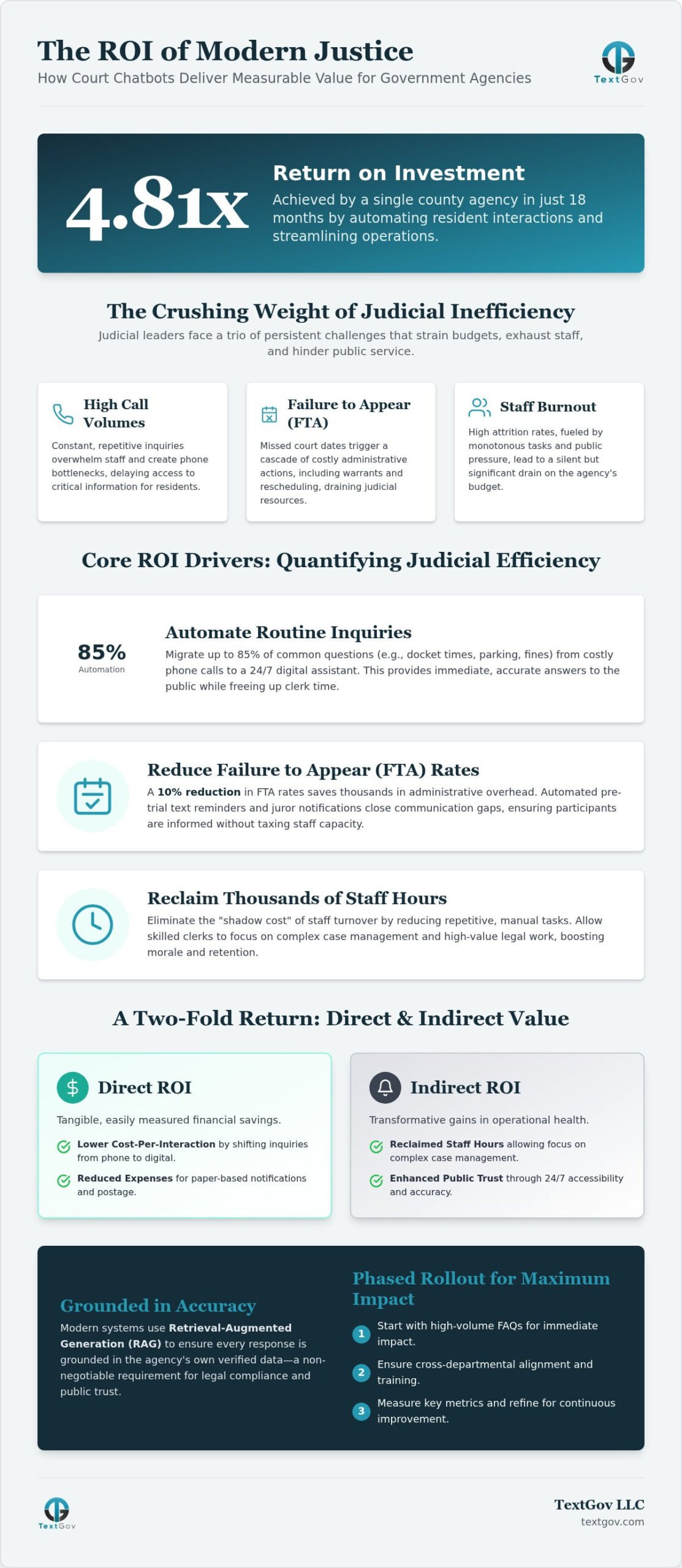
Did you know that a single county agency recently achieved a 4.81x return on investment in just 18 months by automating resident interactions? Most judicial leaders are all too familiar with the crushing weight of high call volumes and the persistent drain of “Failure to Appear” rates on their dockets. You’re likely managing a stagnant budget while public service demands continue to climb, leaving your staff exhausted and your systems strained. Understanding the court chatbot ROI for government agencies is no longer a theoretical exercise; it’s a strategic financial necessity in 2026.
We agree that your department deserves a path toward modernization that doesn’t compromise on accuracy or legal compliance. This article promises to reveal how you can transform judicial operations from cost-heavy departments into streamlined, high-efficiency engines with measurable results. We’ll provide a comprehensive framework for calculating your savings, reducing staff burnout, and improving citizen engagement metrics. By exploring successful 2026 implementations, you’ll see exactly how to reclaim judicial capacity through automated precision and visionary leadership.
Key Takeaways
- Recognize that judicial ROI extends beyond simple cost savings to include significant gains in operational capacity and public trust.
- Quantify the fiscal impact of reducing Failure to Appear (FTA) rates and automating routine inquiries to calculate a true court chatbot ROI for government agencies.
- Evaluate the Total Cost of Ownership by balancing initial integration fees against the long-term efficiency of a SaaS-based messaging platform.
- Implement a phased rollout strategy that begins with high-volume FAQs to ensure immediate impact and cross-departmental alignment.
Defining Court Chatbot ROI: Moving Beyond Simple Cost Savings
Quantifying the value of digital transformation in the public sector requires a bold shift in perspective. For decades, government agencies measured success through throughput and volume. Today, the standard has evolved toward precision and accessibility. A robust court chatbot ROI for government agencies isn’t merely a calculation of dollars saved; it’s a strategic blend of direct fiscal reduction and profound operational gains. We define this ROI as the ratio of net judicial efficiency gains to total platform costs.
The Evolution of Digital Judicial Assistants
The history of Chatbot technology has moved rapidly from simple, scripted FAQ engines to sophisticated tools for modernizing judicial access. Modern systems utilize Retrieval-Augmented Generation (RAG) to ensure every response is grounded in the agency’s verified data, which is a non-negotiable requirement for legal accuracy. This transition allows agencies to move away from manual inquiry handling toward automated 24/7 citizen engagement, significantly reducing the “time-to-resolution” for routine public inquiries. These advancements ensure that the public receives immediate, accurate guidance while the agency maintains total control over its digital narrative.
Identifying Direct vs. Indirect ROI
Distinguishing between different types of value is essential for presenting a clear case to budget committees. Direct ROI manifests through tangible savings, such as:
- Lowering the cost per interaction by shifting high-volume inquiries from phone lines to digital channels.
- Reducing paper-based notification expenses and postage through automated digital messaging.
Indirect ROI, while more nuanced, is often more transformative for the agency’s long-term health. It involves reclaiming thousands of staff hours previously lost to repetitive tasks, allowing clerks to focus on complex case management. Additionally, reducing physical courthouse foot traffic lowers security and maintenance overhead. By focusing on these dual drivers, agencies can present a compelling case for modernization that resonates with both financial officers and judicial leaders looking for high-performance solutions. This shift toward intelligent digital interaction is also seen in personal contexts, where platforms like askjenna.ai provide users with relationship intelligence through text analysis.
The Core ROI Drivers: Quantifying Judicial Efficiency
Transformative efficiency starts with quantifying the invisible costs of judicial friction. When evaluating court chatbot ROI for government agencies, the most immediate impact is seen in the reduction of routine administrative burdens. By automating up to 85% of routine inquiries, agencies can migrate thousands of annual interactions from expensive phone calls to high-performance digital channels. This streamlining isn’t just about speed; it’s about reclaiming resources for high-priority case management and complex legal workflows.
Impact on Failure to Appear (FTA) and No-Show Rates
Missed court dates create a cascading financial drain on the judicial system. Every no-show necessitates the issuance of bench warrants and the rescheduling of hearings, which consume significant clerk and law enforcement time. A 10% reduction in FTA rates can save an agency thousands in administrative overhead. Implementing juror text reminder systems closes the communication gap by meeting citizens on the devices they use most. Automated pre-trial text reminders provide a superior cost-benefit ratio compared to manual phone calls, ensuring that defendants and jurors remain informed without taxing staff capacity.
Staff Capacity and Burnout Reduction
The “shadow cost” of staff turnover is a silent budget killer. Repetitive manual tasks, like answering the same questions about parking or docket times, lead to professional fatigue and high attrition rates. A 24/7 digital assistant effectively eliminates the Monday morning “call surge” that typically overwhelms court clerks after a weekend of accumulated inquiries. This proactive approach allows your team to focus on the complex nuances of the law rather than routine data entry. Agencies looking to bridge this gap often find that a strategic messaging partner is the key to sustainable modernization and improved morale.
Optimizing juror management further strengthens the financial case. By streamlining the summons process, agencies see a measurable increase in response rates and a reduction in the postage costs associated with follow-up notices. These drivers work in tandem to shift the court from a reactive posture into a proactive, high-efficiency engine.
Calculating Total Cost of Ownership (TCO) vs. Long-Term Value
Strategic financial planning for judicial modernization demands a clear distinction between upfront expense and sustainable value. While the sticker price of a solution often dominates the conversation, a true court chatbot ROI for government agencies is found by analyzing the Total Cost of Ownership (TCO) against the long-term operational dividends. This analysis moves beyond the procurement phase to ensure the system remains a high-performance asset for years to come.
SaaS vs. On-Premise: The Efficiency Multiplier
Cloud-based platforms offer a decisive fiscal advantage over traditional on-premise installations. By utilizing a SaaS model, agencies eliminate the need for expensive physical hardware and the specialized IT personnel required to maintain it. These platforms provide automated security updates and feature enhancements, ensuring the technology never becomes obsolete. This scalability allows your agency to expand messaging capabilities without the friction of rigid, legacy infrastructure. It’s a forward-looking approach that aligns perfectly with the demands of modern public service.
The ROI of Integration: Connecting to Case Management Systems
The real power of an automated assistant is realized when it communicates directly with your existing Case Management Systems (CMS). Real-time data syncing eliminates the risks associated with manual data entry and ensures that the information provided to the public is always current. While professional service fees for integration represent an initial investment, they pay for themselves by accelerating the speed of resolution and reducing administrative errors. For agencies ready to optimize their digital infrastructure, modernizing your CMS integration is the most direct path to achieving maximum efficiency.
Administrators must also account for hidden costs that can erode budget predictability. Comprehensive planning includes allocations for staff training, data migration, and recurring security compliance audits. However, these costs are offset by the Value of Investment (VOI), which measures the intangible yet vital increase in citizen satisfaction and trust. When the public can access judicial information 24/7 without waiting on hold, the resulting boost in agency reputation and compliance becomes a force multiplier for your mission.
Implementation Strategy: Maximizing Your Agency’s Return
Executing a successful digital transition requires more than just deploying software; it demands a sophisticated, phased approach to ensure every stakeholder is aligned with the mission. To realize the full court chatbot ROI for government agencies, we recommend a rollout that prioritizes high-volume, low-complexity interactions. By addressing the 20 most common inquiries first, your agency secures immediate wins in staff time reclamation while building the foundational data needed for more complex case management integrations.
Launching your platform with precision involves a clear roadmap to ensure public adoption and technical stability. Follow this step-by-step guide to secure your agency’s transition:
- Audit existing inquiry data: Identify the most frequent questions handled by your clerk’s office to populate your initial knowledge base.
- Establish CMS data mapping: Work with your technical partner to ensure real-time data flows between the chatbot and your case management system.
- Conduct cross-departmental reviews: Align IT, Clerks, and Judges to ensure all automated messaging meets legal standards and operational goals.
- Deploy across omnichannel touchpoints: Launch the assistant on your website and integrate it with SMS channels for maximum reach.
- Monitor and optimize: Use built-in analytics to identify unresolved inquiries and refine responses for continuous improvement.
Leveraging Omnichannel Messaging
True modernization is inclusive and accessible. Combining web-based assistants with SMS text reminders creates a comprehensive engagement strategy that meets residents where they are. In diverse jurisdictions, the ROI of multilingual support is profound; it reduces the need for expensive live translation services and ensures equitable access to justice. This omnichannel approach doesn’t just improve metrics; it strengthens the judicial bond with the community by providing reliable 24/7 assistance in the citizen’s preferred language.
Partnering for Success: The TextGov Approach
Selecting a strategic partner who understands the unique pressures of the public sector is essential for long-term success. TextGov’s focus on specialized judicial workflows ensures a faster path to positive ROI by eliminating the trial-and-error often associated with general-purpose AI tools. In a 2026 regulatory environment where accuracy and data sovereignty are paramount, our 24/7 technical support and proactive platform updates provide the security and reliability decision-makers demand. We don’t just provide a tool; we offer a transformative partnership dedicated to elevating your agency’s performance standards.
Ready to modernize your operations and reclaim your staff’s capacity? Contact TextGov for a customized ROI analysis and implementation plan.
Leading the Future of Judicial Efficiency
The transition toward automated judicial communication is a fundamental restructuring of how public agencies manage limited resources. By now, the evidence is clear: direct fiscal savings from interaction cost reduction and the measurable impact of lower Failure to Appear rates create a powerful court chatbot ROI for government agencies. This strategic shift allows your department to move beyond reactive fire-fighting and toward a proactive, high-performance model that serves the public with precision and speed. Modernization ensures your staff remains focused on high-level legal tasks while the community enjoys seamless, 24/7 access to verified information.
TextGov is your dedicated partner in this digital journey. We combine specialized judicial workflows with national SaaS deployment expertise to deliver integrated text and AI messaging platforms that drive real results. Don’t let your agency be held back by legacy systems that no longer meet the standards of 2026. It’s time to modernize your agency with TextGov’s 24/7 Court Chatbot solutions and reclaim your judicial capacity. We’re ready to help you build a more efficient, accessible, and fiscally responsible future for your jurisdiction.
Frequently Asked Questions
How quickly can a government agency see ROI from a court chatbot?
Agencies typically observe measurable financial gains within the first six to twelve months following full deployment. This rapid turnaround occurs as the platform immediately begins diverting high-volume routine inquiries away from staff phone lines. As the system resolves a higher percentage of contacts through automated self-service, the reduction in cost per interaction translates directly into tangible budget relief.
What are the primary cost drivers in a court chatbot implementation?
The primary financial components include initial integration fees for case management systems and recurring SaaS subscription costs. Strategic implementation also requires a modest allocation for staff training and data verification to ensure the knowledge base is perfectly aligned with local judicial procedures. These investments are foundational to securing a long-term court chatbot ROI for government agencies by ensuring system stability.
Can a chatbot really reduce Failure to Appear (FTA) rates?
Automated messaging is highly effective at lowering Failure to Appear rates by closing the communication gap with defendants and jurors. By delivering proactive text reminders directly to mobile devices, courts resolve the “forgotten date” issue that accounts for a large portion of no-shows. This proactive automation prevents the costly administrative cycle of issuing bench warrants and rescheduling hearings for missed appearances.
How do we measure the ROI of improved citizen satisfaction?
Metrics for citizen engagement are quantified through “time-to-resolution” and the percentage of inquiries successfully handled without human intervention. Higher satisfaction levels correlate with increased compliance and fewer unnecessary physical visits to the courthouse. By tracking these behavioral shifts, administrators can assign a monetary value to the trust and efficiency gained through modern, 24/7 digital access.
Is a SaaS model more cost-effective for courts than building an in-house solution?
A SaaS model is significantly more cost-effective because it eliminates the massive overhead of physical hardware and specialized software engineering. Cloud-based platforms provide 24/7 maintenance and automated security updates as part of the service. This approach allows agencies to leverage a superior court chatbot ROI for government agencies without the financial risk of maintaining a custom, legacy-prone system.