
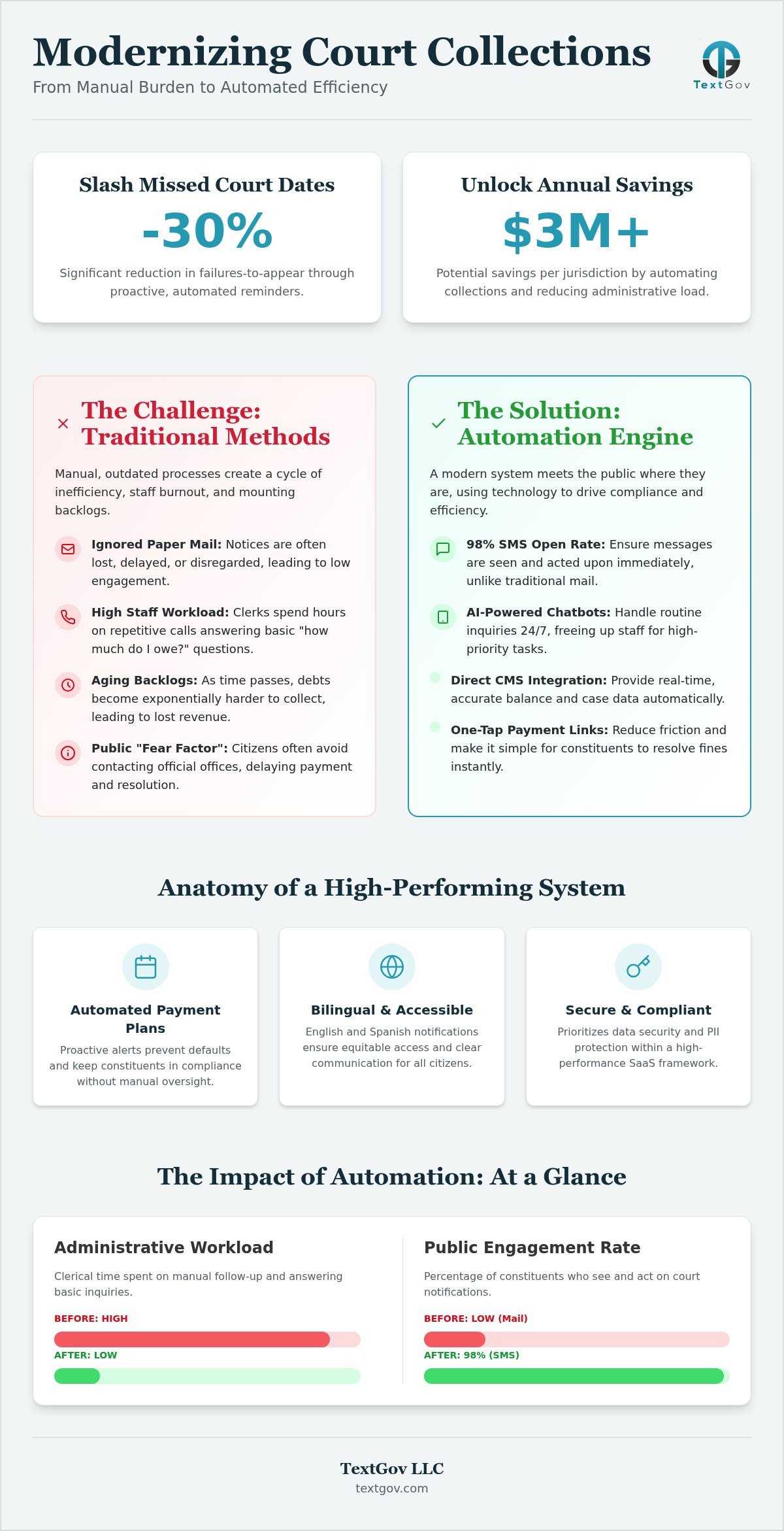
Could a simple shift in communication really save your jurisdiction over $3 million a year while slashing missed court dates by 30%? In 2026, forward-thinking clerks are proving that the answer is a resounding yes. As states like Virginia and Indiana overhaul their fee structures and move toward opt-out models, the traditional manual approach to collections is becoming a liability. Implementing automated court fine payment reminders isn’t just about sending texts; it’s about deploying a sophisticated customer service engine that meets the public where they are.
You’re likely tired of your staff spending hours on the phone answering basic “how much do I owe” questions while aging balances continue to pile up. It’s a frustrating cycle where manual follow-up is often too inconsistent to be effective. This article explores how conversational AI and automated messaging can eliminate your collection backlogs, significantly reduce administrative workload, and drive unprecedented public compliance. We’ll examine the seamless integration of chatbots with your existing Case Management Systems and the specific 2026 legislative trends that make this the optimal time for a digital upgrade.
Key Takeaways
- Identify why manual collection methods fail and how systematic, multi-channel notifications resolve the persistent issue of aging backlogs.
- Leverage the 98% open rate of SMS delivery to ensure defendants receive and act upon balance alerts immediately rather than ignoring traditional mail.
- Deploy automated court fine payment reminders that sync directly with your Case Management System to provide real-time, accurate data to the public.
- Streamline administrative operations by utilizing court-specific chatbots to handle routine inquiries, drastically lowering daily call volumes and staff burnout.
- Master the transition to an integrated digital workflow that prioritizes data security and PII protection within a high-performance SaaS framework.
Why Traditional Court Fine Collection Methods Fail in a Digital Era
Traditional judicial collections often rely on paper notices and cold calls, methods that are increasingly ineffective in a world dominated by instant digital communication. Automated court fine payment reminders represent a shift toward systematic, multi-channel notifications that are automatically triggered by real-time data from a Case Management System (CMS). Unlike manual follow-ups, these systems ensure that no case falls through the cracks. This directly addresses the aging balance problem where older debts become exponentially harder to collect as time passes.
The process often begins with understanding how traffic tickets are issued and managed, as this initial stage sets the tone for the entire collections workflow. When courts rely on manual letters, they face diminishing returns. Mail is frequently ignored, lost, or delayed. This creates two distinct challenges for clerks. They must distinguish between individuals who simply forgot their obligation and those who truly lack the ability to pay. Manual systems struggle to make this distinction, often treating both groups with the same inefficient outreach.
The High Cost of Administrative Friction
Clerks often spend a disproportionate amount of their day answering repetitive phone calls about fine amounts and due dates. This manual friction carries a hidden price tag including postage costs, printing supplies, and the risk of human error in data entry. By modernizing judicial access through digital automation, courts can liberate their staff from these low-level tasks. This allows the clerical team to focus on complex case management and high-priority judicial support rather than acting as a manual switchboard.
Overcoming the “Fear Factor” in Judicial Collections
Many constituents avoid contacting the court due to a psychological fear factor associated with judicial offices. A neutral, automated text message feels less confrontational than a phone call from a government official. It lowers the barrier to engagement. Nudge theory in judicial compliance suggests that small, timely, and low-pressure prompts can significantly alter behavior by making the desired action of payment the path of least resistance.
The Anatomy of a High-Performing Payment Reminder System
Modern judicial collections rely on more than just delivery; they depend on immediate engagement. While traditional mail often sits unopened on a kitchen counter, SMS achieves a staggering 98% open rate. This ensures that automated court fine payment reminders reach the intended recipient where they’re most active. These systems generate dynamic balance alerts by pulling real-time data directly from the case management system. This accuracy eliminates confusion and provides the constituent with a single, reliable source of truth regarding their specific obligations.
Efficiency is further maximized by reducing the “click-to-pay” distance. Integrating one-tap payment links allows individuals to resolve their fines in seconds rather than navigating complex web portals or mailing checks. When uncertainty arises, conversational AI provides an immediate safety net. If a defendant asks, “What if I can’t pay?”, a Court Chatbot handles the inquiry instantly. It can explain available options or escalate the case based on pre-defined judicial rules, ensuring the conversation continues toward a resolution without requiring a clerk’s intervention.
Automated Payment Plan Tracking
Managing installment compliance shouldn’t require manual ledger checks or constant clerical oversight. High-performing systems automate the entire lifecycle of a payment plan, sending proactive alerts days before a due date. This prevents technical defaults and keeps constituents in compliance with court orders. You can implement these digital tools to maintain steady revenue streams while reducing the burden of manual account monitoring.
Bilingual and Accessible Messaging
Equitable access to justice is a cornerstone of modern court administration. Providing notifications in both English and Spanish ensures that language barriers don’t lead to missed payments or unnecessary warrants. In 2026, these digital notifications must also meet rigorous accessibility standards. This ensures that every citizen, regardless of physical or cognitive ability, can interact with the judicial system through clear, understandable, and navigable digital interfaces.
Strategic Implementation: Integrating Reminders into Court Workflows
Successful modernization requires a methodical approach to technical integration. High-performance automated court fine payment reminders function best when they’re deeply embedded within your existing judicial Case Management System (CMS). This process involves establishing secure API connections that allow the messaging platform to pull real-time case data, ensuring that notifications are only sent for active, unpaid balances. Once these data pipelines are established, the system operates autonomously, triggering alerts based on specific judicial milestones or approaching deadlines.
Security remains a non-negotiable priority when handling Personally Identifiable Information (PII) in the cloud. Modern platforms utilize enterprise-grade encryption and maintain strict compliance with 2026 data protection standards to safeguard constituent privacy. Beyond security, courts must define clear metrics for success. Jurisdictions typically track the direct increase in collection rates alongside a significant decrease in inbound call volumes. Implementing a juror text reminder system alongside your payment platform creates a comprehensive digital ecosystem that modernizes every touchpoint of the judicial experience.
Reducing Failure to Appear (FTA) through Payment Engagement
There’s a documented link between resolving outstanding fines and reducing future bench warrants. When defendants engage with payment reminders, they’re more likely to stay connected to the court process, which prevents the cycle of technical defaults. Research indicates that automated text message reminders can reduce warrants issued for missed court dates by approximately 20%. This proactive engagement transforms a simple notification into a broader platform for defendant compliance and judicial efficiency.
Future-Proofing with TextGov AI Solutions
Elevate Your Court’s Collection Standards for 2026
The transition from outdated manual outreach to a dynamic, digital-first strategy is no longer a luxury; it’s a necessity for modern judicial efficiency. By implementing automated court fine payment reminders, jurisdictions can effectively bridge the gap between court obligations and public compliance. You’ve seen how these tools eliminate the aging balance problem while providing the accessibility that today’s constituents expect. This shift doesn’t just improve revenue; it fundamentally redefines the relationship between the court and the community it serves.
Embracing this modernization allows your staff to reclaim their time and focus on higher-level judicial functions. With proven call volume reduction and seamless CMS integration, you can ensure that your office remains both productive and secure. Our 24/7 automated public inquiry support provides a reliable interface for every citizen, ensuring that no question goes unanswered and no payment is missed. This high-level performance is the hallmark of a court that is truly ready for the future.
Take the next step in transforming your administrative workflow. Request a Demo of TextGov’s Court Chatbot and Messaging Platform to see how conversational AI can redefine your collections process. The path to a more efficient, compliant, and modern court system begins with a single digital connection. We’re ready to help you lead the way.
Frequently Asked Questions
How do automated payment reminders integrate with our current case management system?
Modern platforms integrate through secure API connections or automated data exports that sync case statuses in real-time. This ensures that automated court fine payment reminders are only dispatched for active balances and cease immediately once a payment is recorded. The system is designed for low-friction implementation, allowing your IT department to establish a persistent link between your CMS and the messaging platform without disrupting daily judicial operations.
Are automated court text reminders compliant with privacy laws?
These systems are engineered to exceed 2026 data protection standards, including TCPA regulations and rigorous security protocols for sensitive information. All Personally Identifiable Information (PII) is encrypted both in transit and at rest within a secure cloud environment. By utilizing advanced opt-out models and clear disclosure protocols, courts ensure that every digital interaction remains legally compliant while protecting the constituent’s right to privacy and secure communication.
Can the system handle complex payment plans and partial payments?
The platform dynamically tracks partial payments and multi-month installment plans by reflecting real-time ledger updates from your existing database. When a defendant makes a payment, the system automatically recalculates the remaining balance and adjusts the next scheduled notification accordingly. This automation eliminates the need for manual ledger checks, providing defendants with accurate, updated balance alerts that encourage continued compliance until the total obligation is fully resolved.
What happens if a defendant replies to an automated payment text?
Incoming replies are instantly managed by a Court Chatbot that provides 24/7 intelligent responses to common public inquiries. If a constituent asks about specific payment methods or extension options, the AI assistant delivers immediate answers based on court-approved logic. For complex inquiries that require human intervention, the system can flag the conversation for staff review or provide the defendant with the appropriate contact information, ensuring no inquiry goes unaddressed.