
A polished chatbot demo can hide a difficult integration. The best govtech chatbot companies are the ones that fit an agency’s systems, explain first-year costs clearly, and support consistent, useful answers. Government chatbots should connect with relevant databases and backend systems when they need access to current information.
Choosing a solution also means balancing modernization with transparency and public trust. This guide shows how to compare vendors on system integration, the factors that shape first-year costs, transparency, and response consistency. You’ll get a practical framework for assessing whether a chatbot can support your agency’s services and residents, without mistaking a slick presentation for a strong operational fit.
Key Takeaways
- Map the chatbot’s intended tasks to the agency databases and backend systems it needs to access.
- Compare first-year costs by identifying the implementation and ongoing factors that shape total ownership.
- Assess how the vendor supports transparent answers, clear fallback options, and consistent response content.
- Match the solution to your agency’s service needs so the chatbot supports residents without overcomplicating the process.
1. Integrating with government databases and backend systems
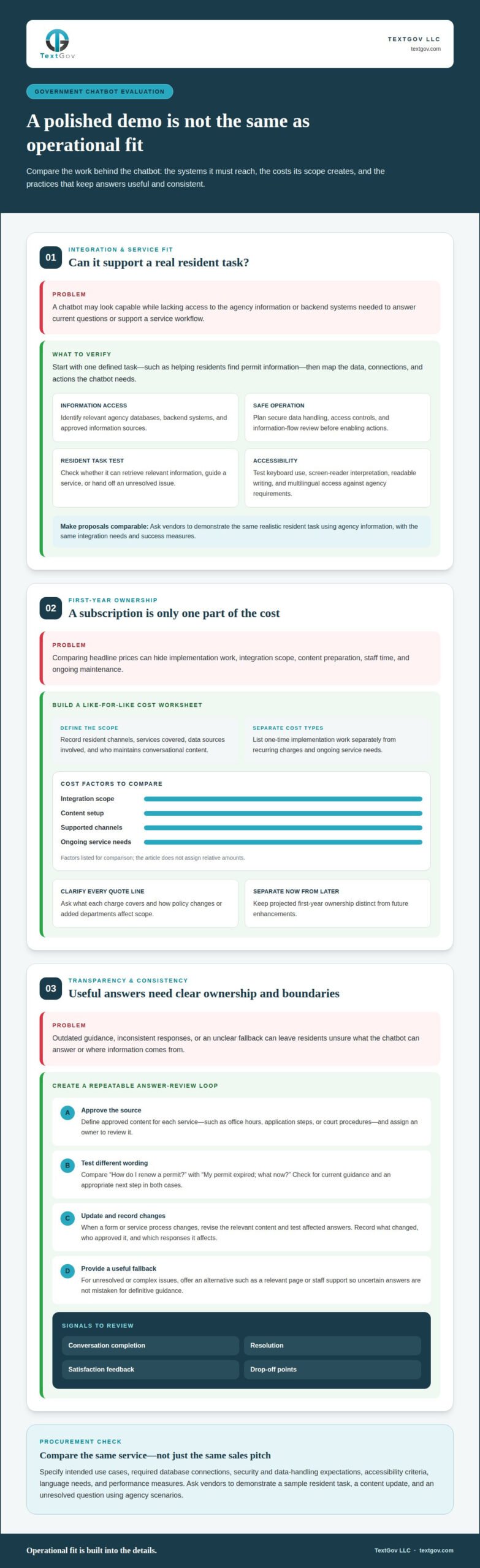
Start with a defined task: helping residents find permit information, for example. Then map the data and actions the chatbot needs. Government chatbots should connect with relevant databases and backend systems to access current information. Agencies should also plan secure data handling and regular content updates as part of implementation.
For state and local government, shortlist vendors that understand public-sector services and can demonstrate how their chatbots answer from an agency’s approved information. There is no universal ranking of the best govtech chatbot companies for every agency: the right fit depends on the services and questions to support. A chatbot based on published service pages, for example, has a different role from one designed around specific agency workflows. Define access controls and review information flows before enabling actions.
Compare features against real resident tasks: can the chatbot retrieve relevant information, guide users through a service, or hand off an issue it can’t resolve? For accessibility, evaluate the interface and conversation flows against your agency’s ADA and Section 508 requirements. Test keyboard use, screen-reader interpretation, readable writing, and multilingual access with representative user scenarios.
Reviews and case studies are most useful when they explain the agency context, the chatbot’s role, and measurable outcomes. Look for measures such as conversation volume, resolution, user feedback, and where residents leave the interaction. Results from one deployment do not guarantee the same outcome for another agency.
In an RFP, specify the intended use cases, required database connections, security and data-handling expectations, accessibility criteria, language needs, and performance measures. Ask vendors to demonstrate a sample resident task using realistic agency information. This makes comparisons practical: assess the same workflow, integration needs, and success measures across proposals.
2. Pricing and first-year total cost of ownership
A first-year budget should account for more than a platform subscription. Separate implementation, integrations, content preparation, staff time, and ongoing maintenance so proposals can be compared on the same basis. A chatbot that answers from approved information has a different scope from one that supports more involved service workflows.
Build a cost worksheet around the agency’s intended use. Record the channels residents will use, the number of services covered, the data sources involved, and who maintains conversational content. Then identify any one-time implementation work and recurring charges in each proposal. Google-style search may help residents find public information, but it doesn’t replace the cost and effort of connecting a chatbot to agency systems.
A chatbot’s price depends on the case and is provided after a quote request; key cost factors include integration scope, content setup, supported channels, and ongoing service needs. Ask vendors to define what each quoted line covers, how changes to policies are handled, and whether expansion to additional departments changes the scope. This keeps projected first-year ownership distinct from later enhancements.
Compare value against the task the chatbot is meant to support, not a headline price alone. Consider the staff effort needed to keep answers relevant, review common unanswered questions, and measure whether residents complete the intended interaction. A consistent evaluation worksheet helps procurement teams weigh service quality alongside the proposed scope.
3. Transparency and consistent responses
Residents need to understand what a chatbot can answer and where its information comes from. Define approved content for each service, such as office hours, application steps, or court procedures. Assign an owner to review each source so outdated guidance does not continue shaping responses. Clear boundaries also help the chatbot direct questions that need staff attention.
Consistency depends on more than using the same script. Test how the chatbot handles the same request in different wording and contexts. For example, compare “How do I renew a permit?” with “My permit expired; what now?” Check that both interactions point to current agency guidance and an appropriate next step. Responses should follow shared policies and approved content.
Treat updates as an operational task. When an agency changes a form or service process, revise the relevant content and test affected answers before publishing. Keep a record of what changed, who approved it, and which responses it affects. This makes review easier and gives teams a clear way to correct inconsistent information.
Measure success through conversation completion, resolution, satisfaction feedback, and drop-off points. These signals show whether residents find useful answers or abandon the interaction. Set a fallback that offers an alternative, such as viewing a relevant page or contacting staff. For complex issues, human support helps prevent uncertain chatbot responses from being mistaken for definitive guidance.
Ask vendors to demonstrate these capabilities using agency scenarios, including a content update and an unresolved question. Observe whether responses stay clear, relevant, and consistent throughout each test.
TextGov: Court Chatbot
TextGov’s Court Chatbot is a natural fit for courts looking to improve public-facing service and reduce call volumes. It gives decision-makers a focused option when common court inquiries are creating pressure on staff or making information harder for residents to access.
For broader agency needs, TextGov also offers a Government Chatbot. Courts seeking text-based juror communication can consider Jury Texting, which includes juror text reminders and pre-trial texting. Each offering addresses a distinct public-sector communication need, so match the option to the audience and tasks your agency wants to support.
If your evaluation points toward a court-focused chatbot, explore how TextGov’s Court Chatbot can support your service goals. Visit textgov.com to learn more.
Build a chatbot program that can evolve
Choosing among the best govtech chatbot companies is only the start of improving public-service interactions. Select a resident need, define what a successful interaction looks like, and assign an owner for approved content and ongoing review. A focused launch gives your team a practical way to learn from real questions, improve guidance, and build confidence before expanding to more services.
Bring service leaders, communications staff, and technology teams into planning. Agree on who updates information, how staff will handle questions beyond the chatbot’s capabilities, and what feedback will guide improvements. A shared operating approach helps keep the tool aligned with the agency’s public-service goals as needs evolve.
Thoughtful modernization starts with a clear purpose and a team prepared to sustain it. Define the resident need, agree on how to measure success, and plan how staff will keep information current.
Frequently Asked Questions
What are typical pricing models and costs for government chatbot deployments?
Government chatbot budgets commonly combine recurring platform charges with one-time implementation or integration work; some proposals also vary by usage or scope. Compare total ownership across the same budgeting period, including staff training, content maintenance, support, and planned expansion. A low initial fee may not reflect the resources needed to keep service information accurate or add departments later.
Which govtech chatbot vendors meet FedRAMP, StateRAMP, SOC 2, and government data privacy requirements?
Vendor fit depends on the specific service and deployment, not simply the chatbot’s category. Compare FedRAMP, StateRAMP, SOC 2, and privacy controls as separate requirements. A procurement matrix can capture the covered environment, data types, retention practices, subprocessors, incident handling, and data-use limits. One certification or authorization should not be treated as proof of every other requirement.
What risks do government agencies face when deploying AI chatbots, and how do vendors address them?
Key risks include inaccurate answers, exposure of sensitive information, and residents mistaking automated guidance for professional advice. Agencies can reduce these risks through approved content, access controls, regular response testing, and a clear path to human support. TextGov’s Court Chatbot is grounded in court policies and never gives legal advice; live-agent handoff is available during business hours.
How do government chatbot vendors support ADA, Section 508, and multilingual access?
Evaluate the interface and conversation flows against your agency’s ADA and Section 508 requirements. Test keyboard use, screen-reader interpretation, readable writing, and multilingual access with representative user scenarios.
What customer reviews, case studies, and measurable outcomes do govtech chatbot companies report?
Case studies are useful when they describe the agency context, the chatbot’s role, and measurable outcomes. Compare conversation completion, resolution, user feedback, and drop-off points. Results from one deployment may not apply to another agency.