
Public communication improves when routine updates move from manual follow-up into structured digital workflows. The benefits of automated government communication include clearer, more consistent information for the public, easier access to service updates, and fewer opportunities for routine tasks to be missed. Automation can support compliance by making communication processes more consistent, but it doesn’t replace an agency’s responsibility to meet applicable requirements.
Government teams need to modernize without making public services harder to use. The benefits of automated government communication include more consistent updates, timely reminders, and less manual follow-up. Used with clear oversight, these tools can improve access to information and free staff to focus on requests that need personal attention.
Key Takeaways
- Understand how digital workflows can move routine government processes forward while making staff work more manageable.
- Learn how online access and timely updates can help agencies communicate about requests and milestones more clearly.
- See how automated messages, alerts, and system conditions can help reduce manual follow-up and forgotten tasks.
- Explore when a Government Chatbot can support public-facing communication as part of a broader modernization effort.
1. What does digital process automation mean for governments?
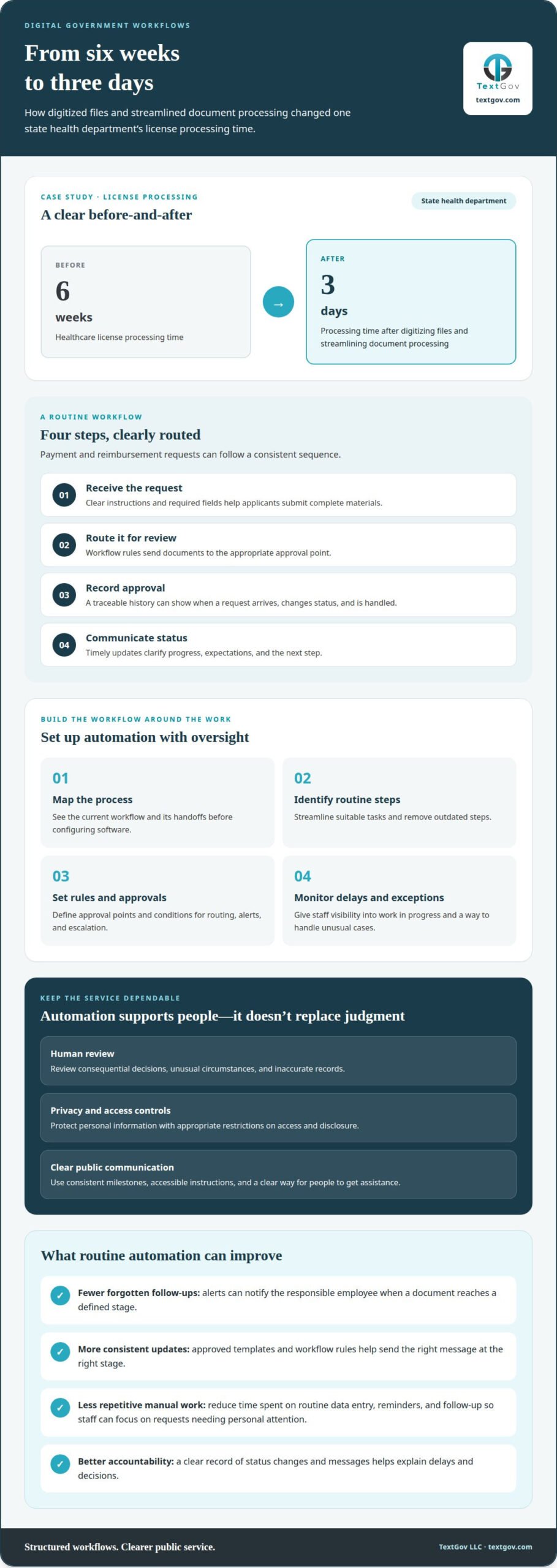
Digital process automation moves routine tasks through defined government workflows. Software can receive applications, route documents for approval, and send status updates without repeated manual handling. To get started, map the process, identify routine steps, set approval points, and decide how staff will monitor delays and handle exceptions. This gives employees a clearer view of work in progress while preserving human review.
Government case studies illustrate how redesigned workflows can change service delivery. A state health department reduced healthcare license processing time from six weeks to three days by digitizing files and streamlining document processing. Previously, a planning department required applicants to bring paper applications and supporting documents to one of three branch offices. Online government services can also let people submit applications and make payments outside Town Hall’s operating schedule.
Payment and reimbursement workflows can follow a consistent sequence: receive a request, route it for review, record approval, and communicate its status. Clear instructions and required fields help applicants submit complete materials, reducing follow-up between residents and staff. At the federal level, the Modernizing Government Technology Act was reintroduced in Congress to update systems and processes behind federal operations. The lesson is to design workflows around an agency’s needs rather than force teams into a rigid process.
Automation has limits. A system can misinterpret someone’s circumstances or repeat errors, so consequential decisions need appropriate human oversight. Privacy and access controls are essential when workflows handle personal information; U.S. Congress defines information security to include authorized restrictions on access and disclosure, including privacy protections. Agencies should review exceptions, correct inaccurate records, and provide a clear way for people to get assistance.
2. Compliance with transparency and accessibility mandates
An online government portal can let people submit applications and supporting documents, pay online, and track request status. Staff can view individual projects and aggregate reports, while the public can access records, published reports, and details of requests. For example, status messages for a Freedom of Information Act request can confirm receipt, show progress, and explain the next step. Using the same clear milestones for similar requests helps departments communicate consistently.
In the United States, automated communications involving personal information should protect privacy and restrict access appropriately. According to U.S. Congress, federal law defines information security to include authorized restrictions on access and disclosure, including protections for personal privacy. Agencies should align message content, access controls, and record handling with the requirements that apply to their operations.
Transparency also requires a traceable record. Record when an application arrives, when its status changes, which department handles it, and what updates are sent. Employees can use this history to explain delays and account for decisions, while aggregate reports help departments identify requests awaiting action. Clear records support accountability without exposing restricted information.
How does automated communication improve public engagement and service satisfaction? Timely email updates and messages clarify expectations, explain project milestones, and reduce uncertainty about a request’s progress. Pair each update with accessible web instructions and a clear next action, such as submitting a supporting document. People then know what to do, and consistent communication helps employees keep service information current.
3. Reduced manual errors and forgotten tasks
Automated emails, system alerts, and workflow conditions help agencies manage routine tasks consistently. When a document reaches a defined stage, for example, software can alert the responsible employee instead of relying on someone to remember a follow-up. A workflow can route a complete submission onward or request missing information when it is incomplete. These steps reduce avoidable handoffs and help staff see where processing has stalled.
How does automation improve accuracy and consistency in government communications? Approved message templates give employees a consistent starting point for common updates, while workflow rules can trigger the right message at the right process stage. Staff still review unusual cases and correct inaccurate records, so automation supports accuracy without replacing judgment. A clear record of each update also strengthens transparency when someone asks what happened to a request.
How can automated communication reduce government operating costs? It can cut time spent on repetitive data entry, routine reminders, and manual follow-up, freeing employees for work that needs personal attention. Moving suitable processes online can also reduce spending on paper, envelopes, toner, postage, and physical record storage. Agencies can assess these gains by tracking repeated tasks, delayed handoffs, and staff time.
Automation works best when departments streamline a process before configuring software. Map each handoff, remove outdated steps, and define conditions for routing, alerts, and escalation. Review exception cases to catch errors the standard workflow might miss. This approach supports dependable communication while preserving human oversight when circumstances call for it.
TextGov: Government Chatbot
TextGov’s Government Chatbot is a practical next step for agencies seeking to improve public-facing service and reduce call volumes. It can support government communication workflows where routine inquiries take staff time away from other responsibilities. Agencies looking to streamline court communication can also consider a Court Chatbot, while Jury Texting supports communication with jurors.
Choose the offering that aligns with the communication challenge: a Government Chatbot for government agencies, a Court Chatbot for court-related inquiries, or Jury Texting for juror communication. These tools complement process improvements by giving agencies another way to manage public inquiries and messages.
To discuss which option fits your government communication needs, contact TextGov.
Build a More Responsive Public Service
The benefits of automated government communication are clearest when modernization starts with a specific service goal. Choose a recurring public inquiry or update that takes staff time. Define what information people need, who owns the response, and when a human should step in. This gives your team a focused way to introduce automation while keeping accountability and public needs central.
As the approach develops, use employee feedback and public questions to refine messages and identify where communication still creates friction. A thoughtful rollout can help agencies make service more accessible, responsive, and consistent over time.
Take the next step at a pace that fits your agency, and keep improving the public experience with every iteration.
Frequently Asked Questions
What does digital process automation mean for governments?
Automated government communication uses digital tools to carry routine administrative steps from intake through completion. A system can sort incoming requests by type, assign them to the right department, and alert staff when action is needed. People still make decisions that require judgment; software coordinates predictable steps and keeps work moving between teams.
What are the main benefits of automated government communication?
Key benefits include more consistent updates, less repetitive follow-up, and clearer visibility into how public requests progress. For example, a resident asking about a permit can receive the same approved information as another applicant, rather than relying on who answers the phone. These gains depend on accurate content, clear workflow ownership, and a process for correcting outdated information.
How does automation improve response times and 24/7 access to government services?
Automated systems can provide routine information and receive online requests outside an office’s operating schedule. People can find instructions or submit an inquiry without waiting for an employee, and automated routing can direct requests to the responsible team. Complex cases still need staff attention, so agencies should explain what happens after submission.
What benefits does automated communication offer for accessibility and multilingual support?
Accessible digital communication can make service information easier to use across different devices and needs. Text-based instructions let people review details at their own pace, while multilingual support can help users understand government information in another language. TextGov’s chatbots are WCAG 2.2 AA compliant, and its Government Chatbot is multilingual, supporting agencies serving diverse communities.
What are examples of automated government communication tools used by U.S. agencies?
Examples include online request portals, automated email updates, system alerts, and chatbots. TextGov’s single platform delivers three services: Court Chatbot, Government Chatbot, and Court Text Messaging, including Jury Texting. Its web chatbots are WCAG 2.2 AA compliant and run on the ChatBot, LiveChat, and HelpDesk stack; Twilio does not power them. Court Text Messaging is A2P 10DLC registered and TCPA-aware, with no app, login, or browser required.