
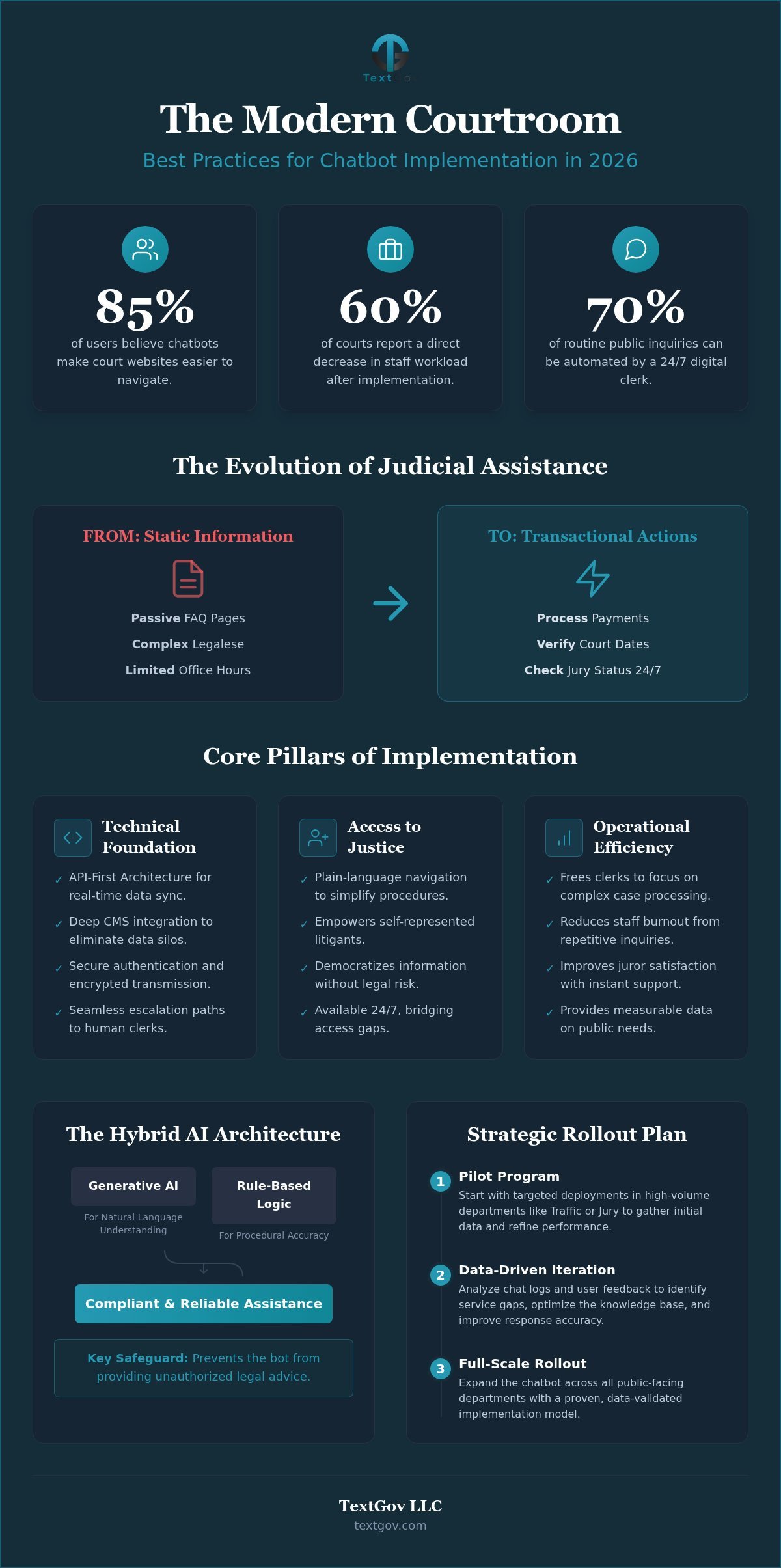
According to a May 2026 report from the National Center for State Courts, 85% of users believe chatbots make it easier to navigate court websites, while 60% of courts have seen a direct decrease in staff workload. You’ve likely felt the strain of rising call volumes and limited capacity, and you’re right to be cautious about the risks of incorrect legal advice or integration hurdles with legacy Case Management Systems. In a year defined by landmark regulations like California SB 243 and the Colorado AI Act, modernization requires more than just new software; it demands a strategic alignment of technology and ethics.
This guide provides the essential framework for court chatbot implementation best practices, ensuring your digital assistants are secure, compliant, and highly efficient. You’ll learn how to deploy 24/7 support that bridges the gap in Access to Justice while maintaining rigorous professional standards. We’ll examine the technical requirements for seamless CMS integration and the ethical safeguards necessary to protect both your staff and the constituents they serve.
Key Takeaways
- Modernize judicial interactions by evolving from static FAQ pages to transactional digital assistants capable of processing payments and verifying court dates 24/7.
- Prioritize data integrity and security through API-first architecture and SOC 2 compliance, ensuring your digital clerk remains a reliable extension of your court records.
- Adopt essential court chatbot implementation best practices by replacing complex legalese with plain language to improve comprehension and Access to Justice (A2J).
- Secure organizational buy-in through phased deployments, starting with targeted pilot programs in high-volume departments like Traffic or Jury to refine performance before a full-scale rollout.
- Leverage data-driven iteration to analyze chat logs and identify service gaps, allowing for continuous optimization of the bot’s knowledge base and constituent support.
Defining the 2026 Vision: Why Court Chatbots are Essential
The 2026 court chatbot is a secure, API-connected interface that automates up to 70% of routine public inquiries. It functions as a 24/7 digital clerk, effectively bridging the gap between constituents and complex judicial data. We’re witnessing a transformative shift from static “Frequently Asked Questions” to dynamic “Transactional Actions.” Constituents no longer settle for reading about how to pay a fine; they expect to verify court dates, check jury status, or process payments directly through the chat interface. This evolution is a cornerstone of court chatbot implementation best practices, as it moves the digital assistant from a peripheral help tool to a core operational asset.
For self-represented litigants, the judicial system can be an intimidating maze of procedural hurdles. Modern digital assistants provide essential plain-language navigation that simplifies these challenges and directly improves Access to Justice (A2J). Developing a sophisticated understanding of lawbots allows court administrators to see how these tools democratize information without compromising the integrity of the court. By translating complex legalese into actionable guidance, courts can empower the public while simultaneously protecting their own administrative resources.
The Role of AI in Modern Judicial Communication
Accuracy is the non-negotiable foundation of judicial trust. In 2026, industry leaders distinguish between generative AI, which handles natural language understanding, and rule-based logic, which ensures procedural accuracy. This hybrid architecture establishes necessary guardrails to prevent the bot from providing unauthorized legal advice. These advanced systems are context-aware and empathetic, yet they remain strictly bound by the court’s verified knowledge base to ensure every interaction is compliant and reliable.
Quantifying the Impact on Court Administration
The administrative benefits of automation are both immediate and measurable. By redirecting routine inquiries to an automated platform, courts experience a significant reduction in manual call volumes. This shift produces several high-level benefits:
- Staff Optimization: Court clerks are freed from repetitive tasks like “Where do I park?” to focus on complex case processing.
- Burnout Reduction: Automating high-volume inquiries reduces the psychological strain on frontline staff.
- Juror Satisfaction: Instant, 24/7 support for jury summons and scheduling creates a more professional experience for citizens.
Adhering to court chatbot implementation best practices ensures that your organization isn’t just installing software, but rather deploying a strategic partner that redefines how you interact with the community.
Technical Best Practices: Architecture and CMS Integration
Successful digital transformation relies on a robust technical foundation that prioritizes agility and security. One of the most critical court chatbot implementation best practices is the adoption of an API-first architecture. This approach facilitates real-time synchronization between the chatbot and court databases, ensuring that every piece of information provided to a constituent is current and accurate. Unlike legacy systems that rely on batch updates, an API-driven model allows for the immediate retrieval of hearing dates and case statuses, which is essential for maintaining public trust.
Security is paramount when handling sensitive judicial data. Implementing secure authentication protocols ensures that only authorized individuals can access case-specific information through encrypted transmission. Additionally, a sophisticated system must include clear escalation paths. When an inquiry exceeds the bot’s programmed logic, the platform should seamlessly hand off the interaction to a human clerk. This hybrid model preserves the efficiency of automation while providing the necessary human oversight for complex matters.
Case Management System (CMS) Connectivity
Eliminating data silos requires deep integration between the chatbot and your existing infrastructure. By mapping workflows to your court management system sms integration, you create a unified ecosystem where information flows freely. This connectivity enables the automated retrieval of payment amounts and case details directly from the CMS, ensuring the clerk’s dashboard and the public-facing bot share a single source of truth. If you’re looking to streamline your internal processes, exploring a professional service for CMS integration can accelerate your modernization journey.
Security and Compliance Standards
In the judicial sector, compliance isn’t optional. Your platform must adhere to SOC 2 standards and CJIS (Criminal Justice Information Services) security requirements to protect sensitive data. Encrypted transmission and regular auditing logs provide the transparency and accountability required for government-grade operations. While the solution should be cloud-based for scalability, it must never compromise on the rigorous security protocols that define modern judicial standards. Adopting these court chatbot implementation best practices ensures that your technology remains a reliable, high-performance asset for years to come.
User Experience: Ensuring Equitable and Accessible Access
Digital accessibility in the judicial sector is a fundamental requirement for modern governance. Adopting court chatbot implementation best practices requires a shift from technical functionality to human-centric design. This process begins with a rigorous constituent needs assessment to identify the top 10 most frequent inquiries, ensuring the system addresses the highest-volume pain points first. Once identified, workflows must be designed using plain language that strips away dense legalese to maximize public comprehension. Clarity is the most effective tool for reducing staff workload and improving the user journey.
True equity demands multi-language support for Spanish, Mandarin, and other locally prevalent languages. Serving a diverse population effectively means meeting them where they are. Additionally, strict adherence to WCAG 2.2 standards ensures that constituents using screen readers or other assistive technologies experience no barriers to entry. These standards aren’t just checkboxes; they’re essential frameworks for a truly inclusive digital courthouse. A system that isn’t accessible to everyone is a system that fails its primary mission.
Designing for the Self-Represented Litigant (SRL)
Self-represented litigants often struggle with the procedural complexities of the law. Decision trees offer a logical path through intricate filings, such as small claims cases, providing a structured journey that reduces errors. It’s imperative to incorporate clear disclaimers that distinguish legal information from legal advice to maintain ethical boundaries; for example, constituents may be encouraged to explore Estate Planning through professional resources to ensure they receive specific counsel that a chatbot cannot provide. Modern interfaces now include document upload features and visual aids, allowing users to interact with the court in a way that feels intuitive and supportive. This guidance empowers users while protecting the court’s integrity.
Mobile-First and Omnichannel Strategy
Since more than 60% of users now access court websites via mobile devices, your digital assistant must be optimized for small screens and touch navigation. Integrating the bot with a juror text reminder system creates a seamless omnichannel experience that follows the user from their first inquiry to their court date. By placing QR codes throughout the physical courthouse, you can offer instant on-site assistance that launches the chatbot immediately. If you’re ready to modernize your public engagement, consider implementing a Court Chatbot designed for the 2026 judicial landscape.
Deployment and Optimization: The Path to Modernization
Executing a successful digital transformation requires a methodical, phased approach that prioritizes stability and continuous improvement. Deployment isn’t a single event but a strategic journey toward operational excellence. Adhering to court chatbot implementation best practices suggests beginning with a focused pilot program. By testing the platform within a specific, high-volume department like Traffic or Jury, administrators can observe the technology in a controlled environment before a full-scale rollout. This initial phase allows for the calibration of workflows and ensures the system meets the unique needs of your jurisdiction.
Once the pilot is active, the focus shifts to data-driven iteration. Analyzing chat logs to identify “unanswered questions” provides a roadmap for refining the bot’s knowledge base and expanding its capabilities. This iterative process is supported by a robust feedback loop where users rate their interactions. These ratings offer direct insight into the constituent experience, allowing the AI training model to evolve based on real-world performance. For technical teams managing these deployments, an AI bug reporting tool for SaaS helps capture and resolve software issues identified during the pilot. In the final stage of maturity, courts move toward omnichannel expansion, linking the chatbot to SMS reminders and pre-trial notifications to create a unified communication ecosystem.
Measuring Success and ROI
Quantifying the impact of your digital assistant is essential for long-term sustainability. Courts should track key performance indicators (KPIs) such as deflection rates, which measure the number of inquiries handled without human intervention. Monitoring average resolution times and calculating cost savings from reduced manual data entry provides a clear picture of the platform’s value. Beyond the numbers, surveying constituents helps measure improvements in public trust and perceived access to justice, confirming that the technology is fulfilling its mission to serve the community.
Partnering for Progress
Modernization is a collaborative effort. Working with specialized GovTech providers like TextGov ensures faster implementation and higher compliance with judicial standards. These strategic partners offer professional implementation services to handle the complexities of CMS integration, ensuring your new tools synchronize perfectly with existing records. By establishing a long-term roadmap for continuous software updates and technical support, your court remains at the leading edge of innovation. Adopting these court chatbot implementation best practices transforms your digital clerk from a simple tool into a powerful engine for judicial efficiency.
Elevating Judicial Engagement through Strategic Automation
The 2026 judicial landscape demands a departure from outdated communication methods. By aligning your digital strategy with court chatbot implementation best practices, you’ve moved beyond simple automation toward a transformative service model. This journey requires a commitment to real-time CMS synchronization, equitable access for self-represented litigants, and a phased deployment that ensures long-term reliability. These frameworks don’t just solve immediate staffing challenges; they redefine the standard for public service.
As an industry leader specialized in court and government agency messaging, TextGov provides the proven CMS integration expertise necessary to bridge the gap between your records and your constituents. Our 24/7 automated support platform is designed to handle high-volume inquiries with the precision and compliance your jurisdiction requires. Ready to redefine your agency’s efficiency? Contact TextGov to modernize your court communication with a 24/7 chatbot solution. Embarking on this path ensures your court remains a pioneer in access and excellence.
Frequently Asked Questions
How do we ensure our court chatbot doesn’t provide legal advice?
We ensure compliance by establishing rigid guardrails that separate procedural information from legal interpretation. The system is programmed to offer guidance on “how” to complete a task, such as filing a form, rather than “what” the constituent should do. Clear disclaimers are embedded throughout the interaction to remind users that the assistant is not an attorney. This approach is a core element of court chatbot implementation best practices.
Can a court chatbot integrate with our existing Case Management System (CMS)?
Modern chatbots achieve seamless integration through API-first architectures that synchronize directly with your existing Case Management System. This connection facilitates the real-time retrieval of hearing dates, case statuses, and outstanding balance amounts. By pulling data from a single source of truth, the bot ensures that the public receives the most accurate information available without requiring staff to perform manual updates or data entry.
Is a court chatbot secure enough to handle sensitive constituent data?
Judicial digital assistants utilize government-grade security protocols, such as SOC 2 compliance and CJIS-aligned data handling, to protect sensitive information. All data transmissions are encrypted to prevent unauthorized access during the exchange of case-specific details. Regular security audits and strict authentication measures ensure that the platform remains a reliable and secure extension of your court’s digital infrastructure, maintaining the highest levels of public trust.
How does a chatbot help reduce failure to appear (FTA) rates?
Chatbots lower FTA rates by offering constituents an immediate, 24/7 method to verify hearing schedules and receive automated notifications. When users can instantly confirm their appearance details via a mobile-friendly interface, the likelihood of a scheduling oversight is greatly reduced. These systems often link to SMS notification workflows, providing timely reminders that keep defendants informed and engaged with their legal obligations without increasing staff workload.
What is the difference between a rule-based chatbot and an AI-driven chatbot for courts?
Rule-based chatbots operate on fixed logic paths, whereas AI-driven models use natural language processing to interpret the intent behind a user’s question. Rule-based systems are highly effective for simple, transactional tasks like paying a traffic fine. AI-driven models offer a more sophisticated experience, guiding litigants through complex procedural inquiries with context-aware responses. Integrating both technologies is frequently cited among court chatbot implementation best practices for 2026.