
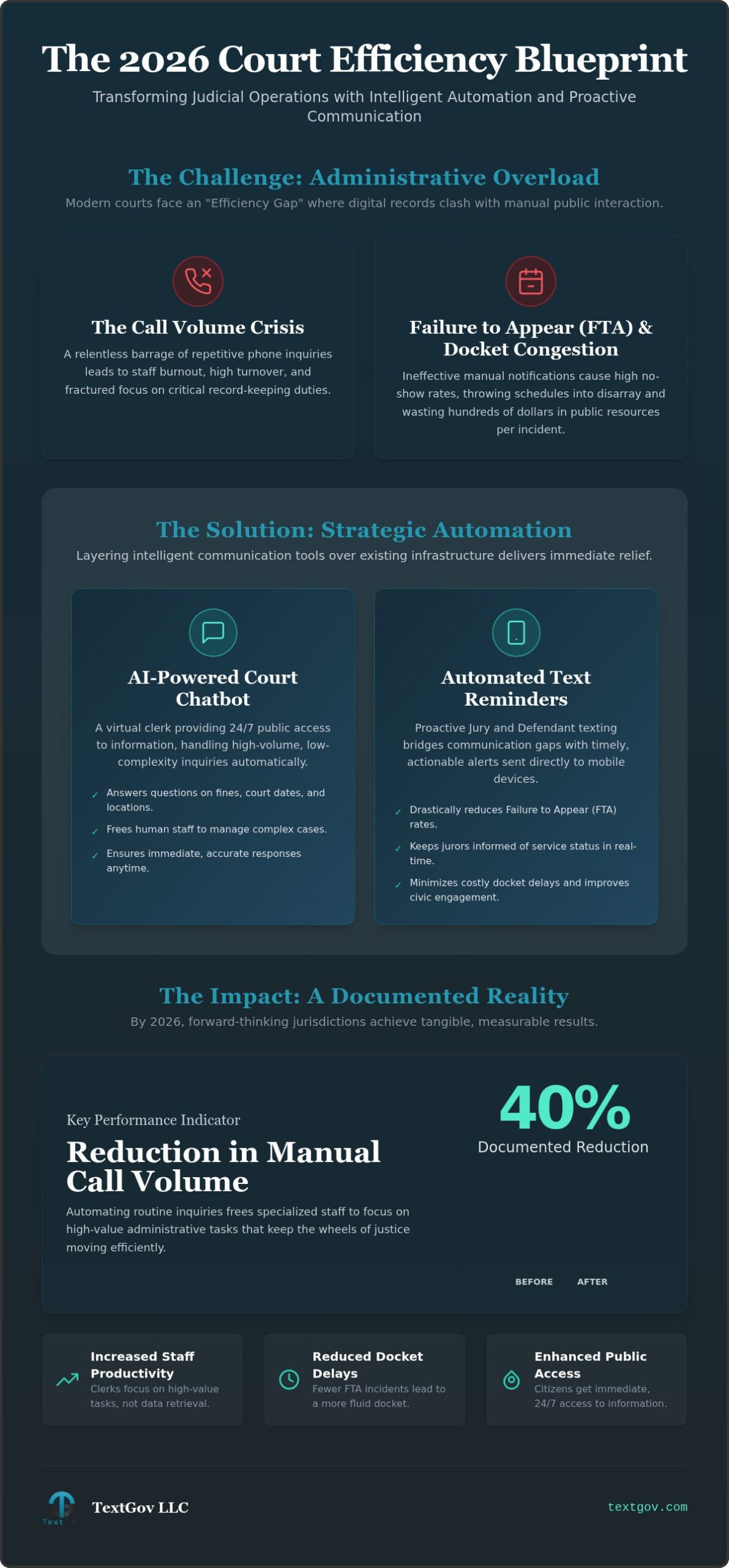
By 2026, forward-thinking jurisdictions have realized that a 40% reduction in manual call volumes isn’t just a goal; it’s a documented reality. The secret lies in a strategic shift where court office efficiency software moves beyond simple record-keeping to become a dynamic communication engine. When your clerks spend less time answering routine status questions, they can focus on complex administrative tasks and research, using specialized tools like Clarami to keep the wheels of justice moving efficiently.
You know the frustration of a crowded docket stalled by high failure-to-appear rates and a staff stretched thin by constant public inquiries. It’s a systemic challenge that often feels like it requires a multi-year IT overhaul to solve. However, the most effective modernizations are happening at the interaction layer, where automated tools bridge the gap between the court and the community.
In this case study, you’ll discover how the integration of AI-driven Court Chatbots and automated Jury Texting provides 24/7 public access while significantly lowering the administrative burden. We’ll examine the practical steps to streamline your operations, improve juror engagement, and achieve measurable results without disrupting your existing judicial workflows.
Key Takeaways
- Understand how modern court office efficiency software serves as a transformative force by reducing manual call volumes by 40% through intelligent automation.
- Discover the strategic advantage of deploying a 24/7 Court Chatbot to act as a virtual assistant, ensuring the public has immediate access to critical information.
- Learn how Jury Texting and automated reminders can drastically improve juror response rates and minimize costly delays caused by Failure to Appear (FTA) incidents.
- Gain a clear roadmap for auditing administrative bottlenecks and integrating sophisticated digital tools that align with rigorous judicial security standards.
The Challenge of Administrative Backlogs in Modern Courts
The 2026 judicial landscape presents a unique paradox. While internal records are increasingly digitized, the volume of public inquiries has reached an all-time high as constituents expect the same digital responsiveness from government agencies that they receive from the private sector. This shift has created a significant “Efficiency Gap” where robust internal case management systems fail to address the chaotic nature of public interaction. Traditional software suites often focus exclusively on the database layer, leaving the communication layer fragmented and reliant on manual intervention.
Maintaining the status quo carries hidden costs that extend far beyond payroll. Every manual document request and scheduling query handled by a clerk represents a diversion of specialized resources. High-performance court office efficiency software is no longer a luxury; it’s a structural necessity to prevent administrative collapse and ensure that judicial staff can focus on high-value tasks rather than basic data retrieval. For instance, you can read more about how specialized platforms allow the public to conduct their own legal process consultations efficiently, serving as a model for modern jurisdictions.
The Call Volume Crisis: Impact on Judicial Staff
The psychological toll on judicial staff is profound. Clerks frequently face a relentless barrage of repetitive phone inquiries, which leads to rapid burnout and high turnover rates. Operationally, these interruptions fracture the deep focus required for accurate judicial record-keeping. To understand the full scale of this challenge, many administrators are looking toward reducing manual court calls as a primary strategy for restoring office sanity and improving overall productivity.
Failure to Appear (FTA) and Docket Congestion
Manual notification systems, such as paper mailers, are increasingly ineffective in a mobile-first society. When defendants or jurors lack clear, immediate reminders, no-show rates climb and courtroom schedules are thrown into disarray. Each instance of a “Failure to Appear” represents hundreds of dollars in wasted public resources, including the idle time of judges, security personnel, and legal counsel. Modernizing these touchpoints through automated court office efficiency software is the only way to ensure the docket remains fluid and functional.
Ensuring that all parties have access to appropriate legal support also contributes to a more efficient judicial process. For individuals navigating the complexities of a motor vehicle incident, EMS Accident Cases serves as a vital resource by connecting victims with experienced attorneys to guide their legal recovery.
Maximizing ROI with Court Chatbot Software and Automation
Realizing a high return on investment in the public sector requires a shift from passive record-keeping to proactive engagement. Instead of replacing expensive legacy databases, savvy administrators are layering intelligent communication tools over their existing infrastructure. This approach transforms court office efficiency software from a back-office utility into a front-facing service powerhouse that delivers immediate relief to both staff and the public.
The most effective digital transformations focus on three core strategies:
- Deploying AI-driven virtual assistants to manage high-volume inquiries.
- Automating outreach for critical reminders to reduce missed appearances.
- Integrating these messaging layers directly with current case management systems to ensure data consistency.
The Virtual Clerk: Handling Public Inquiries 24/7
Most public inquiries follow predictable patterns. Questions about fine amounts, court dates, and parking locations consume hours of clerk time each day. By implementing sophisticated court chatbot software, jurisdictions can provide immediate, accurate answers at any hour. This virtual assistant handles the high-volume, low-complexity tasks, which allows human staff to manage the cases that truly require their expertise.
Case Study: Reducing Failure to Appear through Text Alerts
Communication gaps are the primary driver of Failure to Appear (FTA) rates. Automated pre-trial texting bridges this gap by sending timely, actionable reminders directly to a defendant’s mobile device. Similarly, specialized Jury Texting protocols ensure that potential jurors are informed of their service status in real time. This proactive outreach significantly reduces the waste of judicial resources and improves civic engagement across the board. You can explore how these automated tools integrate with your specific judicial workflow to start capturing these efficiencies immediately.
Measuring the success of these implementations involves tracking specific key performance indicators (KPIs). Courts typically see a measurable reduction in inbound call volume and a corresponding drop in FTA-related docket delays. By focusing on these metrics, administrators can demonstrate the clear value of modern court office efficiency software to stakeholders and the community alike.
Modernizing Judicial Interactions: Implementation and Integration
Transitioning to a digital-first environment requires a methodical approach that prioritizes both security and operational continuity. The first phase involves a comprehensive audit of current communication bottlenecks, specifically identifying where manual clerk intervention creates a lag in public service. By pinpointing these friction points, administrators can deploy court office efficiency software that addresses the most urgent needs first, ensuring a high-impact rollout that gains immediate staff buy-in.
Security remains the cornerstone of any judicial technology upgrade. Selecting a platform that complies with rigorous judicial security standards is essential to protect sensitive case data and maintain public trust. Opting for a SaaS-based solution provides the scalability necessary for modern jurisdictions while ensuring that the court office efficiency software receives ongoing updates and technical support without taxing local IT resources. This model allows for rapid configuration of automated workflows that mirror existing legal protocols.
Beyond security, operational efficiency is improved when staff can quickly document proceedings. Using a Free Notes App to convert spoken words into text allows for faster record-keeping and ensures that vital information is digitized immediately for the court’s internal systems.
Streamlining Clerk Tasks with Virtual Assistants
Modern workflows allow for the seamless automation of repetitive clerk duties. Tasks such as processing transcript requests, handling records inquiries, and providing real-time scheduling updates are now managed through intelligent messaging layers. This shift enables your team to streamline court clerk tasks by offloading the bulk of routine data retrieval to automated systems. The result is a more focused workforce and a significantly faster response time for the public.
Future-Proofing Your Court with AI and Texting
The next generation of jurors and defendants expects interaction through mobile and digital channels. Preparing for this shift means adopting a communication strategy that’s as sophisticated as the community it serves. By integrating AI chatbots and texting protocols, your office moves from a reactive posture to a proactive one. As you look toward this technological transition, TextGov stands as your expert guide, offering the specialized tools and strategic partnership needed to redefine judicial efficiency for the modern era.
Elevating Judicial Standards for a Digital Era
The transition toward a modernized court system is no longer a distant vision; it’s a practical necessity that yields immediate results. By shifting routine inquiries to automated platforms, jurisdictions protect their most valuable asset: the time and focus of their judicial staff. Integrating specialized court office efficiency software allows for a 24/7 virtual clerk presence, ensuring that the public receives the information they need without ever overwhelming the administrative office.
This focus on efficiency also allows court personnel to better coordinate with outside experts and specialized services. For instance, in cases where truth verification is a critical component of the legal process, you can check out Morgan Polygraph for professional polygraph testing services.
This transformation is anchored by specialized 24/7 Court Chatbots and proven strategies to reduce Failure to Appear (FTA) rates through proactive text reminders. These tools function as a seamless extension of your existing judicial case management system, providing a robust messaging layer that scales with your community. Streamline your court operations with TextGov’s AI messaging solutions to begin your journey toward a more responsive and resilient judicial office. The path to digital transformation is clear, and the benefits for your staff and constituents are well within reach.
Frequently Asked Questions
How does court office efficiency software reduce call volumes?
Court office efficiency software reduces call volumes by automating the resolution of high-frequency, repetitive inquiries. Instead of a clerk manually searching a database for a hearing date or fine amount, an AI-powered chatbot provides this information instantly to the user. This strategic shift redirects a significant portion of routine traffic to digital channels, ensuring that phone lines remain open for complex legal matters that require human expertise.
Is court chatbot software compliant with data security regulations?
Modern court chatbot software is engineered to meet or exceed rigorous judicial security standards and data privacy regulations. These platforms utilize encrypted communication channels to protect sensitive case information and maintain public trust. By selecting a solution designed specifically for government use, jurisdictions ensure their digital interactions remain secure while benefiting from continuous security monitoring and updates.
Can text messaging software integrate with our existing case management system?
Yes, professional text messaging solutions are designed to integrate seamlessly with existing judicial case management systems. This connectivity allows the software to pull real-time data for automated pre-trial notifications and jury reminders. Such integration ensures that all public-facing communications are accurate and synchronized with the internal court record without requiring manual data entry from your staff.
What is the ROI of implementing an automated juror text reminder system?
The ROI of an automated juror text reminder system is measured through the reduction in Failure to Appear (FTA) rates and the optimization of courtroom resources. When jurors receive timely, actionable alerts, the court avoids the high cost of stalled dockets and wasted judicial time. Improved response rates translate directly into a more efficient process and a better experience for the community, making it a cornerstone of court office efficiency software strategies.