
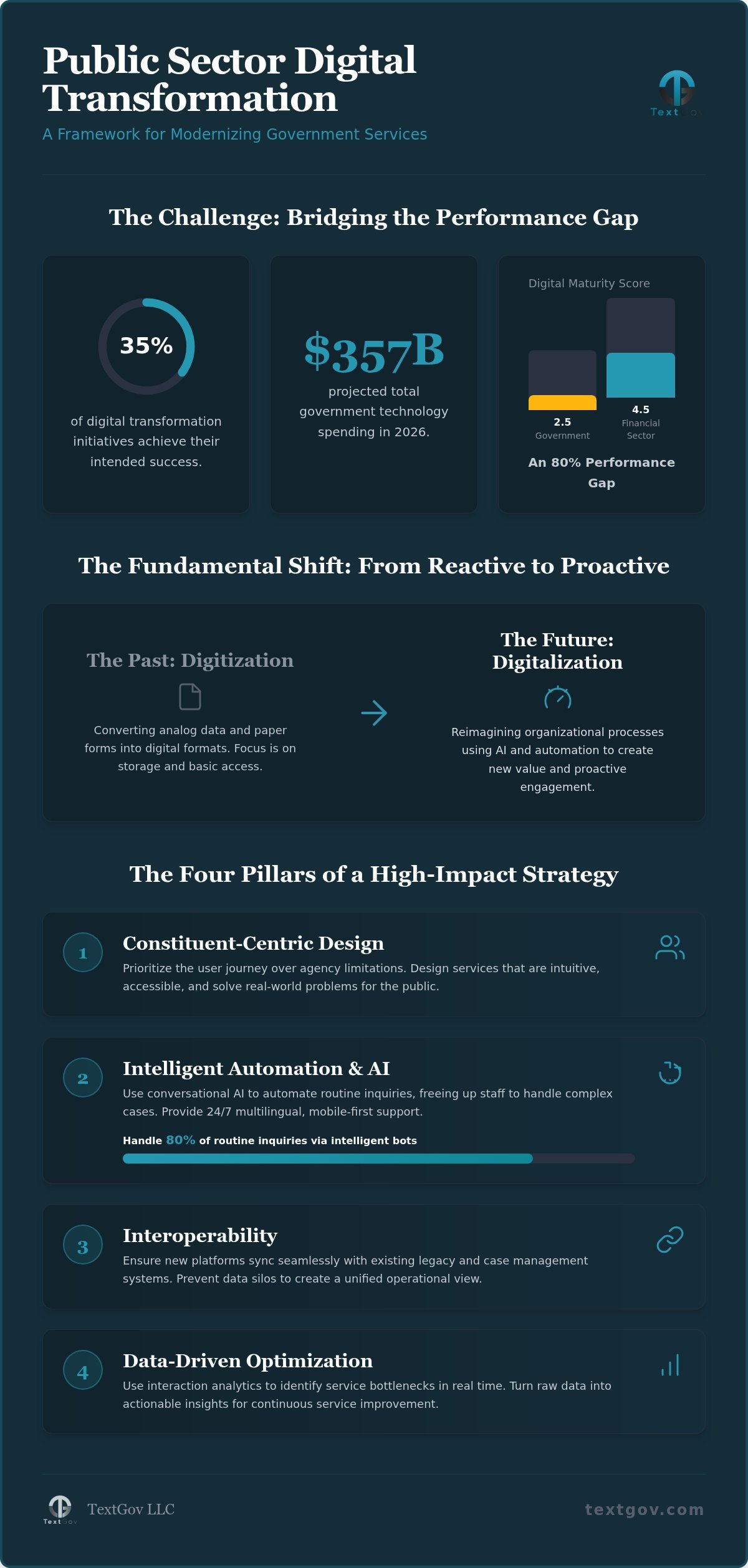
Only 35% of digital transformation initiatives achieve their intended success; yet total government technology spending is projected to reach $357 billion in 2026. This disparity highlights a critical challenge for agencies currently struggling with high call volumes and administrative burdens that legacy systems simply cannot resolve. You’re likely managing the tension between rising public expectations and budget constraints that demand immediate ROI. Building a high-performance public sector digital transformation strategy is no longer just an IT goal; it’s a vital necessity for maintaining organizational relevance and operational efficiency.
We recognize that true progress requires more than just digitizing paper forms. This article provides a definitive framework for modernizing government services through proactive automation and sophisticated conversational AI. You’ll learn how to bridge the performance gap between public services and the private sector by implementing tools that actually talk to your existing infrastructure. We’ll preview a roadmap that reduces operational costs while elevating public trust through seamless, 24/7 engagement models designed for the coming year.
Key Takeaways
- Understand the essential shift from reactive digitization to proactive digitalization to ensure your agency remains resilient in an evolving technological landscape.
- Master a comprehensive public sector digital transformation strategy that prioritizes constituent-centric design and eliminates traditional bureaucratic bottlenecks.
- Discover how integrating sophisticated conversational AI and government chatbots can automate the majority of routine inquiries, allowing staff to focus on complex cases.
- Learn a methodical phased approach to auditing high-volume tasks and implementing automated workflows that deliver immediate, measurable ROI.
- Explore the practical application of automated messaging tools to modernize court operations and significantly improve public engagement metrics.
Beyond Paperless: The New Era of Public Sector Digital Transformation Strategy
Modernization in 2026 has evolved far beyond the simple act of scanning paper documents. A successful public sector digital transformation strategy now centers on shifting from reactive service models to proactive engagement. While many agencies focus on “digitization”, which is the basic conversion of analog data into digital formats, true leaders are embracing “digitalization.” This involves fundamentally reimagining organizational processes through AI and automation to create value rather than just storing files. Organizations like the UK Government Digital Service (GDS) have long demonstrated that centralizing digital principles is the only way to meet modern standards at scale.
The primary driver for this shift is a fundamental change in constituent expectations. Today’s citizens don’t just want digital forms; they expect 24/7 access and immediate responses. With the government sector currently scoring a 2.5 on the digital maturity scale compared to a 4.5 in financial services, where infrastructure leaders like Gemba provide the backbone for modern digital ecosystems, the pressure to close this 80% performance gap is immense. The high cost of sticking with legacy systems manifests as overwhelming call volumes and severe administrative burnout. When staff spend hours answering repetitive questions, they can’t focus on high-value tasks. Transitioning to an automated framework ensures that every technological investment translates into a superior user experience and organizational survival.
Shifting from Reactive Bureaucracy to Proactive Government
The hallmark of a mature public sector digital transformation strategy is the move from waiting for inquiries to initiating contact. Instead of hoping a constituent remembers a deadline, agencies now use automated systems to send court date reminders and status updates. This proactive approach creates a ‘virtual lobby’ that remains open regardless of physical office hours. It empowers the public to resolve issues on their own schedule while simultaneously clearing the phone lines for staff. By automating these low-complexity touchpoints, you transform the government experience from a series of hurdles into a streamlined, collaborative journey.
The Four Pillars of a High-Impact Public Sector Digital Strategy
A robust public sector digital transformation strategy rests on four foundational elements. First, constituent-centric design mandates starting with the user journey rather than agency limitations. This ensures services are intuitive and accessible. With 72% of companies already integrating AI into their operations, public agencies must adopt similar efficiencies to handle 80% of routine public inquiries via intelligent bots. Interoperability ensures that new messaging platforms sync seamlessly with legacy case management systems, preventing data silos. Finally, data-driven optimization uses interaction analytics to identify and fix service bottlenecks in real time. This continuous feedback loop turns raw interaction data into actionable insights for service improvement.
Prioritizing Conversational AI as a Strategic Lever
Modern agencies often find that court chatbot software is the most accessible entry point for comprehensive digital change. These tools bridge the gap between complex legal processes and public understanding. As a core component of a public sector digital transformation strategy, conversational AI allows for rapid scaling without increasing headcount. AI plays a vital role in maintaining digital equity by providing 24/7 multilingual support and mobile-first access. This ensures that every member of the community can navigate government services with confidence.
Ensuring Compliance and Security in Automated Communications
Security remains a non-negotiable priority for any public sector initiative. Modern GovTech platforms address privacy concerns by implementing end-to-end encryption and strictly adhering to legal compliance standards. For sensitive judicial notifications, secure messaging ensures that data remains protected from unauthorized access. High-performance solutions provide the transparency and audit trails necessary to maintain public trust. If you’re ready to modernize your outreach, exploring automated government communication tools can help you balance innovation with rigorous security protocols.
Executing Your Strategy: From Planning to Automated Implementation
Execution is where a visionary public sector digital transformation strategy transitions from a conceptual roadmap into a functional reality. The process begins with a rigorous audit to isolate high-volume, low-complexity tasks. These repetitive actions represent the low-hanging fruit of automation. By identifying these bottlenecks early, agencies ensure an immediate impact on staff workload. Phase 2 focuses on integration, where specialized tools like juror text reminder systems are linked directly to central databases. This creates a vital bridge between static records and active constituent outreach. Finally, Phase 3 involves scaling these solutions across departments to create a unified, agency-wide messaging ecosystem.
Tracking performance is essential for proving the value of these technological upgrades. Key Performance Indicators (KPIs) should focus on three primary areas:
- Reduced Call Volume: Measuring the decrease in routine inquiries handled by human operators.
- Increased Appearance Rates: Documenting the rise in compliance following automated notifications.
- User Satisfaction: Utilizing digital surveys to capture real-time feedback from the public.
Integrating AI Messaging into Case Management Systems
The technical success of your implementation depends on the seamless flow of data between conversational AI and back-end records. Robust API connections ensure that when a constituent updates their information via a chatbot, the change reflects instantly in the case management system. While initial implementation and integration fees are necessary, they provide an exceptional long-term ROI by completely eliminating the need for manual data entry. This level of technical sophistication ensures your public sector digital transformation strategy remains resilient, secure, and ready for the challenges of 2026.
Mastering the Future of Modern Government Engagement
Modernizing your agency’s operations requires a shift from reactive document management to proactive, automated engagement. By focusing on constituent-centric design and the seamless integration of conversational AI, you can resolve the tension between limited budgets and rising public expectations. A successful public sector digital transformation strategy ensures that technology serves as a bridge, not a barrier, to effective communication. You’ve seen how auditing high-volume tasks and scaling automated workflows creates a resilient foundation for the years ahead.
TextGov provides the practical execution layer for this evolution. Our platforms reduce call volumes by up to 40% through automated chatbots while ensuring 24/7 constituent engagement without increasing your headcount. Because our tools seamlessly integrate with national case management standards, you can modernize your outreach without disrupting your existing records. It’s time to redefine how your organization interacts with the community. Partner with TextGov to execute your digital transformation strategy today. We’re ready to help you build a more efficient, trust-based future for your constituents.
Frequently Asked Questions
What are the first steps in a public sector digital transformation strategy?
The first step involves a comprehensive audit of current communication workflows to identify high-volume, repetitive tasks that drain administrative resources. By pinpointing these specific friction points, you can prioritize automation where it offers the most immediate return on investment. This phase also requires establishing clear benchmarks for success to ensure your public sector digital transformation strategy remains focused on measurable outcomes rather than just technical implementation.
How does conversational AI improve government efficiency?
Conversational AI improves efficiency by serving as a 24/7 engagement layer that resolves routine inquiries without human intervention. This technology handles thousands of simultaneous interactions, providing instant answers to common questions about services or procedures. Consequently, your staff is freed from the cycle of repetitive phone calls and can dedicate their expertise to complex, high-priority cases that require manual oversight.
Can digital transformation strategies reduce failure-to-appear rates in courts?
Yes, digital strategies that incorporate automated messaging are highly effective at increasing court compliance. By sending proactive notifications directly to a constituent’s mobile device, agencies eliminate the common logistical oversights that lead to missed dates. This proactive approach significantly reduces the administrative costs of rescheduling and warrants, leading to a more streamlined and cost-effective judicial process for everyone involved.
What is the difference between digitization and digital transformation for government?
Digitization is merely the act of converting physical records into digital files; however, digital transformation is a holistic shift in how an agency functions. A modern public sector digital transformation strategy uses technology like AI and automated workflows to fundamentally improve service delivery. While digitization updates your storage, transformation updates your entire operational philosophy to be more proactive, efficient, and responsive to public needs.