
The on-premise infrastructure public sector teams historically trusted to protect sensitive records has quietly become their greatest operational liability. Transitioning to modern cloud-based government messaging is no longer just an IT upgrade; it’s a vital transformation in how public institutions serve their communities. You likely feel the daily pressure firsthand: front-office staff buried beneath repetitive phone inquiries, courts battling low juror response rates, and mounting concerns over data sovereignty that stall progress.
You don’t have to compromise rigorous compliance to achieve responsive public service. We will evaluate the critical differences between cloud and legacy messaging architectures so you can select a secure, future-proof platform for public sector communication. Ahead, discover how modern FedRAMP-aligned baselines and automated communication workflows empower agencies to slash failure to appear rates, streamline constituent inquiries, and protect public trust.
Key Takeaways
- Discover how shifting to cloud-based government messaging replaces cumbersome capital outlays with agile SaaS architectures that deploy in weeks rather than months.
- Unpack vital compliance baselines, including FedRAMP standards and domestic data sovereignty rules, that safeguard citizen records across modern digital channels.
- Learn how seamless CMS integration automates constituent outreach to dramatically alleviate administrative strain and phone queue congestion.
- Master strategic evaluation criteria to implement proactive court chatbots and automated reminders that drive measurable reductions in failure to appear rates.
Comparing Architectures: Cloud-Based vs. Legacy On-Premise Systems
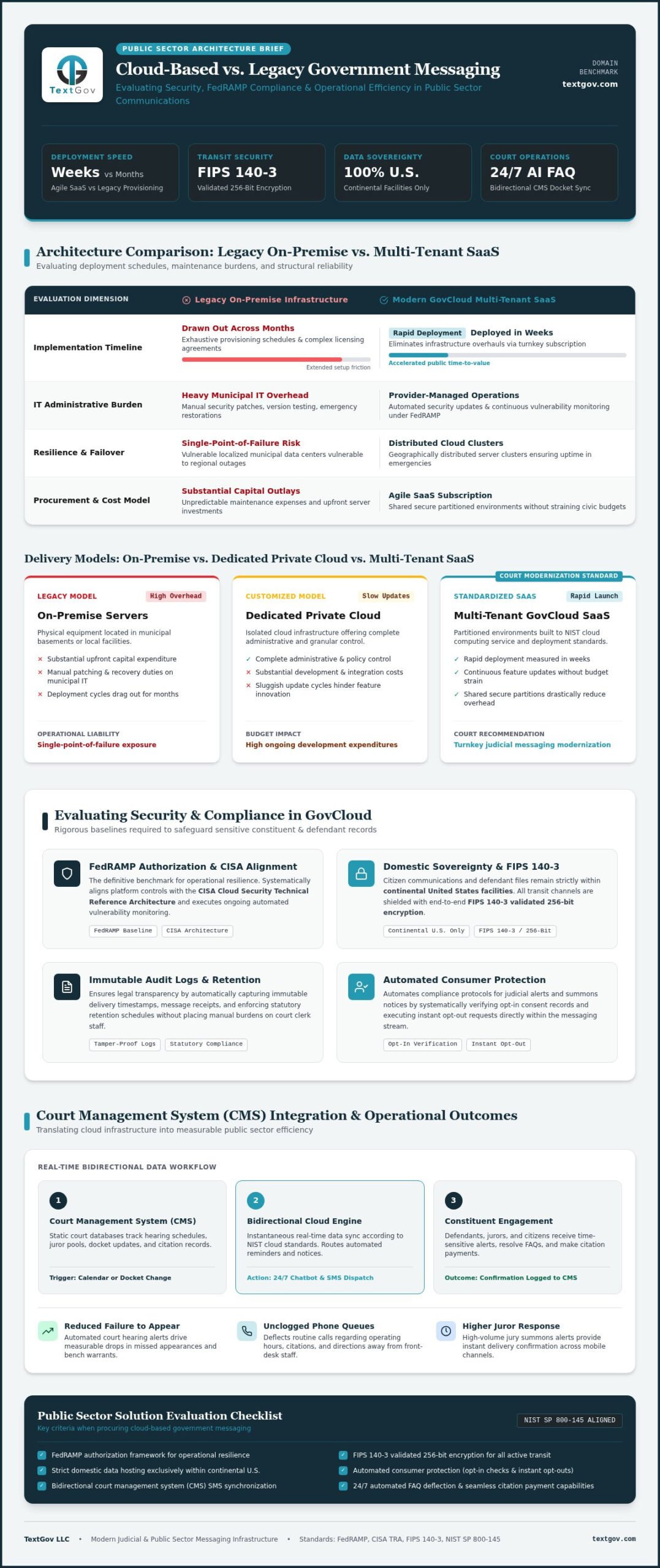
Public sector operational efficiency hinges on system adaptability. Legacy messaging architectures require substantial capital outlays, complex licensing agreements, and exhaustive provisioning schedules that routinely drag implementations out for months. Conversely, modern cloud-based government messaging operates on agile SaaS subscription models. This shift eliminates unpredictable infrastructure overhauls, allowing public agencies to deploy sophisticated outreach channels in weeks rather than quarters.
Operational maintenance presents an equally stark contrast. Legacy systems place the heavy administrative burden of manual patching, version testing, and emergency system restorations squarely on municipal IT departments. Cloud messaging solutions transfer this operational overhead directly to the provider. Platforms operating under the FedRAMP authorization framework continuously execute automated security updates and vulnerability monitoring. Furthermore, geographically distributed cloud server clusters eliminate the single-point-of-failure vulnerabilities inherent to localized municipal data centers, ensuring reliable uptime during regional emergencies.
SaaS vs. Private Cloud for Municipal Agencies
Dedicated private clouds provide complete administrative control and granular customization, yet they carry substantial development costs and sluggish update cycles. Multi-tenant SaaS architectures share secured, partitioned environments that dramatically reduce overhead while accelerating innovation. This unified model explains why multi-tenant SaaS serves as the preferred standard for court technology modernization, delivering rapid deployments and continuous feature improvements without straining civic budgets.
Evaluating Security and Compliance in the GovCloud Ecosystem
Deploying cloud-based government messaging requires uncompromising safeguards to protect sensitive constituent records, as public agencies can’t risk unauthorized exposure. Modern administrators treat FedRAMP authorization as the definitive benchmark for operational resilience, directly aligning their systems with the CISA Cloud Security Technical Reference Architecture. In tandem with FedRAMP controls, strict data sovereignty regulations guarantee that citizen communications and sensitive defendant records remain hosted exclusively within continental United States facilities. Legal transparency also demands comprehensive accountability. Leading cloud architectures capture immutable audit logs that automatically record delivery timestamps, message receipts, and statutory retention schedules without placing manual burdens on clerk staff.
Maintaining Court Messaging Compliance in the Cloud
Managing judicial notifications introduces specialized operational requirements. Public officials must adhere to strict protocols for court messaging compliance, especially when delivering time-sensitive hearing notices or summons alerts. Modern cloud platforms automate consumer protection guidelines by systematically verifying opt-in permissions and executing instant opt-out requests. The 2026 standard for secure government data transit requires end-to-end FIPS 140-3 validated 256-bit encryption across all active communication channels. Judicial teams looking to modernize their outreach can evaluate how TextGov provides secure, turnkey messaging engineered for court operations.
Selecting the Right Messaging Solution for Public Sector Modernization
Procuring the right platform requires evaluating operational compatibility alongside technical rigor. While generic connectivity vendors overlook judicial workflows, modern cloud-based government messaging must align with standardized NIST cloud computing service and deployment models to deliver rapid scalability during high-volume jury summons or emergency alerts. Prioritize platforms that provide 24/7 automated FAQ resolution, seamless citation payments, and dedicated implementation specialists who understand public sector governance.
Future-Proofing with AI-Enabled Court Chatbots
Deep synchronization bridges the gap between static databases and dynamic constituent engagement. Direct court management system sms integration enables bidirectional, real-time data exchanges that trigger automated hearing reminders and docket updates instantly. Deploying specialized court chatbot software deflects routine inquiries around operating hours, fine schedules, and filing deadlines, driving down manual call volumes and helping clerks focus on critical administrative tasks.
Evaluate conversational accuracy and platform intelligence with this core checklist:
- Domain-Specific Intent Mapping: Accurately parses legal terminology and complex public sector queries.
- Context-Aware Escalation: Routes sensitive conversations to live court personnel when human intervention is required.
- Strict Guardrails: Prevents unauthorized procedural advice while consistently delivering verified court information.
Transform Judicial Access and Public Sector Communication
Modernizing public sector outreach is no longer an optional initiative; it’s an immediate operational imperative. Adopting modern cloud-based government messaging enables public institutions to replace vulnerable legacy systems with resilient, FedRAMP-aligned security protocols that actively protect sensitive constituent records. By deploying platforms specialized in judicial and court workflows, leaders can eliminate administrative bottlenecks, dramatically lower failure to appear rates, and activate 24/7 citizen engagement tools that keep communities informed around the clock.
Equipping your team with intelligent, automated messaging ensures your agency remains agile, secure, and ready to meet rising public expectations. Taking this collaborative step today lays the foundation for a transparent, efficient public sector tomorrow.
Frequently Asked Questions
Is cloud-based government messaging as secure as on-premise servers?
Yes, cloud-based government messaging often exceeds the security capabilities of legacy on-premise servers. Modern cloud architectures enforce continuous compliance through FedRAMP baselines and automated vulnerability patching that internal IT teams struggle to match manually. Sensitive records stay protected via end-to-end 256-bit encryption and strict domestic data hosting, ensuring public records remain resilient against unauthorized access without burdening local staff.
How does cloud messaging help reduce failure to appear rates?
Automated text alerts dramatically lower failure to appear rates by delivering direct, proactive court notifications straight to mobile devices. Timely SMS reminders keep defendants and jurors informed about upcoming appearance dates, location details, and procedural obligations. By replacing easily missed paper notices with direct digital communication, agencies eliminate communication barriers, improve hearing attendance, and keep court dockets operating on schedule.
Can cloud-based messaging platforms integrate with legacy case management systems?
Modern cloud platforms easily bridge the gap with legacy systems through custom APIs and secure database connectors. Purpose-built solutions extract scheduled hearings and case updates from older court management software without disrupting existing workflows. This automated synchronization ensures court chatbots and outbound SMS tools receive real-time data, allowing staff to modernize constituent communications without undergoing a costly, full-scale infrastructure replacement.
What are the cost benefits of moving government messaging to the cloud in 2026?
Migrating to cloud-based government messaging eliminates unpredictable capital expenditures by transitioning agencies to a predictable subscription model. Public sector organizations avoid routine server replacements, proprietary licensing fees, and emergency IT overtime. In addition, deploying automated chatbots resolves high volumes of routine citizen inquiries instantly, freeing administrative personnel to focus on higher-value tasks and significantly lowering per-interaction operational expenses.