
The era of the ‘please hold’ queue is officially over, yet many agencies still operate as if digital transformation is a luxury rather than a necessity. You’ve likely seen how manual call volumes for routine inquiries can paralyze a department, while low juror response rates create significant delays in the legal process. This 2026 government messaging platform comparison provides the clarity needed to transition from fragmented communication to a unified, proactive digital strategy. We understand that maintaining compliance while modernizing public sector data is a delicate balance that requires a sophisticated partner.
This guide promises to simplify your decision-making process by highlighting tools designed to reduce failure-to-appear rates and provide 24/7 support without adding to your payroll. We’ll examine how advanced court chatbots and jury texting solutions integrate directly with your case management systems to streamline workflows. You’ll gain a clear roadmap for selecting a platform that transforms citizen engagement into a seamless, high-performance operation.
Key Takeaways
- Identify the critical shift from reactive FAQ responses to proactive, automated reminders that significantly reduce failure-to-appear rates for jurors and defendants.
- Navigate the technical nuances between generic municipal tools and specialized systems through our comprehensive government messaging platform comparison.
- Evaluate how direct Case Management System (CMS) integration synchronizes your digital communication with real-time agency data to ensure absolute compliance and accuracy.
- Establish a roadmap for professional implementation that secures 24/7 automated support while drastically reducing the operational strain on court clerks.
Evaluating Core Capabilities: What Defines a Leading Government Messaging Platform?
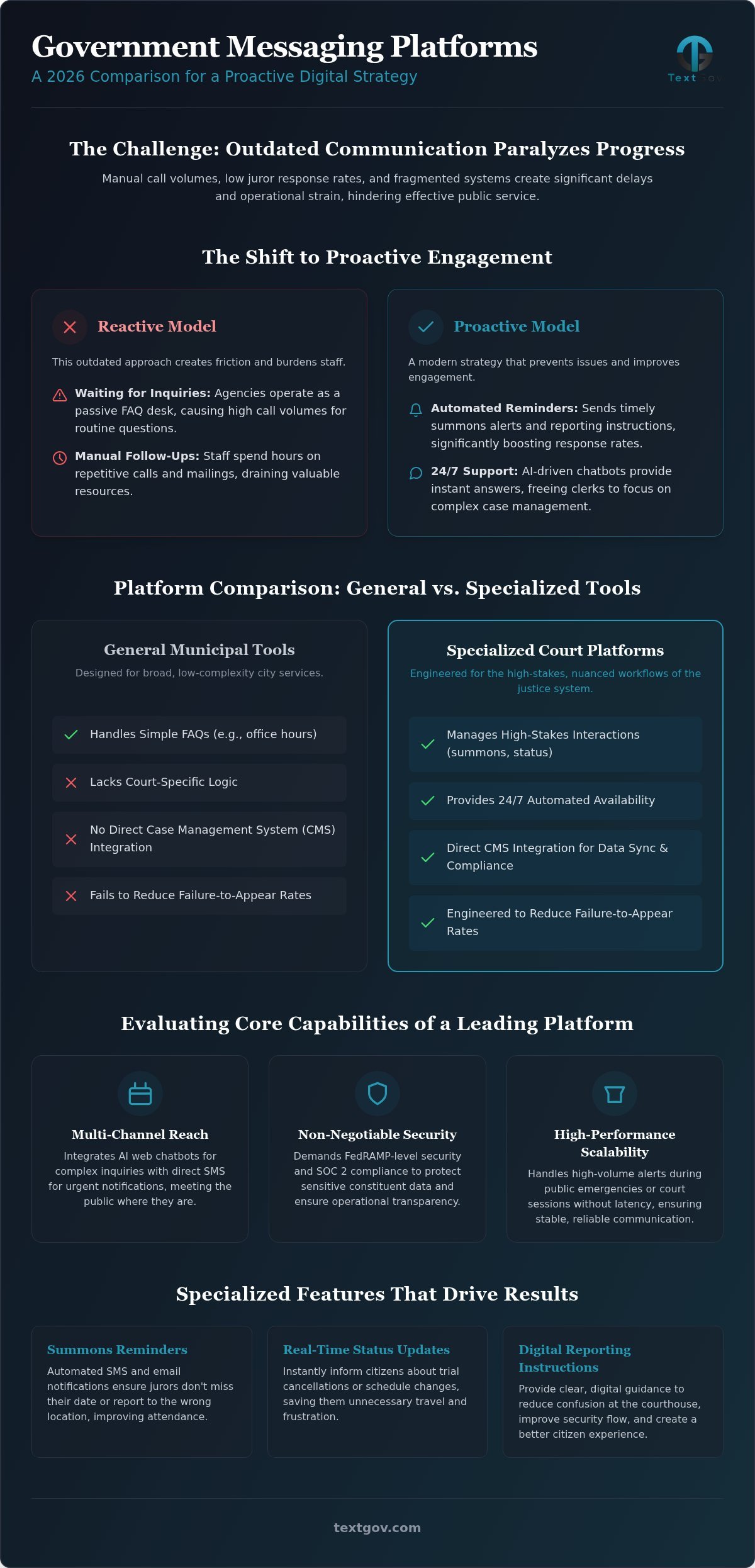
Selecting the right tool requires a deep dive into functional excellence. A robust government messaging platform comparison reveals that top-tier solutions must bridge the gap between high-level E-government principles and daily operational utility. This starts with multi-channel reach. Platforms that only offer SMS or only offer web-based tools fail to meet the public where they are. You need an integrated approach that combines AI-driven web chatbots for complex inquiries with direct SMS for urgent notifications. This dual-pathway ensures that every citizen, regardless of their technical proficiency, can access vital services with ease.
Security is non-negotiable. Public sector data demands FedRAMP-level security and SOC 2 compliance to protect sensitive constituent information against evolving threats. These certifications prove that a vendor prioritizes data integrity and operational transparency. Scalability also plays a critical role. Your system must handle high-volume alerts during court sessions or public emergencies without latency. High-performance platforms maintain stability even when thousands of messages are dispatched simultaneously, ensuring that your agency stays connected when it matters most.
The Shift Toward Proactive Public Engagement
Proactive engagement in GovTech is the transition from waiting for citizen questions to delivering critical information before it’s requested. This model transforms the juror experience by sending automated summons reminders and reporting instructions directly to their mobile devices. These targeted alerts drive up response rates and reduce the administrative burden on court clerks who’d otherwise spend hours on manual follow-ups. Embracing this shift is a core component of Digital Transformation for Courts in 2026. By prioritizing proactive outreach, agencies don’t just answer FAQs; they prevent the confusion that leads to missed appearances and high call volumes. It’s a strategic move that elevates the standard of service for the entire community.
Platform Comparison: Court-Specific Tools vs. General Government Messaging
Distinguishing between a generic municipal bot and a specialized judicial tool is critical for long-term success. A comprehensive government messaging platform comparison reveals that while general-purpose bots handle simple FAQs, they’ll often fail to navigate the complexities of legal workflows. Court-specific systems manage high-stakes interactions like summons status and reporting instructions with absolute precision. They offer 24/7 availability, meeting public expectations for instant answers outside of standard office hours. This immediate accessibility ensures that citizens remain informed and engaged without taxing limited agency resources.
Specialized features like pre-trial messaging are specifically engineered to reduce failure to appear (FTA) rates. By sending automated, timely alerts to defendants, these platforms bridge the gap between court requirements and constituent action. Implementing these tools allows your agency to move beyond reactive service. You can explore how these high-performance court messaging solutions redefine efficiency by automating the most time-consuming aspects of public outreach.
Specialized Judicial Messaging Features
Deploying court chatbot software serves as a strategic force multiplier for court clerks. Instead of managing hundreds of repetitive phone calls, staff can focus on complex case management. Jury text alerts further streamline the summons process through targeted functionality:
- Summons Reminders: Automated notifications ensure jurors don’t miss their dates or arrive at the wrong location.
- Real-time Status: Instant updates regarding trial cancellations save citizens unnecessary travel and frustration.
- Reporting Instructions: Clear digital guidance reduces confusion at the courthouse entrance and improves security flow.
Defendant engagement platforms for pre-trial notification operate on similar principles, ensuring every stakeholder remains informed through a centralized digital channel. This level of specialization is what separates a generic tool from a transformative strategic partner that understands the nuances of the justice system.
Integration and Implementation: Choosing a Strategic Partner
Modernizing agency communication requires more than just selecting a tool; it demands a seamless connection between your new digital interface and your existing Case Management System (CMS). A detailed government messaging platform comparison shows that the most effective solutions offer deep integration, allowing messaging to reflect real-time court data. This synchronization ensures that when a hearing time changes or a juror is excused, the system updates automatically without manual intervention. It’s this level of technical synergy that transforms a simple notification tool into a strategic asset.
Choosing a partner that provides professional implementation services is equally important. Transitioning from legacy phone trees to automated digital assistants shouldn’t be a technical burden for your staff. A dedicated implementation team ensures that the platform is configured to your specific workflows from day one. Additionally, ongoing SaaS support provides continuous updates, keeping your agency at the leading edge of security and feature parity. Success is ultimately measured through clear ROI metrics, such as a documented reduction in no-show rates and a significant drop in routine call volumes for clerks.
Ensuring Successful Agency Adoption
Moving away from manual processes requires a clear roadmap and a commitment to organizational excellence. When evaluating a 24/7 government messaging platform, consider this essential checklist:
- Data Compatibility: Does the platform support your specific CMS architecture?
- Workflow Automation: Can it replace specific manual tasks like summons follow-ups?
- User Accessibility: Is the interface intuitive for both staff and constituents?
By following these steps, you can confidently manage the transition and refer to our 2026 Guide to Government Chatbots for deeper insights into FAQ management. This strategic approach ensures your agency doesn’t just adopt new technology but masters it to improve public service delivery.
Redefining the Standard for Public Sector Communication
The path to modernization is clear. This government messaging platform comparison highlights the vast difference between basic chatbots and specialized judicial tools. By prioritizing proactive engagement and deep CMS integration, your agency can eliminate the inefficiencies of manual call handling and low juror response rates. This transition isn’t just about software; it’s about establishing a high-performance digital infrastructure that serves your community 24/7. We’re ready to serve as your strategic partner. Our team provides expert implementation and specialized solutions tailored for courts and municipal agencies, ensuring your communication is always accurate and secure.
Partner with TextGov LLC to Modernize Your Agency Communication and experience the benefits of automated, real-time public inquiry support. The future of government communication is proactive, integrated, and ready for you to lead. Take the next step toward operational excellence today.
Frequently Asked Questions
What is the primary difference between a government messaging platform and a standard SMS service?
Specialized platforms offer two-way AI interaction and public sector compliance that standard SMS tools simply can’t match. While standard SMS is often a one-way broadcast, a high-performance platform uses automated logic to handle complex inquiries and maintain official records. This ensures every interaction meets strict data retention standards required for transparent agency operations and constituent accountability.
How do automated messaging systems help reduce failure to appear (FTA) rates in courts?
Automated systems reduce failure to appear rates by delivering persistent, timely reminders directly to a user’s mobile device. These notifications include specific reporting instructions and real-time trial status updates that prevent confusion. By removing the friction of manual tracking, agencies ensure defendants and jurors have the exact information they need to fulfill their legal obligations on time.
Can these platforms integrate with our existing case management system (CMS)?
Yes, leading digital tools are designed to integrate seamlessly with your existing Case Management System (CMS). This connection allows the messaging tool to pull real-time data, ensuring every automated reminder or chatbot response reflects the most current case information. It eliminates manual data entry and maintains a single, synchronized source of truth for your entire department.
What are the security requirements for government messaging software in 2026?
Security in 2026 requires FedRAMP-level authorization and SOC 2 Type II compliance to safeguard sensitive public sector data. A thorough government messaging platform comparison should prioritize vendors that offer end-to-end encryption and robust audit trails. These standards protect constituent information from unauthorized access while ensuring your agency remains compliant with evolving federal and state privacy regulations.
How long does it typically take to implement a court or government chatbot?
Implementation typically follows a streamlined professional service model that spans several weeks depending on your specific integration requirements. While basic configurations can be deployed quickly, a full rollout involving deep CMS synchronization ensures long-term stability and accuracy. This methodical approach guarantees that your staff is fully prepared to manage the new digital interface without technical burdens.
Do these platforms support multi-language communication for diverse constituents?
Modern platforms provide comprehensive multi-language support to ensure equitable access for all constituents. By offering automated responses and SMS alerts in multiple languages, agencies can effectively communicate with non-English speakers without requiring additional bilingual staff. This capability is essential for maintaining inclusive public service standards and improving overall engagement across your entire community.