
High call volume isn’t a sign of a thriving court; it’s a symptom of a communication framework that’s struggled to keep pace with the digital age. Most clerks spend their days trapped in a cycle of repetitive questions about hearing times and fine payments, leading to burnout and significant administrative bottlenecks. You’ve likely felt the strain of trying to manage a rising lower court call volume while facing tight budget constraints that make hiring more staff impossible.
It’s time to stop treating the symptoms and start implementing a cure that scales. This 2026 guide shows you how modern judicial agencies are utilizing public inquiry automation to slash call volumes and elevate administrative efficiency across the board. We’ll explore the strategic implementation of court chatbots and automated jury texting, demonstrating how these tools integrate with your legacy systems to provide faster resolutions for the public and a more manageable workload for your team.
Key Takeaways
- Identify the primary operational bottlenecks that escalate lower court call volume and learn to quantify the administrative cost of manual inquiry handling.
- Discover how AI-driven court chatbot software acts as a 24/7 front-line responder, resolving repetitive questions about fines and hearing dates without clerk intervention.
- Implement strategic “Text-to-Chat” prompts within your existing phone menus to seamlessly divert voice traffic toward more efficient digital communication channels.
- Utilize automated juror and pre-trial texting to proactively provide status updates, significantly reducing the volume of inbound status-check inquiries.
- Understand the critical requirements for integrating public inquiry automation with legacy Case Management Systems to ensure data security and organizational optimization.
The Evolving Landscape of Lower Court Call Volumes: Identifying Operational Bottlenecks
Judicial administration in 2026 demands a shift from reactive phone management to proactive digital engagement. Maintaining a high lower court call volume isn’t just an inconvenience; it’s a structural failure that drains modern judicial budgets. When clerks spend hours repeating fine amounts or hearing dates, they aren’t performing the high-level legal processing they were hired for. This manual model creates a ripple effect of inefficiency that compromises the entire court’s performance.
Digital-first expectations have fundamentally changed how the public interacts with government agencies. Citizens no longer tolerate long hold times or limited office hours. They expect instant, on-demand access to information from their mobile devices. When a court fails to provide these channels, the resulting frustration erodes public trust and increases the likelihood of missed appearances or late payments. Furthermore, high call volumes correlate directly with increased errors in manual data entry as overworked staff struggle to multitask between phone lines and case files.
When late payments are a result of temporary financial strain, citizens often seek out short-term funding options. Resources like QuickCashDirect can help individuals resolve their financial obligations to the court more quickly, which in turn helps administrators manage the overall volume of inquiries regarding payment extensions.
The Hidden Costs of the “Phone-First” Model
The true cost of manual call handling extends far beyond payroll. It encompasses the lost productivity of skilled staff and the increased risk of systemic errors. As the lower court call volume spikes, clerks are often forced to rush through case updates, leading to mistakes that can take hours to rectify later. It’s a cycle of inefficiency that prevents judicial agencies from achieving true administrative excellence. When the public can’t get a clear answer quickly, they call back repeatedly, compounding the problem and creating a gridlock that benefits no one. Forward-thinking jurisdictions are turning to court office efficiency software to break this cycle and transform their communication infrastructure into a dynamic public engagement engine.
Identifying High-Frequency Inquiries
Most inbound traffic consists of routine administrative questions rather than complex legal issues. Mapping these inquiries is essential for any modernization strategy. Common drivers include:
- Status checks on parking or traffic citations
- Requests for hearing dates and courtroom locations
- Inquiries regarding jury duty eligibility and deferrals
- Clarification on payment methods and deadlines
Distinguishing these routine tasks from complex inquiries is the first step toward modernization. By automating the “easy” answers, courts can preserve their human resources for the cases that actually require professional judgment. This strategic separation ensures that clerks are engaged in meaningful work while the public receives the immediate service they require, and firms like Mission Focus Legal Group can focus on providing expert advocacy in personal injury and criminal defense cases.
Public Inquiry Automation: Redefining the Role of the Virtual Court Clerk
Public inquiry automation represents the new gold standard for 2026 GovTech. It’s a strategic shift from reactive call centers to proactive digital engagement hubs that serve the public on their own terms. By deploying these digital interfaces, judicial agencies can transform their operations, ensuring that the first point of contact for any citizen is instant, accurate, and available every hour of the week. This isn’t just about answering questions; it’s about reclaiming clerk time for high-value legal tasks that require human expertise.
Modern judicial leaders recognize that manual phone systems are no longer sustainable. Transitioning to a virtual assistant model allows a court to act as a 24/7 front-line responder, addressing the bulk of inquiries before they ever reach a physical desk. This evolution is essential for agencies looking to modernize their public image while maintaining strict adherence to procedural accuracy and compliance standards.
The Anatomy of a Court Chatbot
The core of this technology lies in advanced Natural Language Processing (NLP). Unlike basic search tools, modern court chatbot software is engineered to interpret complex legal terminology and conversational intent. These systems provide immediate, verified answers for several critical areas:
- Real-time case status and upcoming hearing schedules
- Detailed payment options for fines, fees, and citations
- Physical court locations, parking instructions, and security protocols
- Step-by-step guidance for filing routine documents
Why Automation is Essential for Judicial Modernization
Judicial modernization requires the ability to scale services without an equivalent increase in headcount. Automation provides this elasticity. By pulling data directly from verified Case Management Systems, these digital tools eliminate the risk of human error in relaying information. It’s a reliable way to manage a heavy lower court call volume while ensuring that every citizen receives the same high standard of service. If you’re ready to see how these tools function in a live environment, you can explore our court-specific messaging solutions to begin your transition toward a more efficient administrative model.
Accuracy is the cornerstone of public trust. When a chatbot provides information, it does so by accessing the same “single source of truth” used by the clerks themselves. This integration ensures that whether a citizen is checking a trial date at 2:00 PM or 2:00 AM, the data remains consistent, secure, and fully compliant with government standards.
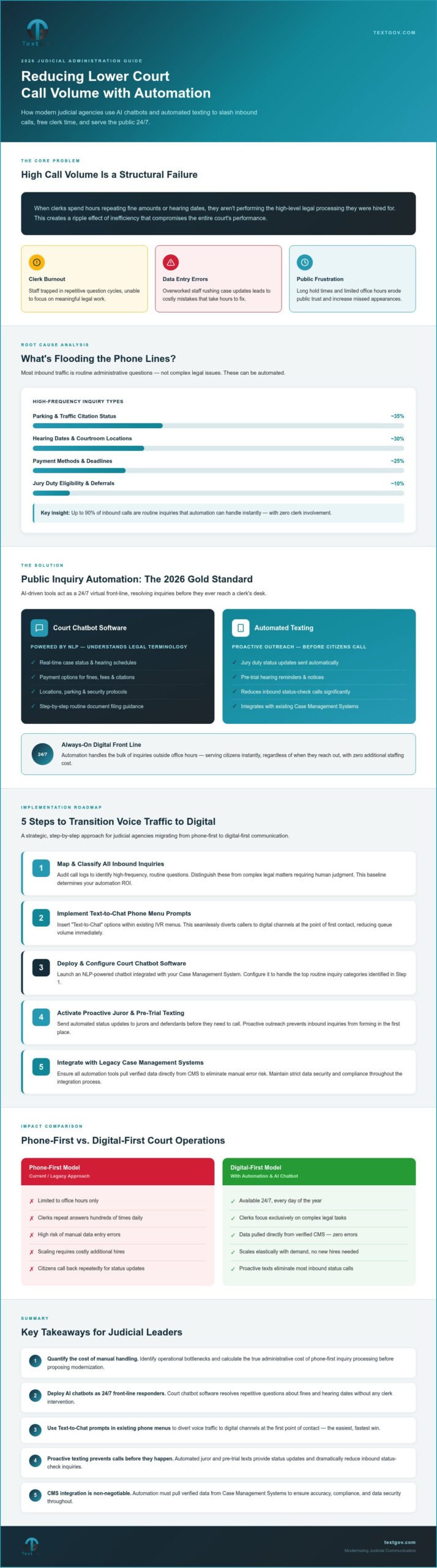
5 Steps to Transition Voice Traffic to Digital Channels
Transitioning from traditional voice traffic to digital-first communication requires more than just new software; it demands a strategic roadmap. By following these five steps, judicial leaders can effectively manage lower court call volume while simultaneously elevating the citizen experience. This shift moves the court from a reactive stance, where clerks are overwhelmed by the phone lines, to a proactive model of administrative excellence.
Step 1-3: Setting the Foundation for Diversion
Success begins with a thorough audit of existing phone logs to identify the “low-hanging fruit” for automation. Most agencies find that a handful of repetitive questions account for the majority of their traffic. Once these are identified, configuring the chatbot with a comprehensive knowledge base ensures that responses are consistent and legally compliant. The final part of the foundation involves promoting these digital channels through every physical and digital touchpoint. This includes:
- Implementing “Text-to-Chat” prompts on court phone menus to offer callers an immediate digital alternative.
- Integrating QR codes on all summons and citations to drive traffic directly to automated portals.
- Updating the court’s website and social media profiles to highlight the 24/7 availability of the virtual assistant.
Step 4-5: Execution and Optimization
The next phase focuses on proactive engagement. Leveraging a juror text reminder system is one of the most effective ways to prevent status-check calls before they happen. By sending automated alerts regarding reporting times or cancellations, the court eliminates the need for citizens to call in for updates. Similarly, using pre-trial text reminders can significantly reduce “Failure to Appear” rates, as defendants are kept informed of their obligations through the devices they use most.
Optimization is the final, ongoing step. Modern judicial administrators must monitor diversion rates and refine AI responses based on real-world user feedback. This iterative process ensures the system remains accurate as local rules or schedules change. If you’re ready to modernize your outreach, explore how TextGov’s automated court messaging solutions can transform your administrative workflow and permanently reduce lower court call volume.
Future-Proofing Judicial Administration with Integrated Messaging Solutions
The final step in achieving administrative excellence is the seamless integration of communication tools with your existing infrastructure. Modern judicial agencies shouldn’t view their Case Management Systems (CMS) as isolated silos. Instead, these systems must act as the engine for public engagement. By connecting automated messaging solutions directly to your CMS via secure APIs, you ensure that every citizen interaction is powered by real-time, verified data. This connectivity eliminates the manual labor of relaying case updates, allowing the system to handle the heavy lifting while your staff focuses on complex legal processing.
Security remains a paramount concern for government entities. Transitioning to digital-first communication requires a platform that prioritizes data integrity and SOC2 compliance. These rigorous standards ensure that sensitive information is protected through high-level encryption and strict access controls. When you choose a messaging platform designed for the public sector, you aren’t just reducing lower court call volume; you’re building a secure, resilient gateway to justice that the public can trust at any hour of the day.
Overcoming Implementation Hurdles
Many administrators hesitate to modernize because they fear a total system overhaul. It’s a common myth that AI implementation requires replacing legacy software. In reality, the most successful judicial transitions happen through phased rollouts. By starting with high-traffic areas like jury duty or traffic court, agencies can prove the technology’s value without disrupting the entire organization. This incremental approach allows clerks to see the immediate benefit of a lightened lower court call volume, fostering internal support for broader digital adoption. Documented results from jurisdictions that have deployed court office efficiency software show that a 40% reduction in manual call volumes is an achievable milestone, not just an aspirational target. For a comprehensive breakdown of how to streamline court clerk tasks through auditing bottlenecks and implementing automated tools, our 2026 digital guide provides a clear step-by-step roadmap.
The 2026 Vision for the Modern Courtroom
The judicial standard of 2026 is defined by accessibility and proactive service. We’re moving toward a future where the court is always open, even when the physical building is closed. This digital-first vision prioritizes the citizen experience while reclaiming thousands of clerk hours every year. By automating routine inquiries, you empower your team to focus on the high-value tasks that truly require human judgment. It’s time to stop managing the phone lines and start leading your agency into a new era of efficiency. Modernize your court communications with TextGov and set a new benchmark for judicial administration.
Pioneering the Next Era of Judicial Efficiency
The transition toward a modernized court system is a commitment to superior public service and organizational excellence. We’ve explored how identifying operational bottlenecks and implementing automated virtual clerks can fundamentally shift your administrative burden. By integrating these tools directly with your existing Case Management Systems, you ensure that every response is accurate and every process remains secure. Efficiency isn’t just a goal; it’s the inevitable result of smart technological integration.
Reducing your lower court call volume allows your team to reclaim their time for high-level legal work that requires human expertise. This shift doesn’t require a total system overhaul but rather a strategic partnership with a guide that understands the complexities of the public sector. With 24/7 automated support and a proven track record of slashing manual inquiries, the path to a more responsive court is clear.
Elevate your court efficiency with TextGov’s automated messaging solutions. It’s time to lead your agency into a more accessible, data-driven future where administrative excellence is the standard, not the exception.
Frequently Asked Questions
How much can a court chatbot realistically reduce call volume?
A court chatbot can typically resolve a majority of routine inquiries, with some agencies reporting a reduction in manual traffic by up to 80% for common questions. By handling repetitive queries about fine amounts, payment deadlines, and court locations, these systems allow the clerk’s office to reclaim hundreds of hours each month. This direct intervention effectively manages the lower court call volume while providing instant, accurate answers to the public.
Is public inquiry automation secure enough for sensitive court data?
Modern automation platforms prioritize data integrity through high-level encryption and SOC2 compliance. These systems are specifically engineered for the public sector to ensure that sensitive case information remains protected at all times. By utilizing secure API connections, the software accesses only the necessary data points from your Case Management System without compromising the overall security of your judicial records.
Will court chatbots replace the need for clerk staff?
Automated solutions are designed to augment your existing team rather than replace them. By automating high-volume, low-complexity tasks, you enable your clerks to focus on specialized legal duties that require human judgment and professional expertise. This shift in workload improves staff morale by reducing burnout and allows your agency to scale its services effectively without needing to increase your total headcount.
How do automated text reminders help reduce lower court call volume?
Automated text reminders provide proactive updates that eliminate the need for citizens to call the clerk’s office for routine status checks. When defendants and jurors receive timely notifications about hearing dates or reporting instructions directly on their mobile devices, the lower court call volume drops significantly. It’s a highly efficient way to keep the public informed while preventing the phone lines from becoming congested with simple inquiries.
Can these automated systems integrate with our current Case Management System?
Seamless integration with existing Case Management Systems is a standard feature of modern judicial messaging platforms. These systems use secure APIs to pull real-time data, ensuring that the information provided to the public is always verified and up to date. This bi-directional flow of information streamlines administrative workflows and prevents the creation of data silos, ensuring your digital tools and human staff are always working from the same source of truth.