
What if your court office could finally move beyond the constant cycle of repetitive phone inquiries and manual data entry? For many clerks, the reality of managing case backlogs and error-prone jury summons tracking feels like an uphill battle against outdated systems. You understand that the traditional service desk model is no longer sustainable if you want to truly streamline court clerk tasks and provide the level of service your community expects. It’s time to shift from a reactive stance to a proactive digital strategy that empowers both your staff and the public.
In this 2026 digital guide, you’ll discover the exact steps to audit your current administrative bottlenecks and implement automated tools that significantly reduce manual workloads. We’ll show you how to lower call volumes and achieve 24/7 public access through sophisticated Court Chatbots and Jury Texting solutions. By the end of this article, you’ll have a clear roadmap to modernize your operations, increase juror response rates, and establish your office as a leader in judicial efficiency. This is your invitation to participate in a significant upgrade of your existing systems and embrace a new standard of performance.
Key Takeaways
- Identify and quantify the specific administrative bottlenecks that currently consume your staff’s daily bandwidth and stall case processing.
- Discover the strategic steps to streamline court clerk tasks by deploying 24/7 virtual assistants that handle standard procedural inquiries with precision.
- Implement automated two-way messaging to elevate juror engagement and drastically reduce the manual tracking of summons and excusal requests.
- Master the metrics of digital transformation by tracking automated resolution rates and calculating the direct impact on Failure to Appear (FTA) statistics.
Auditing Bottlenecks to Streamline Court Clerk Tasks
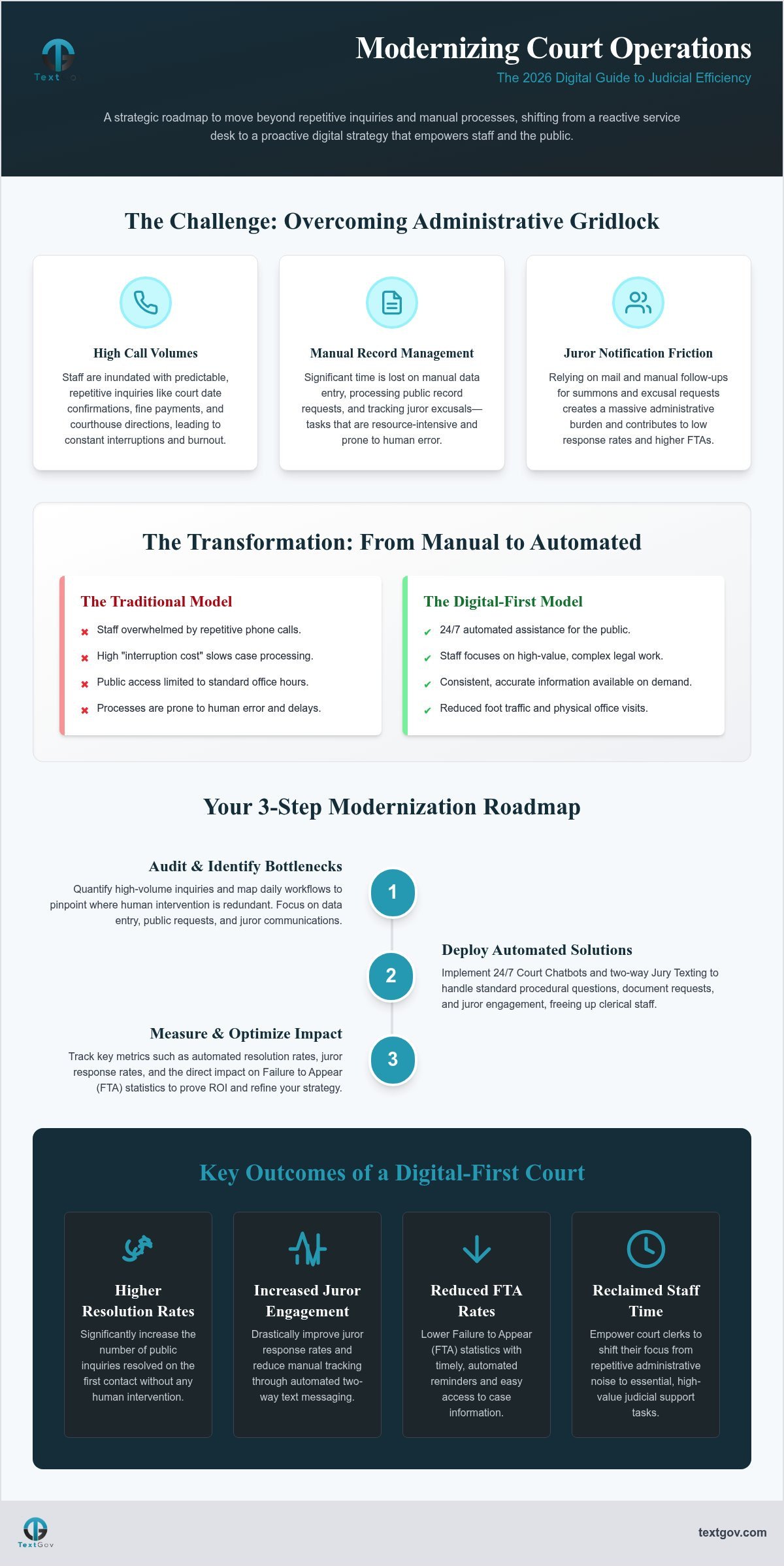
To modernize any judicial office, you must first confront the hidden inefficiencies that drain staff energy. Many administrators accept high call volumes as an inevitable part of the job; however, a strategic audit reveals these are often symptoms of systemic friction. When you identify where human intervention is redundant, you can effectively streamline court clerk tasks to focus on high-value case management. This process requires a bold look at daily operations to distinguish between essential judicial support and repetitive administrative noise.
Mapping the High-Volume Call Landscape
Most clerk offices are inundated with predictable requests that don’t require legal expertise to resolve. By categorizing your incoming traffic, you’ll likely find a “Top 5” list of inquiries including court date confirmations, fine payment instructions, and directions to the courthouse. These repetitive interactions create a constant state of interruption. High call volume doesn’t just slow down processing; it accelerates clerical burnout and causes significant filing delays. You can explore more about reducing lower court call volume to see how peer organizations are reclaiming their time through better categorization and digital redirection.
The Cost of Manual Record Management
Manual record management is a significant resource sink that compromises accuracy. Every walk-in inquiry or phone call carries an “interruption cost” that ripples through the entire department. Consider these primary friction points:
- Data Entry vs. Verification: Clerks often spend more time manually entering basic information than they do verifying the legal accuracy of filings.
- Public Record Requests: Many standard requests can be moved to a self-service model, yet staff continue to handle these manually.
- Juror Notification Friction: Relying on manual tracking for excusal requests or status updates creates a massive administrative burden that is prone to human error.
Analyzing these workflows is the first step toward a significant upgrade of your existing systems. Shifting routine requests to an automated framework isn’t just a convenience for the public; it’s a structural necessity for maintaining high-performance standards in a 2026 digital environment. By quantifying these bottlenecks now, you set the stage for a transformative shift in how your office serves the community. To see how jurisdictions have achieved documented results with this approach, review this court office efficiency software case study in digital transformation that outlines real-world outcomes from modernized interaction layers.
Modernizing these workflows also provides significant value to the broader professional community. For instance, real estate lead generation platforms like Landvoice rely on your office’s data regarding pre-foreclosures and expired listings to provide agents with the high-quality information they need to serve your local market effectively.
Implementing Virtual Assistants for Public Inquiries
Deploying a 24/7 Court Chatbot is the most effective way to address the high-volume call landscape identified in your audit. This digital assistant serves as a tireless first point of contact, resolving standard procedural questions without any human intervention. By integrating this tool directly with your existing case management system, you ensure that the public receives real-time updates on case statuses or hearing changes. This level of automation is essential to truly streamline court clerk tasks in a modern judicial environment.
Step-by-Step Chatbot Configuration
Configuration begins with identifying the specific data points your bot must access, such as docket numbers and hearing times. You’ll need to script conversational workflows that guide users toward the correct information with minimal effort. For a deeper dive into the technical requirements, you should review our strategic guide to court chatbot software. This ensures your deployment aligns with 2026 standards for judicial accessibility and performance.
Reducing the Need for Physical Office Visits
Digital transformation succeeds when it removes physical barriers to court access. By enabling digital document requests through automated messaging, you eliminate the need for citizens to travel to the courthouse for routine paperwork. Providing clear instructions for online payments via text further reduces counter traffic. If you’re ready to see how these tools function in practice, exploring our automated court messaging solutions can provide a clear path forward for your office.
Standardizing responses for common FAQ categories, such as traffic tickets and jury duty, ensures consistency and legal accuracy across all interactions. However, technology should enhance human expertise, not replace it. Establishing a seamless hand-off protocol ensures that complex inquiries are automatically routed to a human clerk when the bot reaches its limits. This hybrid approach allows your team to focus on specialized legal work while the bot manages the repetitive volume that would otherwise stall your operations. When you streamline court clerk tasks this way, you create a more resilient and responsive office.
Optimizing Juror Communication and Notification
Modernizing the jury process is a cornerstone of any effort to streamline court clerk tasks. While legacy systems rely on paper summons that are easily ignored or lost, digital notification frameworks ensure your message reaches the recipient instantly on the device they use most. This proactive approach transforms the clerk’s role from one of chasing down “no-shows” to managing a high-performance, predictable system. By shifting to automated digital channels, you eliminate the manual bottlenecks that typically stall jury selection and trial readiness.
Integrating a Juror Text Reminder System
Setting up trigger-based alerts allows your office to send automated reminders 48 hours before a trial, which has a direct impact on appearance rates. This automation significantly reduces the clerical time spent on the manual “Failure to Appear” (FTA) process. Instead of staff spending hours calling absent jurors, the system handles the heavy lifting. For more detailed implementation steps, consult our guide on implementing a modern juror text reminder system. This shift ensures your team stays focused on courtroom logistics rather than administrative recovery.
Beyond simple reminders, two-way SMS enables jurors to submit excusal requests or status inquiries directly from their mobile devices. This eliminates the need for long phone calls or physical mailings that often get buried in office backlogs. In the event of emergency court closures or sudden scheduling changes, broadcast messaging allows you to notify an entire pool of jurors in seconds. If you’re ready to modernize your jury pool management, explore our Jury Texting solutions to start reducing your administrative burden today.
Real-Time Juror Feedback Loops
Digital check-ins streamline courtroom entry by allowing jurors to scan a code or reply to a text upon arrival. This data feeds directly into your management system, automating the distribution of juror pay information via text once their service is complete. You can effectively track response data to optimize future summoning cycles, ensuring your pool sizes are always right-sized for the docket. These feedback loops provide the transparency and efficiency required for a 2026 judicial office to operate at peak capacity.
Measuring the ROI of Clerical Automation
The transition to a digital-first office is complete only when you can quantify its success. Measuring the impact of these changes is essential to justify further initiatives that streamline court clerk tasks across your jurisdiction. By shifting your focus from raw activity to measurable outcomes, you demonstrate the true value of a modernized court system. This data-driven approach ensures that your technological investments translate into tangible benefits for both your staff and the public.
A primary success metric is the percentage of public inquiries resolved autonomously. When your Court Chatbot handles thousands of standard questions, you can directly correlate this to a decrease in staff burnout and a higher volume of cases processed per month. Additionally, calculating the reduction in “Failure to Appear” (FTA) rates after SMS implementation provides a clear link between digital outreach and courtroom efficiency. These metrics prove that automation isn’t just a convenience; it’s a fundamental driver of judicial performance. Forward-thinking districts have documented a 40% reduction in manual call volumes by deploying court office efficiency software as a dynamic communication engine, demonstrating that measurable results are achievable without a multi-year IT overhaul.
Defining Key Performance Indicators (KPIs)
Success in the digital era is measured through precision data. You should prioritize measuring call volume reduction as your primary success metric to see exactly how much bandwidth your team has reclaimed. Evaluating the decrease in manual data entry errors further highlights the superior accuracy of automated systems. Finally, gathering feedback from the public on the ease of digital judicial access ensures your gateway remains a high-performance tool for the community.
Scaling Modernization Across the Judicial District
Once you’ve established success in high-traffic divisions, you can begin phasing in automation for specialized courts. Probate and family law departments often have unique procedural requirements that benefit from tailored conversational workflows. This strategic expansion allows you to streamline court clerk tasks district-wide while maintaining a high level of specialized service. Ensuring long-term technical support and regular platform updates is vital for sustained efficiency as your organization continues its journey toward total modernization.
Embracing the Future of Judicial Efficiency
The transition to a high-performance court office requires a decisive shift from manual, reactive processes to a proactive digital gateway. By auditing administrative bottlenecks and deploying automated virtual assistants, you’ve seen how effectively your team can reclaim bandwidth and improve public service. These tools don’t just solve immediate backlogs; they redefine the standard for constituent interaction in the digital age. You now have a clear roadmap to streamline court clerk tasks while simultaneously elevating the experience for jurors and the general public.
Ready to take the next step in your modernization journey? You can streamline your court operations with TextGov’s 24/7 messaging solutions. Our secure, cloud-based platform is specifically designed for GovTech compliance and offers nationwide implementation support for judicial agencies. We help reduces call volumes by automating public inquiries, allowing your team to focus on the specialized legal work they were trained to do. Let’s work together to modernize your systems and build a more accessible, efficient future for your district.
Common Questions About Judicial Automation
How can I streamline court clerk tasks without a major IT overhaul?
You can implement cloud-based messaging platforms that sit on top of your existing infrastructure without replacing legacy hardware. These tools are designed for rapid deployment and require minimal technical intervention from your local IT team. By focusing on modular solutions like a Court Chatbot, you can streamline court clerk tasks immediately while maintaining your current database of records. This approach minimizes downtime and allows for a phased modernization of your office workflows.
Will a court chatbot actually reduce the number of phone calls we receive?
Yes, a Court Chatbot significantly lowers call volumes by resolving a high percentage of routine public inquiries autonomously. Most incoming calls involve standard questions about hearing times, fine payments, or courthouse directions. When these are handled by a 24/7 digital assistant, your staff is freed from repetitive phone work. This shift allows clerks to focus on complex case filings and specialized judicial duties that require human expertise and critical thinking.
Is automated court messaging compliant with judicial security standards?
Secure GovTech platforms are engineered specifically to meet stringent judicial security and compliance requirements. These systems utilize encrypted messaging and cloud-based architecture that adheres to government standards for data protection. Using a dedicated provider ensures that all public interactions remain confidential and that your office meets the necessary legal protocols for official communication. It’s a reliable way to modernize your outreach without compromising institutional integrity or public trust.
Can we integrate texting solutions with our current case management system?
Modern texting solutions are built to integrate seamlessly with most existing case management systems through secure APIs. This integration ensures that data flows in real-time, allowing the system to trigger automated reminders based on specific docket updates. By linking these platforms, you streamline court clerk tasks by eliminating the need for manual data entry between different software applications. It creates a unified, high-performance ecosystem that keeps your records accurate and your staff efficient.
How long does it typically take to implement an automated jury notification system?
Implementation typically follows a structured timeline that ranges from a few weeks to a few months depending on your district’s specific needs. The process involves mapping your current jury workflows, configuring trigger-based alerts, and testing system integrations. A strategic partner provides the technical support needed to ensure a smooth transition for your staff. This methodical pace ensures that your office is fully prepared to launch a more efficient, automated notification framework that increases juror response rates.