
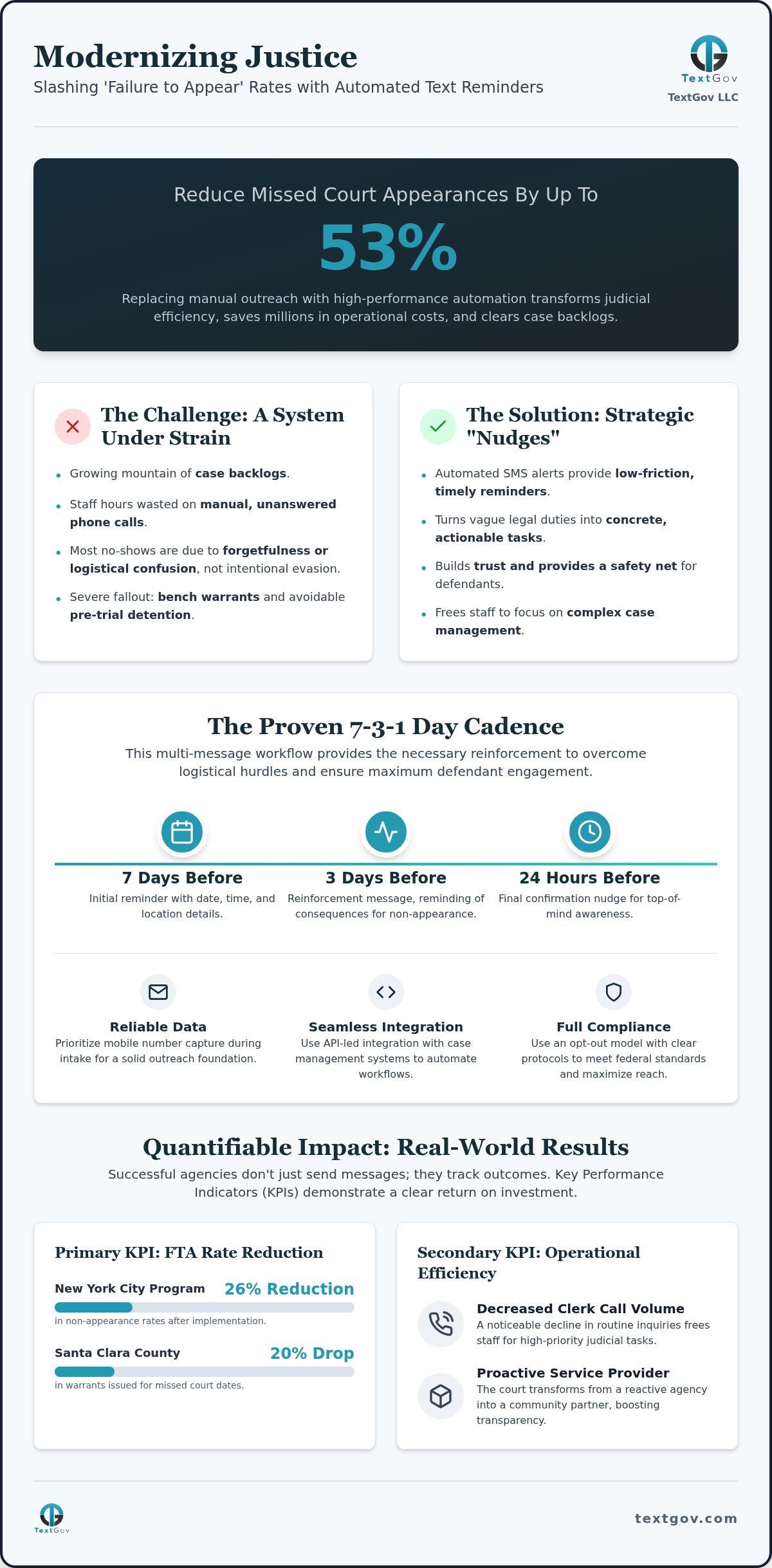
What if a simple digital nudge could reduce missed court appearances by up to 53% while saving millions in operational costs annually? Many judicial departments face a growing mountain of case backlogs while staff spend hours on manual phone calls that often go unanswered. It’s frustrating to watch budget constraints stall progress while failure to appear rates continue to climb. Implementing automated pre-trial text reminders is no longer just a technological luxury; it’s a strategic necessity for any modern court system looking to reclaim its schedule and improve constituent outcomes.
Discover how to strategically deploy these notifications to slash failure to appear rates and modernize judicial efficiency. This guide explores the nationwide shift toward automated communication models and examines the multi-message workflows that reduce administrative burdens while ensuring your department remains at the leading edge of public sector innovation.
Key Takeaways
- Transform judicial efficiency by replacing manual outreach with high-performance automation designed to eliminate case backlogs.
- Execute a precise deployment of pre-trial text reminders using a proven 7-3-1 day cadence to ensure maximum defendant engagement.
- Quantify your success by tracking specific KPIs like failure to appear (FTA) reductions and decreased administrative call volumes.
- Modernize your communication workflow by integrating advanced court chatbot software to handle routine inquiries and FAQ resolution 24/7.
Modernizing Court Attendance: The Role of Pre-Trial Text Reminders
Pre-trial text reminders function as automated SMS alerts designed to keep defendants informed of their upcoming hearings and legal obligations. In 2026, these systems have become foundational to the nationwide effort to reduce failure to appear rates and clear the persistent backlogs affecting the US judicial system. Transitioning to high-performance digital tools allows your staff to focus on complex case management rather than routine phone tag. It’s a visionary shift toward total organizational optimization.
Data shows that the vast majority of no-shows aren’t intentional evasions of the law. Instead, they’re the result of logistical confusion or simple forgetfulness. When a defendant misses a date, the fallout is severe, often leading to bench warrants and avoidable Pre-trial detention, which strains public resources and disrupts lives. Automated pre-trial text reminders bridge this gap by providing a reliable safety net for defendants who may be managing high-stress lives or complex schedules. Reliable communication builds trust.
Understanding the Psychology of Defendant Engagement
Modernizing your approach requires an understanding of “nudge theory.” This behavioral science concept proves that low-friction, timely communication significantly increases compliance. By delivering specific details like the exact time, location, and the consequences of missing a date, you create a “must-appear” mindset. Strategic messaging turns a vague legal obligation into a concrete task. Research confirms that multiple touches provide the reinforcement to ensure defendants navigate their legal journey successfully. These nudges aren’t just notifications; they’re professional partnerships that guide individuals toward compliance.
A Strategic Blueprint for Implementing Automated Notification Systems
Implementing a high-performance system begins with a rigorous audit of your defendant data. You must ensure your intake processes prioritize mobile number capture to build a reliable foundation for outreach. Without accurate data, even the most sophisticated pre-trial text reminders remain underutilized. Investments in Text Reminders show that a structured “7-3-1” strategy, sending alerts seven days, three days, and 24 hours before court, yields the highest engagement. This cadence provides the necessary reinforcement to overcome logistical hurdles and planning errors. To ensure your department follows every critical step, review the 2026 checklist to automate court date reminders and build a zero-intervention messaging ecosystem.
Compliance is equally vital for a successful rollout. Your system must establish clear opt-out protocols to meet federal messaging standards and maintain public trust. Modern systems across the country have transitioned to opt-out models, which automatically enroll defendants to maximize participation and reduce friction. Following these standards ensures your pre-trial text reminders reach their intended recipients without technical interference or legal risk. It’s about creating a seamless, compliant path toward total judicial modernization.
Integrating SMS Workflows with Existing Case Management Systems
A visionary judicial system relies on API-led integration to ensure data flows seamlessly from the docket to the messaging platform. This connectivity allows you to automate reminders for specific case types, ranging from simple traffic citations to complex bond notifications. Automated synchronization is the key to reducing manual clerk data entry. By removing the administrative burden of manual outreach, your team can focus on higher-level judicial priorities. If you’re ready to modernize your workflow, partnering with an expert integrator can accelerate your transition to a digital-first court environment that serves both the staff and the community.
Measuring Success and Optimizing Judicial Outcomes in 2026
Establishing Key Performance Indicators (KPIs) is the first step toward long-term optimization. Successful agencies don’t just track sent messages; they track outcomes. Your primary focus should be the tangible reduction of failure to appear (FTA) rates. For instance, a New York City program reduced non-appearance by 26%, while Santa Clara County saw a 20% drop in warrants for missed dates. You should also monitor clerk call volumes. A successful implementation of pre-trial text reminders leads to a noticeable decline in routine inquiries, freeing your staff for high-priority tasks.
This shift transforms the court from a reactive enforcement agency into a proactive service provider. Engaging constituents early demonstrates a commitment to transparency and accessibility. Real-world examples like the Oregon Judicial Department’s text reminder program show how standardized enrollment and clear opt-out procedures create a user-friendly experience. It’s about moving toward a strategic partnership between the court and the community.
Beyond Basic Alerts: Leveraging AI and Multi-Channel Communication
The next evolution involves moving beyond simple one-way notifications. Implementing court chatbot software allows for 24/7 FAQ resolution. These AI-driven tools handle questions about parking, courtroom attire, or rescheduling without human intervention. The future of judicial communication is multi-channel. Integrating secure messaging apps and email alongside SMS ensures no defendant is left behind. This holistic approach maximizes reach and solidifies your agency’s role as a leader in technological sophistication.
Revolutionizing Judicial Access Through Digital Innovation
The transition to a modernized communication framework is a present-day imperative for efficient court management. By adopting a strategic cadence for pre-trial text reminders, your agency can significantly reduce failure to appear (FTA) rates while simultaneously decreasing the manual call volume that overwhelms court clerks. This shift toward automation doesn’t just solve immediate logistical hurdles. It positions your court as a sophisticated, constituent-focused leader in the public sector. Integrating these tools with 24/7 automated defendant support ensures every individual has the guidance they need to navigate the legal process successfully. The future of judicial efficiency is digital, proactive, and deeply collaborative.
Discover how TextGov modernizes court communication with automated pre-trial reminders.
Join us in redefining the standard for modern governance and building a more accessible justice system for everyone.
Frequently Asked Questions
Do pre-trial text reminders actually reduce bench warrants?
Yes, pre-trial text reminders significantly decrease the issuance of warrants by ensuring defendants don’t miss court due to cognitive barriers. Randomized trials show nonappearance rate reductions can reach up to 39.2%. By preventing these warrants, courts avoid the high costs of incarceration and the administrative cycle of processing avoidable arrests, creating a more streamlined and efficient judicial environment for all stakeholders.
How much does it cost to implement a court text reminder system?
Implementation is surprisingly affordable, with many statewide programs costing less than 50 cents per eligible case. While specific integration fees depend on your current case management system, the operational savings are immense. A program in New York City saved $650,000 over three years by reducing non-appearance. This makes digital notifications one of the most cost-effective upgrades available to modern judicial departments.
Can defendants opt out of receiving court date text messages?
Defendants usually have the ability to opt out, though modern legislation favors an “opt-out” rather than “opt-in” model. Virginia is currently considering legislation to transition their electronic system to this model to increase effectiveness. This ensures high participation rates for pre-trial text reminders while providing a clear path for individuals who prefer not to receive digital correspondence from the court.
Is automated court texting compliant with privacy and legal standards?
Automated systems are engineered to adhere to strict legal and privacy standards, including the TCPA and state-specific mandates. The 2026 Illinois law highlights this by requiring agencies to maintain delivery receipts as proof of service. These platforms protect sensitive defendant information through secure, encrypted data transfers, ensuring that your communication strategy remains both legally compliant and technologically sophisticated.