
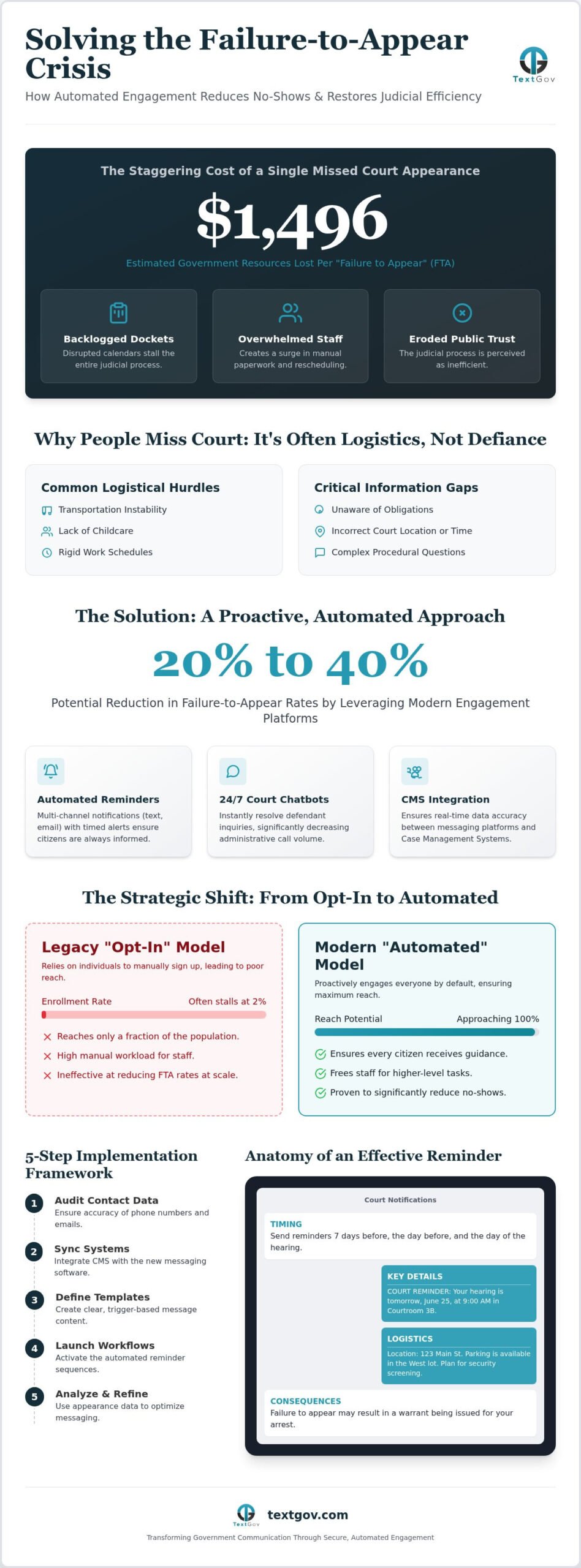
$1,496. That’s the estimated cost in government resources every time a single defendant misses a court appearance and a warrant is issued. You’re likely all too familiar with the ripple effect of these no-shows: backlogged dockets, an overwhelmed administrative staff, and a public that perceives the judicial process as inefficient. Finding ways to reduce failure to appear rates isn’t just about enforcement; it’s about addressing the logistical hurdles like transportation or simple forgetfulness that keep individuals from their hearings.
This guide explores how modern agencies are leveraging automated technology and procedural justice to lower no-show rates by 20% to 40%. You’ll discover strategies to cut administrative call volumes and improve public perception through high-performance digital solutions. We’ll examine the shift toward interactive tools like court chatbots and automated text reminders that transform court communication from a manual burden into a streamlined, proactive partnership.
Key Takeaways
- Discover why it’s vital to transition from manual outreach to proactive engagement to eliminate operational bottlenecks and protect judicial resources.
- Identify how automated, multi-channel notification systems and strategically timed reminders can help your agency reduce failure to appear rates by up to 40%.
- Explore the benefits of 24/7 court chatbots that resolve defendant inquiries instantly, significantly decreasing the administrative call volume for your court staff.
- Understand how seamless integration between messaging platforms and your Case Management System ensures real-time data accuracy and a more sophisticated judicial process.
Understanding the Failure to Appear (FTA) Crisis in Modern Courts
A Failure to appear (FTA) occurs when a defendant or juror misses a scheduled court date, creating a ripple effect that stalls the entire judicial machinery. In 2026, these incidents are more than just scheduling hiccups; they’re significant operational bottlenecks that drain judicial resources and compromise public safety. When calendars are disrupted, it leads to backlogged dockets and an administrative surge that forces court clerks to manage a mountain of manual paperwork.
The financial impact is staggering. Processing a single missed appearance can cost the government nearly $1,500 in time and resources. This includes the high administrative burden of issuing warrants, law enforcement hours spent on service, and the endless cycle of rescheduling hearings. Agencies looking to reduce failure to appear rates must recognize that every no-show is a lost opportunity for efficiency.
Beyond the balance sheet, addressing FTAs is about procedural justice. When courts prioritize clear, accessible communication, they build institutional trust. It shows that the system respects the citizen’s time and provides the necessary tools for compliance, transforming a punitive environment into a proactive partnership.
Identifying the Root Causes of Judicial No-Shows
Research consistently shows that most no-shows aren’t acts of defiance. Instead, they stem from logistical hurdles like transportation instability, lack of childcare, or rigid work schedules. Many individuals also face ‘information gaps,’ where they’re simply unaware of their obligations or the specific court location. Implementing court chatbot software bridges the gap between complex legal requirements and citizen understanding by providing instant, 24/7 answers to common procedural questions. By identifying these barriers, courts can implement targeted interventions that effectively reduce failure to appear rates while streamlining internal operations.
Proven Strategies to Increase Court Appearance Rates
Modern judicial agencies are moving away from manual phone calls toward high-performance, multi-channel notification systems. This shift ensures 100% reach by delivering critical information directly to mobile devices. By automating these touchpoints, courts can effectively reduce failure to appear rates while freeing staff for higher-level tasks. It’s a proactive approach that treats court attendance as an engagement challenge rather than a purely punitive one.
Timing is the catalyst for cognitive reinforcement. While sending a reminder seven days out is helpful, ‘day-before’ and ‘day-of’ alerts are the ones that drive immediate action. Effective messages go beyond simple date notifications; they include substantive details like parking locations, public transit routes, and the specific consequences of a no-show. This strategy is supported by research on written reminders, which highlights how clear, informative content significantly outperforms generic notices.
The Strategic Shift from Opt-In to Automated Models
Transitioning to a modern framework requires a strategic five-step approach: auditing contact data, syncing case management systems with messaging software, defining trigger-based templates, launching automated workflows, and analyzing appearance data. Legacy opt-in models often fail because enrollment rates frequently stall at 2%, leaving the majority of the population unreachable. Defaulting to an automated model ensures every citizen receives the necessary guidance to reduce failure to appear rates across all departments. Following a structured checklist to automate court date reminders gives agencies a proven framework for building a zero-intervention messaging ecosystem that integrates seamlessly with existing workflows. Specialized juror text reminder systems further streamline the broader jury pool management process by applying these same principles of efficiency. If you’re looking to elevate your agency’s standards, adopting sophisticated engagement tools is a transformative move toward a more responsive system.
Leveraging Defendant Engagement Platforms for 2026
Judicial agencies are discovering that one-way notifications are only the first step. To truly reduce failure to appear rates, courts must adopt interactive engagement platforms that facilitate two-way communication. When these systems integrate directly with a Case Management System (CMS), they ensure that every piece of information shared with a defendant is accurate and reflected in real-time. This level of synchronization eliminates the “information lag” that often leads to missed dates or incorrect filing submissions.
By automating responses to routine inquiries about court dates and fines, these platforms drastically lower call volumes in the clerk’s office. This shift allows staff to reclaim hours previously spent on repetitive tasks, focusing instead on complex case management that requires human expertise. Implementing modern strategies to reduce FTAs transforms the court from a black box into an accessible, transparent institution. Agencies seeking a broader framework for digital transformation can explore how automated messaging for government agencies is reshaping public sector communication and reducing operational costs across every department.
Modernizing Judicial Interactions with AI and SMS
AI-driven chatbots serve as the first line of engagement, providing instant answers to logistical questions like “Where do I park?” or “Can I bring my phone into the building?” These interactions occur 24/7 without requiring staff intervention. For transient populations who lack stable physical addresses, pre-trial text reminders are a lifeline. It maintains a consistent point of contact that traditional mail simply can’t match. As courts refine these tools to reduce failure to appear rates, they’ll see a marked improvement in compliance and community trust.
Automated workflows handle the heavy lifting of routine notifications, ensuring that no citizen falls through the cracks due to administrative oversight. This technological sophistication doesn’t just improve efficiency; it creates a more equitable system where every individual has the information they need to succeed. It’s a bold step toward a court technology modernization strategy that prioritizes accessibility and performance.
Pioneering the Future of Judicial Efficiency
As we’ve explored, the path to a high-performance court in 2026 lies in transforming how citizens interact with the legal system. Moving away from manual outreach toward interactive, CMS-integrated solutions empowers your staff and creates a more equitable environment. By prioritizing engagement over purely punitive measures, your agency can effectively reduce failure to appear rates and ensure the judicial machinery operates at peak efficiency. These tools provide the clarity and support necessary for consistent compliance while protecting vital public resources.
TextGov LLC serves as your strategic partner in this evolution, providing 24/7 citizen support and seamless CMS integration that delivers a proven reduction in call volumes. It’s time to replace outdated legacy systems with a forward-looking infrastructure that elevates the standards of your organization. Modernize your court’s engagement strategy with TextGov LLC’s automated solutions today. The journey toward a more responsive and modernized judiciary starts here.
Frequently Asked Questions
How much can automated reminders actually reduce failure to appear rates?
Automated text reminders have been shown to reduce failure to appear rates by 21% to 35% across various jurisdictions. This measurable improvement stems from addressing common logistical barriers and simple forgetfulness through timely, direct-to-mobile communication. By implementing these high-performance notification systems, judicial agencies can transform their docket efficiency while saving nearly $1,500 in resources for every avoided warrant.
Is text messaging for court dates compliant with privacy and legal standards in 2026?
Modern judicial messaging platforms are engineered to meet the rigorous privacy and legal standards established by 2026. These sophisticated systems utilize secure, encrypted channels and strictly adhere to opt-out regulations to ensure all constituent data remains protected. By partnering with specialized technology leaders, agencies can confidently modernize their outreach while maintaining full compliance with both state and federal communication mandates.
What is the difference between a simple SMS reminder and a defendant engagement platform?
A simple SMS reminder is a basic one-way notification, whereas a defendant engagement platform facilitates interactive, two-way communication. These advanced systems integrate directly with your existing Case Management System to provide real-time data accuracy. They often feature 24/7 court chatbots that instantly resolve inquiries about parking or fines, offering a much more comprehensive and supportive experience than a standard text.
How do automated court notifications help reduce the workload of court clerks?
Automated notifications help reduce the workload of court clerks by eliminating the need for manual outreach calls and repetitive information requests. When technology handles routine reminders and FAQs, office call volumes drop significantly. This allows your administrative staff to focus on high-value tasks and complex case management, effectively streamlining operations while working to reduce failure to appear rates.