
What if your jurisdiction could reclaim the $1,496 in government resources lost every time a defendant misses a hearing, all while eliminating the manual call volumes that exhaust your clerks? You already know that the traditional cycle of bench warrants and rising jail populations is both financially draining and operationally unsustainable. It’s a constant challenge to bridge the gap between disconnected legacy systems and the digital convenience that the public now expects. This guide shows you how to automate court date reminders to create a sophisticated, zero-intervention messaging ecosystem that significantly reduces Failure to Appear (FTA) rates. We’ll explore a strategic 2026 checklist to integrate automated chatbots and texting protocols directly into your workflow, ensuring your court remains a pioneer in judicial efficiency and accessibility.
Key Takeaways
- Establish a clear ROI baseline by aligning strategic objectives with measurable reductions in administrative call volumes and Failure to Appear rates.
- Deploy a multi-channel messaging strategy that leverages SMS and email to ensure your court achieves maximum reach and accessibility for all constituents.
- Utilize our 2026 implementation checklist to automate court date reminders, transforming legacy manual processes into a streamlined, zero-intervention workflow.
- Navigate critical compliance requirements, such as 10DLC registration and robust encryption protocols, to safeguard sensitive data within a secure judicial environment.
Establishing a Strategic Foundation for Automated Court Notifications
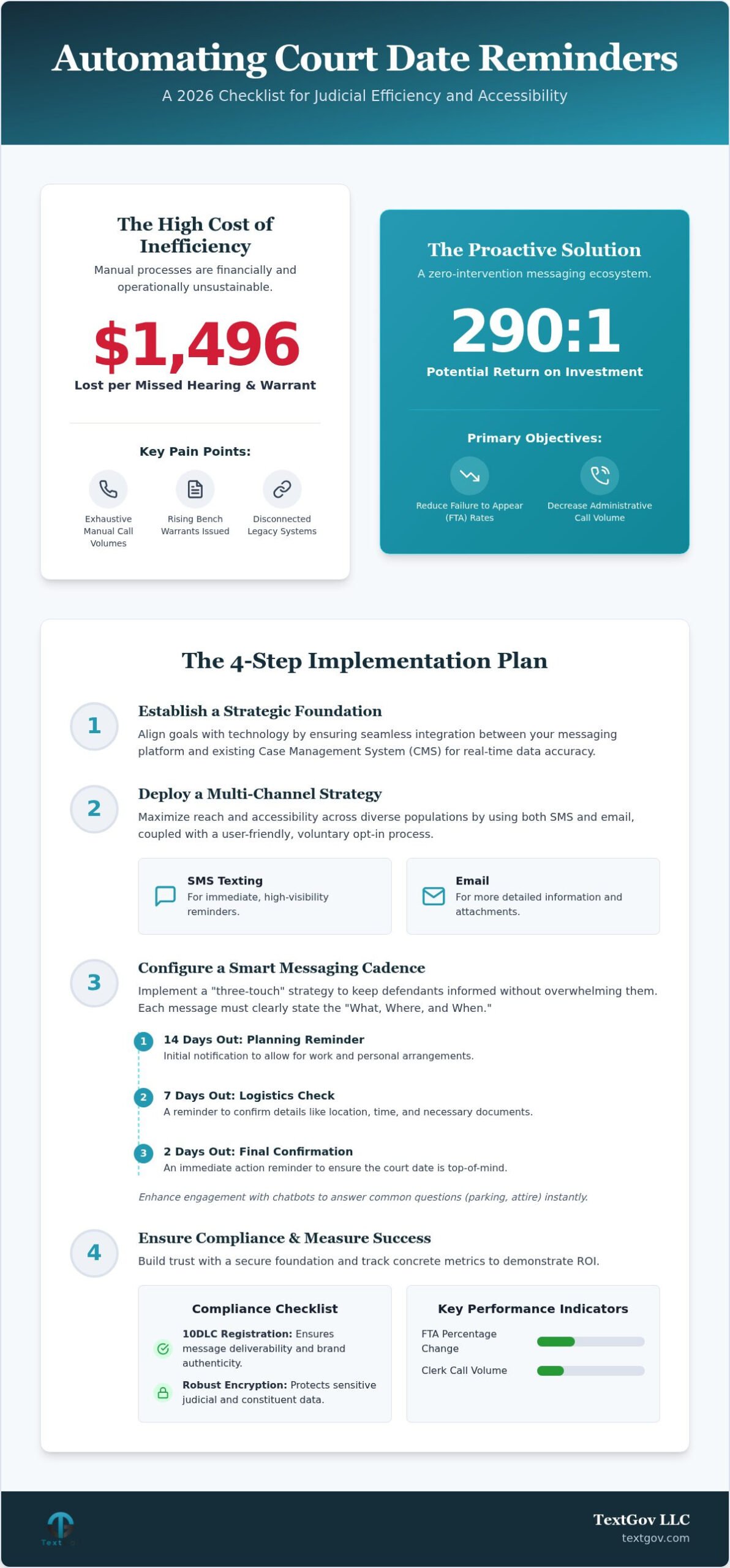
Modernizing your jurisdiction requires a clear alignment of judicial goals and technological capabilities within an electronic court environment. Your primary objectives must center on two critical metrics: a measurable reduction in Failure to Appear (FTA) rates and a substantial decrease in administrative call volumes. Research indicates that each missed court appearance where a warrant is issued costs the government approximately $1,496 in time and resources. By establishing these baseline costs, you create a powerful justification for the investment. Automated court reminders are a data-driven communication bridge between judicial databases and defendant mobile devices. Whether you’re managing misdemeanors, complex felonies, or jury summons, defining the scope early ensures the system scales effectively. This strategic clarity allows you to transition from reactive management to a proactive, constituent-focused model.
Identifying Key Data Integration Points
Accuracy is non-negotiable. Success depends on how seamlessly your messaging platform communicates with your existing Case Management System (CMS). You’ll need to audit your CMS for API availability and ensure data cleanliness to prevent messaging errors. Mapping essential fields like case numbers, defendant contact details, and hearing locations is vital for precision. A high-performance system must pull real-time updates to automate court date reminders effectively. This prevents the friction caused by sending reminders for hearings that have already been canceled or rescheduled. With a 290-to-1 ROI reported for some reminder programs, the financial benefits are as compelling as the social impact. By ensuring this real-time link, you eliminate manual intervention and provide defendants with the most accurate information available, ultimately elevating the standard of judicial service.
The Implementation Checklist: Steps to Automate Court Date Reminders
Selecting a messaging platform requires a commitment to government-grade security and uncompromising reliability. It isn’t just about sending a text; it’s about ensuring every constituent receives timely, accurate data. Research from the Harvard Kennedy School proves that these systems reduce warrants for arrest by addressing simple human forgetfulness. By adopting a multi-channel approach using both SMS and email, courts can maximize their reach across diverse populations. This strategy ensures no one falls through the cracks due to a lack of communication.
Accessibility must remain at the forefront. Design a voluntary opt-in process that complies with consumer protection laws while staying user-friendly. For those managing specific case types, our Guide to Implementing Pre-Trial Text Reminders in 2026 provides tailored workflows for pre-trial populations. Success depends on clear pathways. It’s time to build a system that works for everyone.
Configuring Cadence and Messaging Logic
A logical cadence is the backbone of any effort to automate court date reminders. We recommend a three-touch strategy: 14 days for planning, 7 days for logistics, and 2 days for immediate action. Each message must clearly state the “What, Where, and When” of the appearance. Integrating sophisticated court chatbot software allows for two-way engagement, answering common FAQs about parking or court attire instantly. This level of interaction empowers constituents. If you’re ready to elevate your standards, working with a strategic partner makes the transition seamless.
Ensuring Compliance and Measuring the ROI of Court Automation
Compliance isn’t a hurdle; it’s a foundation for trust. Government entities must prioritize 10DLC (10-digit long code) registration to ensure message deliverability and brand authenticity. This goes hand-in-hand with robust encryption protocols that meet stringent judicial standards for sensitive data. When you automate court date reminders, you aren’t just sending alerts; you’re managing a secure flow of information that protects both the court and the constituent.
Measuring the impact of these systems requires a focus on concrete metrics. To align these technical shifts with your broader institutional mission, refer to our comprehensive guide on reducing failure to appear rates. Focus your evaluation on these essential performance indicators:
- FTA Percentage Change: Track the direct reduction in missed court dates.
- Call Volume Reduction: Measure the decrease in routine inquiries handled by clerks.
- Bench Warrant Issuance Rates: Monitor the drop in warrants related to non-appearance.
This data-driven approach ensures your investment delivers measurable value while proving the efficiency of your new ecosystem.
Measuring Success and Reducing Administrative Burden
Success isn’t just about the numbers; it’s about the people. By analyzing clerk time savings, you can reallocate staff to complex tasks that require a human touch. Collecting defendant feedback further refines the clarity of your automated alerts, ensuring they remain helpful and accessible. Once your core infrastructure is stable, you can scale your success by implementing juror text reminder systems. This phased approach allows you to automate court date reminders effectively while building a truly modern, responsive judicial ecosystem.
Pioneering a New Era of Judicial Excellence
Transitioning from manual outreach to a sophisticated digital ecosystem is no longer a luxury; it’s a strategic necessity for modern courts. By aligning your case data with a secure, cloud-based platform, you can automate court date reminders to preserve precious resources and elevate public accessibility. We’ve explored how establishing a clear foundation and maintaining strict compliance standards ensures long-term success. Our proven GovTech solutions offer 24/7 messaging and a measurable reduction in administrative burdens, allowing your staff to focus on high-priority judicial tasks. The path to judicial efficiency is clear, and the tools are at your fingertips. Contact TextGov LLC to modernize your court communications with automated reminders today. Together, we can redefine how your jurisdiction interacts with its constituents and set a new standard for excellence.
Frequently Asked Questions
How do automated court date reminders reduce failure to appear (FTA) rates?
Research indicates that most individuals who miss court are not attempting to avoid prosecution but are instead facing hurdles like illness or transportation issues. Well-designed court reminder systems can reduce failures to appear by 10% to 30% by addressing these simple logistical barriers. By providing consistent updates, jurisdictions can transform the defendant experience and significantly lower the number of warrants issued for unintentional absences.
Is SMS messaging for court dates compliant with privacy and security regulations?
SMS messaging is highly compliant when managed through secure, cloud-based platforms that prioritize data encryption. A 2026 ruling in the Northern District of Georgia determined that text messages are not considered telephone calls under certain TCPA provisions, providing further legal clarity for court notifications. By adhering to 10DLC registration and judicial privacy standards, courts can safely modernize their constituent outreach while protecting sensitive information.
Can automated reminder systems integrate with existing judicial case management software?
Most modern platforms are specifically engineered to integrate with existing judicial databases through advanced API connections. This allows the system to automate court date reminders by syncing directly with your Case Management System (CMS) in real time. This automated bridge ensures that if a hearing is rescheduled or a case is settled, the messaging logic updates instantly to prevent inaccurate notifications from being sent.
What is the ideal cadence for sending court date text reminders to defendants?
The standard industry cadence follows a 14, 7, and 2-day schedule to maximize defendant preparedness. The 14-day alert allows for long-term planning, the 7-day reminder covers logistical needs like childcare or work leave, and the 2-day message provides a final call to action. This strategic timing ensures that the court date remains a priority without overwhelming the recipient with excessive communication.