
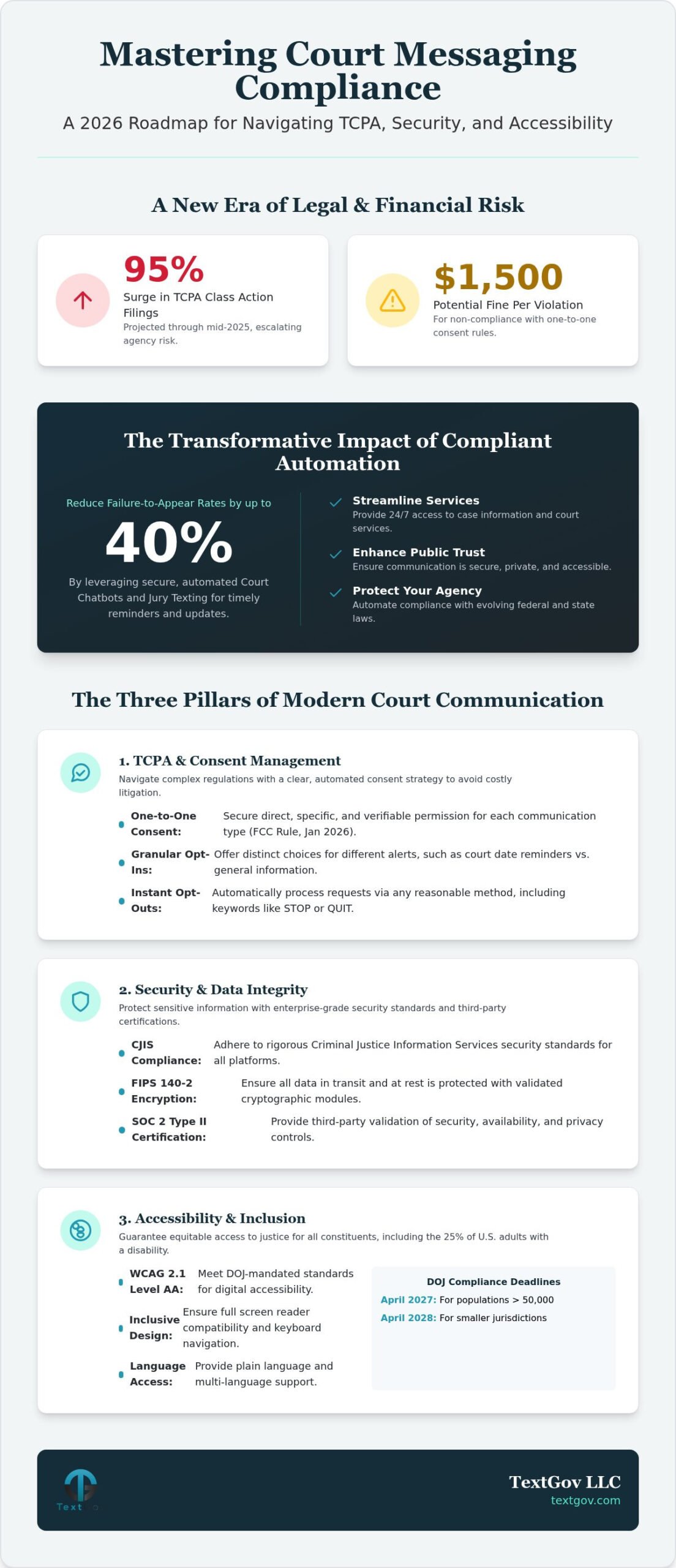
With TCPA class action filings surging nearly 95% through mid-2025, the legal stakes for judicial communication have never been higher. You’re likely feeling the pressure to modernize while staring down a maze of conflicting 2026 circuit court rulings and strict DOJ accessibility deadlines. It’s a daunting task to balance efficiency with the rigorous demands of court messaging compliance, especially since a single misstep leads to significant penalties. We understand your priority is maintaining public trust while streamlining essential services.
This guide provides a definitive roadmap to mastering the regulatory landscape, ensuring your digital transformation is both visionary and legally sound. We’ll explore the shift in one-to-one consent rules, the latest WCAG 2.1 standards, and how secure automation through a Court Chatbot or Jury Texting can slash failure-to-appear rates by up to 40%. You’ll gain the strategic insights needed to implement 24/7 accessible tools that protect your agency and serve your community effectively.
Key Takeaways
- Navigate the complex shift in federal privacy laws and 2026 circuit court rulings to safeguard your agency against escalating TCPA litigation.
- Establish a robust framework for court messaging compliance by implementing direct consent protocols and adhering to strict local time zone messaging windows.
- Ensure universal accessibility and data integrity by aligning your digital tools with the latest DOJ-mandated WCAG 2.1 standards and CJIS encryption requirements.
- Leverage a secure SaaS model to integrate a Court Chatbot and Jury Texting with your existing case management system for automated, real-time public communication.
The Regulatory Landscape of Court Messaging in 2026
Modern court messaging compliance represents more than a technical checkbox; it’s the critical intersection of privacy, accessibility, and data integrity. Administrators must ensure every digital touchpoint protects constituent information while meeting federal standards. This evolution is part of a broader legal technology overview where efficiency doesn’t compromise constitutional rights. State-level privacy acts now impose stricter data retention limits, forcing courts to rethink how they store and purge constituent messaging history to maintain transparency without risking exposure.
The Telephone Consumer Protection Act (TCPA) remains a primary hurdle for public agencies. A February 2026 Fifth Circuit ruling permits oral consent in some jurisdictions, but a July 2026 Seventh Circuit decision created a complex legal split over text message classification. This volatility makes court messaging compliance difficult without a unified strategy. Since the FCC’s one-to-one consent rule took effect in January 2026, courts must secure direct, non-transferable permission from every constituent to avoid fines reaching $1,500 per violation.
Mastering TCPA and Opt-In Requirements
Successful implementation starts with clear, proactive opt-in workflows for defendants using a Court Chatbot or prospective jurors via Jury Texting. You must offer distinct choices for different alert types, such as court date reminders versus general information. Managing these preferences requires high-level performance from your software. As of April 2025, regulations require that you honor opt-out requests through any reasonable method, which demands automated systems that recognize keywords like STOP or QUIT instantly.
The 2026 standard for digital consent in judicial contexts mandates that public entities obtain direct, specific, and verifiable permission from the individual for each distinct type of communication service provided.
Security and Accessibility Standards for Judicial Digital Tools
Securing public trust requires a dual focus on rigorous data protection and universal accessibility. In 2026, court messaging compliance hinges on meeting CJIS data security standards for all cloud-based platforms. This ensures that sensitive pre-trial texting and case information remain encrypted through FIPS 140-2 validated modules. High-performance systems must also maintain SOC 2 Type II certification to provide rigorous third-party validation of their security and privacy controls. This level of oversight aligns with the latest DOJ Corporate Compliance Guidance regarding data retention and the governance of messaging applications. If you’re looking for secure messaging solutions, prioritizing these rigorous certifications is a non-negotiable step toward modernizing your infrastructure.
ADA Compliance and Inclusive Chatbot Design
Digital accessibility is a fundamental requirement for modern judicial interactions. The Department of Justice mandates that public entities with populations over 50,000 meet WCAG 2.1 Level AA standards by April 2027, while smaller jurisdictions follow by 2028. This means your Court Chatbot must feature seamless screen reader compatibility and full keyboard navigation. True equity in justice also requires utilizing plain language and comprehensive multi-language support to reach every constituent. Effective court technology modernization prioritizes these inclusive features to ensure no citizen is left behind. By designing specifically for the 25% of U.S. adults living with a disability, your agency reinforces its commitment to fair and open access. A robust court messaging compliance strategy isn’t complete without a platform that serves everyone, regardless of their physical or technical limitations.
Implementing a Compliant Messaging Strategy with TextGov
Modernizing your judicial communications requires a platform that evolves alongside shifting federal mandates. By leveraging a specialized SaaS model, your agency gains access to automated security patches and compliance updates that reflect the latest 2026 regulatory changes. This proactive approach ensures your court messaging compliance remains current without taxing internal IT resources. Integrating a Court Chatbot directly with your existing case management system facilitates secure, real-time data synchronization, allowing for instantaneous updates to hearing schedules and defendant records. A strategic court management system SMS integration dissolves data silos and establishes a seamless flow of information that reduces manual workloads while cultivating deeper public trust.
The operational benefits of this digital transformation are measurable and impactful. Implementing automated juror text reminder systems significantly reduces the heavy administrative burden on court staff who previously managed manual call lists. These high-performance tools allow you to scale constituent outreach and reduce failure to appear rates by 20% to 40% based on verified industry outcomes. By maintaining these high standards of efficiency and security, your court can provide 24/7 public information services that are both reliable and legally compliant.
Secure Case Management Integration and Archiving
Maintaining transparency is a core requirement for public sector entities. TextGov automates the archiving of all digital communications, ensuring your agency stays prepared for public records requests and FOIA compliance. Every message sent through our Jury Texting or Government Chatbot platforms utilizes end-to-end encryption to protect sensitive data from unauthorized access. This seamless integration reduces manual clerk tasks while maintaining a comprehensive, tamper-proof audit trail for every interaction. This level of technological sophistication turns court messaging compliance from a regulatory burden into a strategic foundation for modern judicial excellence.
Lead the Future of Judicial Communication
Transitioning to a digital-first approach is a significant upgrade for any public institution. Achieving long-term court messaging compliance requires a sophisticated partner who understands the nuances of federal privacy laws and evolving security mandates. By prioritizing a CJIS-ready security architecture and ensuring universal accessibility, your agency sets a new standard for organizational optimization. These high-performance tools don’t just streamline workflows; they actively foster a more inclusive and transparent relationship between the court and the public.
Our 24/7 automated messaging platforms and proven failure-to-appear reduction strategies are designed to help you lead with confidence. It’s time to move beyond outdated systems and embrace a transformative path that ensures your agency remains resilient, accessible, and ahead of the curve.
Frequently Asked Questions
How does the TCPA apply to court-initiated text messages?
The TCPA requires courts to obtain express consent before sending automated alerts to constituents. This is a fundamental pillar of court messaging compliance. Under the FCC’s January 2026 one-to-one consent rule, this permission must be obtained directly by the court. Failure to adhere to these standards or messaging outside the 8 a.m. to 9 p.m. window can result in statutory damages of $500 to $1,500 per violation.
What are the ADA requirements for government chatbots in 2026?
Government chatbots must comply with the Web Content Accessibility Guidelines (WCAG) 2.1, Level AA standard as mandated by the Department of Justice. Public entities serving populations over 50,000 must meet this requirement by April 26, 2027. Smaller jurisdictions have until April 2028. Compliance involves ensuring your Court Chatbot supports screen reader technology and keyboard navigation. It’s about providing equitable access to justice for every constituent.
Is a court chatbot secure enough to handle sensitive case information?
A modern Court Chatbot is engineered with a CJIS-ready security architecture to protect sensitive judicial data. These platforms utilize FIPS 140-2 validated encryption and maintain SOC 2 Type II certification. This ensures rigorous third-party oversight. By choosing a SaaS model, you benefit from continuous security patches that defend against evolving threats. It maintains a tamper-proof audit trail for every constituent interaction.
How do automated text reminders help in maintaining judicial compliance?
Automated systems strengthen court messaging compliance by removing human error from opt-out management. These tools instantly process keywords like STOP or QUIT to ensure no further messages are sent. This has been a requirement since April 2025. Additionally, they provide verifiable logs of delivery and consent. This creates a robust defense against TCPA litigation while reducing failure-to-appear rates by 20% to 40%.