
Automation should handle repeatable questions, not decide what the law allows an agency to release. For agencies looking to automate public records inquiries, questions about where to submit a request, what happens next, and how to check status can take staff time while leaving residents unsure where to turn.
Efficiency matters only when residents receive clear, consistent guidance and staff retain control of records review, privacy, legal judgments, and complex cases.
This article explains how to automate routine public communication with approved self-service answers, clear routing for requests, and safeguards that escalate questions needing human attention. You’ll learn where automation fits, what should remain with staff, and how to plan workflows that support transparency without blurring accountability.
Key Takeaways
- To automate public records inquiries effectively, separate procedural questions and status updates from formal requests that need staff attention.
- Build a workflow that classifies inquiries, provides reviewed answers, and routes unresolved questions to the appropriate staff.
- Assign an owner and review schedule to your knowledge base so public-facing guidance stays accurate and consistent.
- Keep disclosure decisions, records searches, and legally significant communications with staff. Review privacy, accessibility, security, and retention safeguards before launch.
How to Automate Public Records Inquiries Without Losing Human Oversight
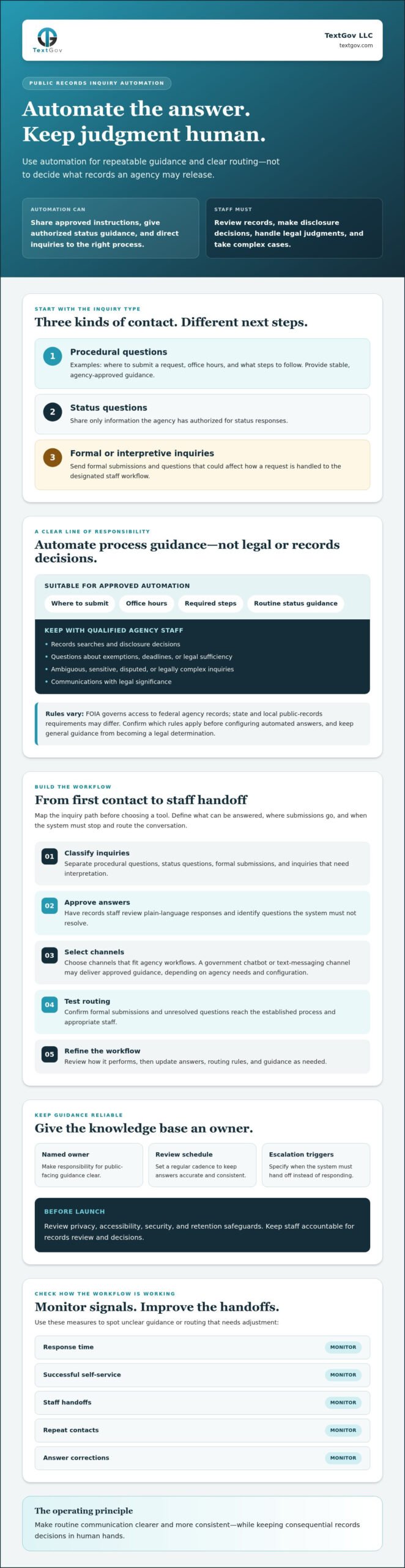
To automate public records inquiries safely, use automation to provide repeatable information and direct people to the right next step. Do not use it to review records or make disclosure decisions. An automated channel can share agency-approved instructions or direct a resident to the appropriate contact. Staff remain responsible for evaluating the request and the records involved.
Start by distinguishing three kinds of contact: procedural questions about submitting a request, status questions about an existing request, and formal requests for records. A chatbot or messaging channel can provide approved procedural guidance. Status responses should use only information the agency has authorized for that purpose. Formal requests, and questions that could affect how a request is handled, should go to the designated staff workflow.
The federal Freedom of Information Act (FOIA) governs access to federal agency records, while state and local public-records requirements may differ. Confirm which rules apply to your agency before configuring automated answers. Keep general guidance from becoming a legal determination.
Which public records questions are suitable for automation?
Begin with stable, agency-approved information, such as where to submit a request, office hours, required steps, and routine status guidance. A government chatbot or text-messaging channel can deliver these answers when configured around reviewed content and the agency’s established workflows.
- Answer: Where can I submit a request?
- Guide: What steps should I follow?
- Route: Can someone clarify a sensitive or disputed issue?
Escalate ambiguous, sensitive, disputed, or legally complex inquiries to qualified agency staff. Automated guidance should not decide questions about disclosure, exemptions, deadlines, or legal sufficiency. These boundaries help agencies streamline routine communication while keeping consequential judgments accountable to people.
Build a Public Records Inquiry Workflow: From Intake to Staff Escalation
A dependable workflow makes automation easier to manage and clarifies each handoff. Before selecting a tool, map how an inquiry moves from first contact to staff response. Identify which answers can be automated, where formal submissions go, and when the system must stop and hand off the conversation.
- Classify inquiries: Separate procedural questions, status questions, formal submissions, and inquiries that need interpretation.
- Approve answers: Ask records staff to review plain-language responses and identify questions the system must not resolve.
- Select channels: Choose channels that fit agency workflows. Depending on the agency’s needs and configuration, a government chatbot or text-messaging channel may provide approved guidance.
- Test routing: Confirm formal submissions and unresolved questions reach the established process and appropriate staff.
- Refine: Review how the workflow performs, then update answers, routing rules, and guidance as needed.
Support the workflow with a knowledge base that has a named owner, a regular review schedule, and clear escalation triggers. For guidance on structuring public-facing answers, see this government chatbot FAQ guide. Agencies can also consider whether making proactively disclosed documents easy to find could help address recurring information needs.
How should agencies prepare answers and escalation rules?
Have records staff approve each answer, check that it uses clear language, and specify when the system must hand off instead of responding. Route formal submissions and questions requiring interpretation through the agency’s established process. To check whether the workflow is working, monitor response time, successful self-service, staff handoffs, repeat contacts, and answer corrections. These signals can show where guidance is unclear or routing needs adjustment.
Agencies evaluating chatbot channels can explore TextGov LLC’s government chatbot solutions as one option for delivering approved public-facing information. TextGov LLC also offers chatbot and text-messaging solutions tailored to courts and government agencies, with implementation and integration support.
Protect Accuracy and Accountability When Automating Public Records Inquiries
Automation can make routine communication more consistent, but it should not make decisions that require agency judgment. Staff must remain responsible for records searches, disclosure decisions, exemptions, and communications with legal significance. A system can share approved process information or route an inquiry. It should not determine which records may be released.
Before choosing a channel, discuss agency requirements with the appropriate records, legal, privacy, accessibility, and security experts. Check whether the approach fits applicable jurisdictional rules, protects personal information, supports accessible use, and aligns with records retention and security practices. Build these safeguards into the workflow and tool configuration from the start. For related public-sector considerations, see this court chatbot software guidance.
How can agencies test and improve an automated inquiry service?
Before launch, test realistic questions, unclear wording, unsupported requests, and scenarios that should trigger staff escalation. Check that the service does not present uncertain answers as definitive and always gives residents a clear next step. Keep a record of test materials and references consulted throughout the implementation process.
After launch, assign staff to review answer changes, user feedback, routing failures, and outdated information. This review cycle helps agencies automate public records inquiries while keeping accuracy and accountability visible. TextGov LLC provides chatbot and text-messaging solutions for public-sector clients. Agencies can explore TextGov LLC’s public-sector communication solutions as they evaluate options, without assuming that a specific records workflow is supported.
Move Toward Clearer, More Accountable Public Communication
Agencies can automate public records inquiries without handing over decisions that require staff judgment. Focus automation on approved answers and clear routing, while keeping records searches, disclosure decisions, and legally significant communications in human hands.
A well-designed workflow starts with classifying inquiries, reviewing answers, and testing escalation paths. Ongoing attention to accuracy, privacy, accessibility, security, and applicable requirements helps keep the service trustworthy as agency needs evolve.
TextGov provides chatbot and text-messaging solutions for courts and government agencies, along with implementation and integration support. When evaluating communication tools, consider how a potential channel could fit the agency’s approved guidance and workflows.
With thoughtful planning and staff oversight, agencies can make routine information easier to access while preserving accountability where it matters most.
Frequently Asked Questions
Can public records inquiries be automated?
Yes. Agencies can automate public records inquiries that involve repeatable guidance, such as explaining submission channels, office hours, or routine process steps. Automated tools can also direct residents to the appropriate contact or established request process. They should not replace staff review of records or make disclosure decisions. Set clear escalation paths for questions that are ambiguous, sensitive, or require interpretation.
What parts of a public records request should remain with staff?
Staff should handle records searches, disclosure decisions, exemption determinations, and communications that carry legal significance. They should also review formal submissions and requests that are unclear, sensitive, or require interpretation. Automation can provide approved procedural information, but it should not determine whether a request is legally sufficient or what information may be released. Define these boundaries in the workflow before making automated guidance available to the public.
How do agencies keep automated public records answers accurate?
Assign an owner to the approved answer set and have records staff review it on a defined schedule. Update guidance when agency procedures or applicable requirements change. Before launch, test realistic questions, unclear wording, and escalation paths. After launch, monitor user feedback, routing failures, repeat contacts, and answer corrections. Use those findings to revise unclear responses and remove outdated information.
Does FOIA apply to state and local public records requests?
No. The federal Freedom of Information Act applies to records held by federal agencies. It does not govern state and local agencies’ records requests. State and local access requirements come from the rules that apply in each jurisdiction, and processes may differ. Agencies should confirm applicable requirements with qualified staff before publishing automated answers about request procedures, response timelines, or access to records.