
What if AI could help residents get clear answers faster without taking consequential decisions out of human hands? That’s the central opportunity for AI for local government: make everyday services easier to navigate while keeping accuracy, privacy, and public accountability in view. For agencies balancing rising expectations with limited staff and capacity, the practical questions are which tasks are suitable for AI and how to prevent errors from undermining public trust.
This guide looks at where AI can support local services, from routine resident questions to administrative workflows, and where human judgment must remain central. It covers safeguards for transparent, accountable use and a manageable first step for assessing an agency’s needs, data, and oversight. Government chatbots offer one focused example: they can answer routine questions while staff handle complex or sensitive matters.
Key Takeaways
- Distinguish generative AI from rule-based automation to identify which tools fit your agency’s service needs.
- Assess potential uses for routine questions, request routing, and document review based on data sensitivity and the impact of errors.
- Keep human review central when AI outputs could affect complex or sensitive resident matters.
- Explore AI for local government with a focused first step: define a service need, review the data, set oversight rules, and evaluate results.
AI for Local Government in 2026: What Is Changing, and Why It Matters
Residents expect clear, convenient ways to find public information, while agency teams manage high workloads and requests across multiple channels. AI is drawing attention because it can help staff handle information-intensive tasks and make routine services easier to navigate. The practical aim is to improve how people find answers and how work moves through an agency, without handing public judgment to a machine.
Artificial intelligence identifies patterns in information and uses them to generate, classify, or recommend responses, while conventional automation follows fixed rules and predefined steps. The distinction helps clarify which tool fits a task. A rule-based system might route a form according to a selected category. An AI tool might interpret a resident’s written inquiry and suggest the relevant department. Either can support a workflow, but neither should make consequential public decisions without appropriate human oversight. The broader concept of Government by algorithm also highlights why transparency and attention to bias matter when algorithms shape public processes.
Which AI capabilities are most relevant to local agencies?
These capabilities can work together, but they serve different purposes:
- Conversational AI supports back-and-forth interactions, such as answering routine questions through a government chatbot.
- Natural language processing helps systems interpret, classify, or summarize everyday language. It can support tasks such as sorting inquiries or reviewing documents.
- Generative AI creates new text, such as a draft summary, using information in its prompt or approved sources.
A chatbot may combine scripted answers with AI-powered language features, so agencies should understand which functions it uses and what each one does. AI for local government is most useful when it assists with repetitive information tasks and employees verify outputs, respond to sensitive cases, and remain accountable for decisions. Before adopting a tool, define the task it will support, the information it can use, and the point at which a staff member takes over. That keeps automation in a supporting role rather than treating it as a substitute for public responsibility.
Where AI Can Improve Local Services, and Where Human Review Matters
AI can support specific steps in a local service workflow, especially where staff handle recurring questions or large volumes of information. Potential uses include answering routine questions about public services, routing inquiries to the right department, and helping staff summarize or review documents. A government chatbot FAQ guide offers a focused example of using conversational tools to help residents find routine information.
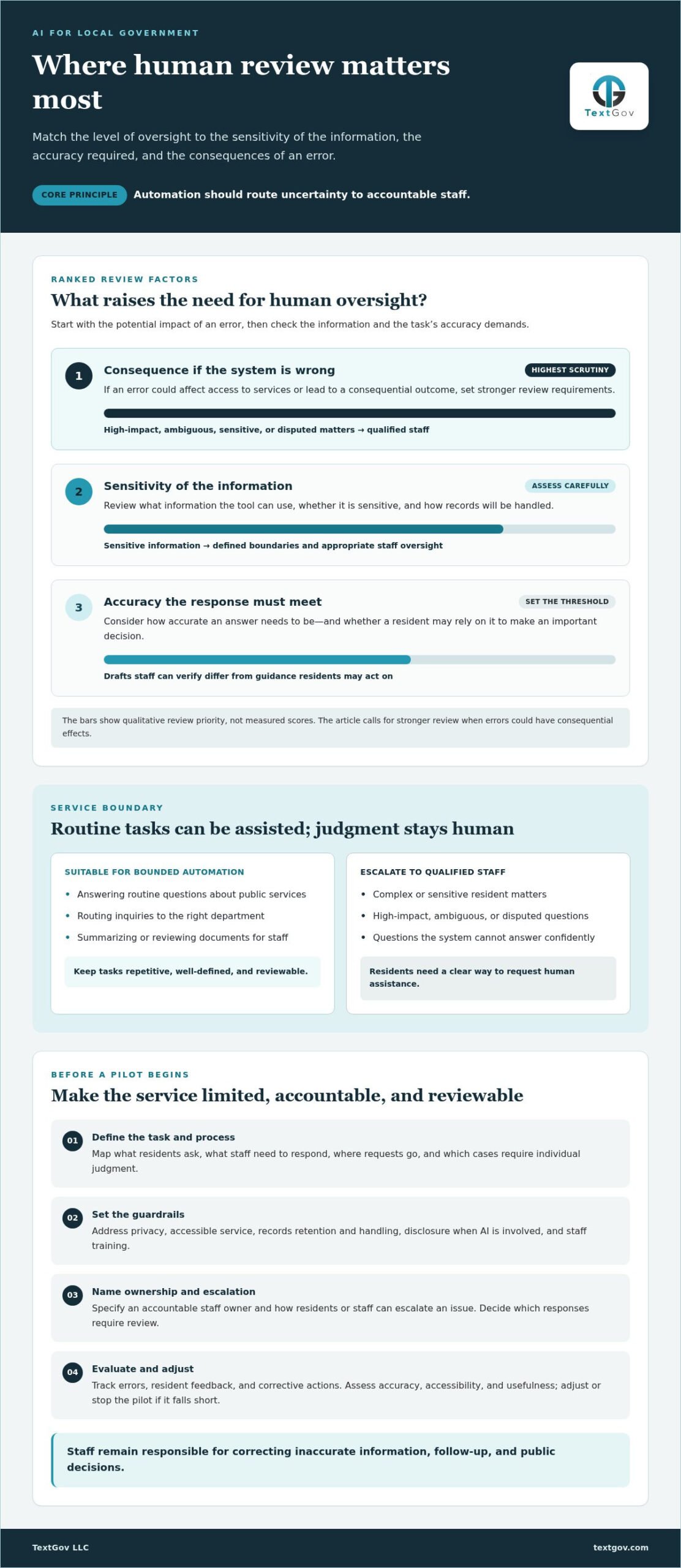
These tasks are not equally suited to automation. Consider how sensitive the information is, how accurate an answer must be, and what could happen if the system gets it wrong. For example, a draft summary that staff review before using is different from guidance a resident might rely on when making an important decision. Set stronger review requirements when errors could affect a resident’s access to services or lead to a consequential outcome. A framework for responsible AI can help agencies weigh safeguards alongside operational goals.
How can agencies balance faster responses with reliable service?
Set clear boundaries before deployment. Automated tools can handle routine, well-defined questions, but high-impact, ambiguous, sensitive, or disputed matters should go to qualified staff. Establish an escalation path for questions the system cannot answer confidently, and give residents a clear way to request human assistance. Staff should be able to correct inaccurate information and take responsibility for follow-up.
Automation should route uncertainty to accountable staff, not turn uncertainty into an automated answer.
For resident communication, a government chatbot can provide a structured first point of contact while employees remain responsible for complex or sensitive issues. Explore government chatbot solutions to support routine public inquiries.
How Local Governments Can Explore AI Responsibly
Start with a defined service task, such as organizing routine public records inquiries, rather than trying to automate an entire department. Map the current process: what residents ask, what information staff need to respond, where requests are sent, and which cases require individual judgment. Then assess whether the information is sensitive and how the system will handle records. Guidance on automating public records inquiries can help frame that use case, while government messaging modernization offers a related lens on resident communications.
Set guardrails before a pilot begins. Address privacy, accessible service for residents with different needs, records retention and handling, disclosure when AI is involved, and staff training. Decide which responses can be automated and which must be reviewed or escalated. The UNC School of Government guidelines on AI offer local governments a starting point for developing internal guidance.
What should an agency define before piloting an AI-assisted service?
Keep the pilot limited and reviewable. Specify the task, name the accountable staff owner, establish how residents or staff can escalate an issue, and decide how service quality will be assessed. Track errors, resident feedback, and corrective actions. Review the results against the original purpose, then adjust or stop the pilot if it falls short.
Agencies should verify current legal and policy requirements before deploying an AI-assisted service.
For AI for local government, evaluation should look beyond speed. Check whether responses are accurate, accessible, and useful, and whether staff can intervene when the system falls short. A government chatbot can be a bounded starting point for routine public communication. Explore public-sector chatbot solutions to support that work.
Move Forward with AI That Serves Residents
AI for local government can make routine services easier to access, but lasting value depends on choosing well-defined tasks and keeping staff accountable for sensitive or uncertain matters. Start with a focused need, assess the information involved, set clear review and escalation rules, and evaluate service quality before expanding.
For resident communication, TextGov provides chatbot and text-messaging solutions tailored to courts and government agencies. Its platforms support public communication around the clock and are designed to reduce routine call volumes, helping agencies improve access while staff focus on more complex needs.
Thoughtful safeguards and practical service improvements can advance together. With a clear purpose and human oversight, your agency can take a confident next step toward more responsive public services.
Frequently Asked Questions
How can AI help local government?
AI can help local government teams manage routine information tasks, such as answering common resident inquiries, routing requests, summarizing documents, and retrieving internal information. For example, a chatbot can answer frequently asked questions about public services. Match each tool to a defined task, protect sensitive information, and establish human review and escalation processes so faster service does not create accuracy or access problems.
Is AI safe for local government use?
AI is not automatically safe or unsafe. Risk depends on the system, data, task, and potential consequences of an error. Agencies can reduce risk with access controls, testing, transparent processes, staff oversight, and clear paths to human assistance. Before deployment, review current authoritative legal and policy guidance and consult agency counsel about requirements that apply to the specific use case.
What are examples of AI in local government?
Examples include conversational systems that answer routine service questions, tools that classify and route resident requests, and applications that help staff summarize documents. These uses can support service delivery by organizing information and assisting with repetitive tasks. Staff should remain accountable, especially when inquiries are complex, sensitive, disputed, or could affect a resident’s rights or access to public services.
How should a local government start using AI?
Start with a specific service problem, not a goal of adopting AI for its own sake. Identify the data involved, assign an accountable staff owner, and set review and escalation rules. Test the workflow on a limited basis, then assess accuracy, accessibility, resident experience, and staff workload. Use those findings to decide whether to adjust, continue, or expand the application.