
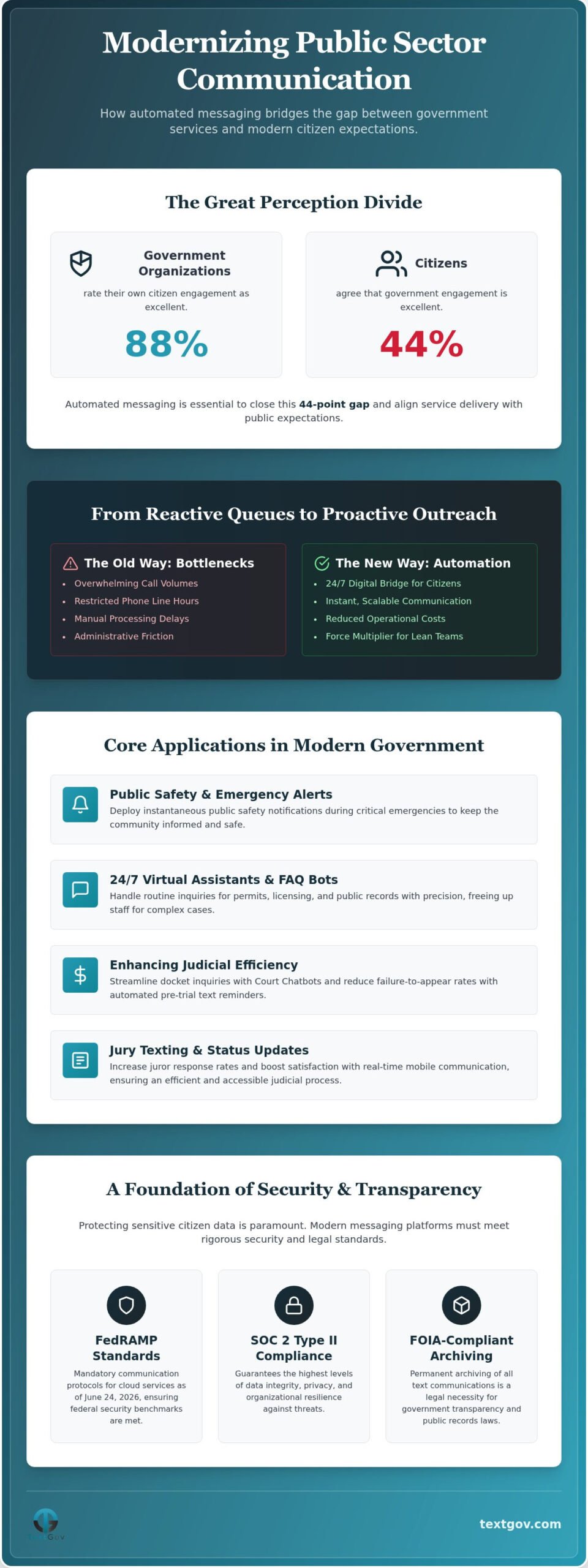
Did you know that while 88% of government organizations rate their engagement as excellent, only 44% of citizens actually agree? You likely feel the weight of this disconnect every day through overwhelming call volumes and the constant pressure to maintain compliance with evolving public record laws. Modernizing with automated messaging for government agencies isn’t just about software; it’s about closing that gap and reclaiming administrative time. It’s time to move beyond the “please hold” queue and embrace a more proactive, digital-first approach to public service.
This guide reveals how sophisticated digital assistants scale public sector communication, reduce operational costs, and transform the citizen experience. We’ll explore the latest 2026 FedRAMP standards, the strategic deployment of a Government Chatbot, and how Jury Texting is solving high failure-to-appear rates. You’ll discover how to build a unified strategy that delivers 24/7 access and improves judicial efficiency across every department.
Key Takeaways
- Learn why implementing automated messaging for government agencies is the vital 24/7 digital bridge needed to meet modern citizen expectations and scale public communication.
- Explore how specialized tools like a Court Chatbot or Jury Texting can eliminate routine administrative friction and significantly boost judicial efficiency.
- Identify the essential security standards and FOIA-compliant archiving protocols required to safeguard sensitive data while ensuring organizational transparency.
- Discover the transition from reactive responses to proactive outreach that reduces call volumes and fosters a more collaborative relationship with your community.
The Evolution of Public Sector Communication: Why Automation is Essential in 2026
The history of e-government demonstrates a clear trajectory from static portals to dynamic, real-time interactions. In 2026, automated messaging for government agencies acts as a vital 24/7 digital bridge, ensuring that public offices remain accessible long after physical doors have closed. This evolution addresses a glaring perception gap; while 88% of government organizations believe their engagement is excellent, only 44% of citizens agree. Traditional communication hurdles, such as restricted phone lines and manual processing, often lead to administrative bottlenecks. AI-driven messaging removes these barriers, offering a scalable infrastructure that functions as a force multiplier for lean government teams. It’s a fundamental requirement for operational continuity.
Bridging the Gap Between Bureaucracy and Digital Expectations
A digital-first mandate now dictates agency funding and directly influences public trust. Research indicates that digital interactions account for 70% of all citizen engagement, yet a significant gap remains between service delivery and constituent satisfaction. A government chatbot for faq management solves this by resolving routine inquiries through an automated interface without requiring human intervention. This technological leap is especially critical for modernizing judicial access. By deploying a Court Chatbot, agencies can streamline complex procedural questions and ensure that legal information is both accurate and immediate. These tools empower citizens to navigate bureaucratic systems with the same speed and ease they expect from the private sector.
Core Applications of Automated Messaging in Modern Government
Deploying automated messaging for government agencies allows for instantaneous public safety notifications during critical emergencies. Beyond urgent alerts, 24/7 virtual assistants now handle routine permits, licensing, and public records inquiries with remarkable precision. By following a robust public sector messaging framework, departments can transition from reactive responses to proactive community engagement. This shift encourages participation in volunteer programs and ensures that critical information reaches the mobile-first citizen exactly when it’s needed, fostering a deeper sense of public trust and reliability.
Automation excels at managing high-volume, low-complexity tasks that typically clog phone lines and create long wait times for the public. When digital tools handle the significant portion of engagement that’s routine, personnel can finally dedicate their expertise to complex, high-stakes cases that require human empathy and specialized problem-solving. This strategic reallocation of human capital via automated messaging for government agencies is why many forward-thinking agencies now partner with specialized GovTech experts to modernize their workflows and elevate their service delivery standards. It’s about working smarter to serve the community effectively.
Enhancing Judicial Efficiency with Court and Jury Messaging
Implementing court chatbot software streamlines docket inquiries and reduces the administrative burden on clerks. Agencies are also adopting proven strategies to reduce failure to appear rates via pre-trial text reminders. Dedicated Jury Texting further enhances this by:
- Increasing response rates through mobile-first communication.
- Boosting juror satisfaction with real-time status updates.
- Ensuring the judicial process stays efficient and accessible for everyone.
Implementing a Secure and Scalable Messaging Strategy
Transitioning to automated messaging for government agencies requires a rigorous security posture to protect sensitive judicial and citizen data. As of June 24, 2026, the new FedRAMP consolidated rules establish mandatory communication protocols for cloud service providers. Modern platforms must achieve SOC 2 Type II compliance to ensure data integrity and organizational resilience. The GSA’s Notify.gov case study illustrates how federal agencies successfully navigate these security challenges while building public trust. Beyond security, every interaction must remain FOIA-compliant. Permanent archiving of text-based communications is no longer optional; it’s a legal necessity for transparency.
When selecting a partner, look for platforms that offer national scalability while preserving localized agency control. Many organizations begin with pilot programs to test specific use cases, like a government SMS notification service for permit inquiries. However, the ultimate goal is a full-scale, agency-wide deployment that provides a unified experience across all departments. It’s essential to stay ahead of regulatory shifts, such as the TCPA revoke-all requirement now effective January 31, 2027. This proactive approach ensures that your communication infrastructure remains robust and compliant as standards evolve.
Integrating Automated Workflows with Case Management Systems
Connecting your messaging platform to existing judicial databases is a technical necessity for providing real-time status updates. Seamless integration ensures that a Court Chatbot can pull accurate docket information instantly, reducing the need for manual data entry. A comprehensive approach to court technology modernization provides the strategic framework needed to align these integrations with long-term judicial goals. Implementation fees typically cover the custom configuration of scripts and automated workflows tailored to your specific agency needs. High-performance digital assistants require dedicated technical support to maintain 99.9% uptime. This ensures that the public always has a reliable point of contact, regardless of the hour, which significantly elevates the standard of public service.
Redefining the Future of Public Service
The transition toward digital modernization requires more than new tools; it demands a fundamental shift in how organizations interact with the public. By adopting specialized Court and Government Chatbot solutions, your agency can effectively bridge the gap between bureaucratic processes and modern citizen expectations. These systems deliver a proven reduction in call volumes and administrative friction, allowing your staff to focus on high-priority tasks. Integrating these platforms with your existing case management systems ensures real-time accuracy and long-term scalability.
Implementing automated messaging for government agencies is the definitive step toward a more responsive and efficient public sector. It’s about building a resilient infrastructure that serves your community 24/7 while maintaining the highest security standards. For municipalities and counties looking to reduce routine inquiries by up to 60%, a dedicated local government automated response strategy provides the practical framework to achieve seamless, ADA-compliant service delivery. Modernize your agency’s communication with TextGov’s 24/7 messaging solutions. Your journey toward a more connected and efficient government starts today.
Frequently Asked Questions
How does automated messaging ensure compliance with public record laws like FOIA?
Modern platforms maintain permanent, immutable logs of every constituent interaction to ensure full transparency. These systems are designed to archive all messages automatically, which allows agencies to fulfill Freedom of Information Act (FOIA) requests with absolute precision. By centralizing digital records, your organization avoids the risks of fragmented data. This approach protects the agency while providing the accountability citizens expect from modern governance.
Can automated messaging systems integrate with our existing case management software?
Yes, high-performance automated messaging for government agencies is built specifically to bridge the gap with legacy case management systems. Through secure API connections, these platforms pull real-time data to provide citizens with accurate updates on docket statuses or permit applications. This technical synergy eliminates manual data entry, reduces human error, and ensures your digital assistants operate with the most current information available.
What is the difference between a standard SMS service and a government-specific chatbot?
A standard SMS service is typically a one-way notification tool, whereas a Government Chatbot is a sophisticated, interactive digital assistant. While basic SMS might send a broad alert, a specialized chatbot engages in two-way dialogue to resolve specific inquiries or guide users through complex applications. To understand how these tools complement each other, exploring a dedicated government SMS notification service can clarify how agencies layer proactive outreach with interactive engagement. This advanced capability allows agencies to handle nuanced public interactions 24/7 without requiring intervention from human staff members.
How do automated text reminders help reduce failure to appear rates in courts?
Automated reminders reduce failure to appear rates by delivering timely, mobile-first notifications directly to defendants and jurors. These messages include critical details such as hearing times, locations, and links to procedural requirements. By providing this proactive outreach, courts can significantly improve judicial efficiency and response rates. This method effectively addresses simple forgetfulness, which remains a primary driver of courtroom absences and administrative delays.
Is citizen data secure when using a cloud-based government messaging platform?
Security is a foundational pillar for automated messaging for government agencies, particularly within cloud environments. Modern platforms must adhere to SOC 2 Type II compliance and the latest FedRAMP standards to protect sensitive judicial data. These protocols involve rigorous encryption and dedicated security monitoring. By choosing a partner focused on court technology modernization and GovTech, agencies ensure that citizen information remains shielded while maintaining high system uptime.