
In 2026, the traditional 8-to-5 government office is no longer the standard for citizen service; it’s the bottleneck. You likely feel the daily strain of endless phone queues and staff burnout from repetitive inquiries. It’s a cycle that limits accessibility and drains resources. This guide shows you how to implement a secure 24/7 government messaging platform to slash call volumes and meet the strict WCAG 2.1 Level AA accessibility standards mandated by the Department of Justice.
By shifting routine inquiries to automated infrastructure, your agency can lower overhead and significantly reduce failure-to-appear rates. We’ll explore how to modernize engagement through a specialized court chatbot and jury texting, ensuring every constituent receives an instant, professional response at any hour. Discover the path to a more efficient, digitally resilient public sector that prioritizes both staff well-being and citizen satisfaction.
Key Takeaways
- Understand why modernizing your agency requires shifting to an on-demand service model that matches the 2026 public expectation for instant digital accessibility.
- Identify the non-negotiable security and scalability requirements for a 24/7 government messaging platform that ensures reliable, high-performance communication across all departments.
- Learn why pure SMS “no app” solutions consistently outperform traditional mobile applications in driving meaningful constituent engagement and higher response rates.
- Explore how specialized court chatbot software integrates with your existing systems to automate complex legal inquiries and significantly reduce administrative overhead.
The Evolution of 24/7 Government Messaging in 2026
A 24/7 government messaging platform is a secure, automated ecosystem designed for the instant resolution of public inquiries. Unlike the traditional Emergency Alert System (EAS) which focuses on one-way mass notifications, these modern platforms facilitate two-way, interactive dialogues. The public now views government services through the same lens as private sector e-commerce, expecting “on-demand” assistance at any hour. Waiting for a clerk to return a call on Monday morning isn’t an acceptable standard for a digitally native population.
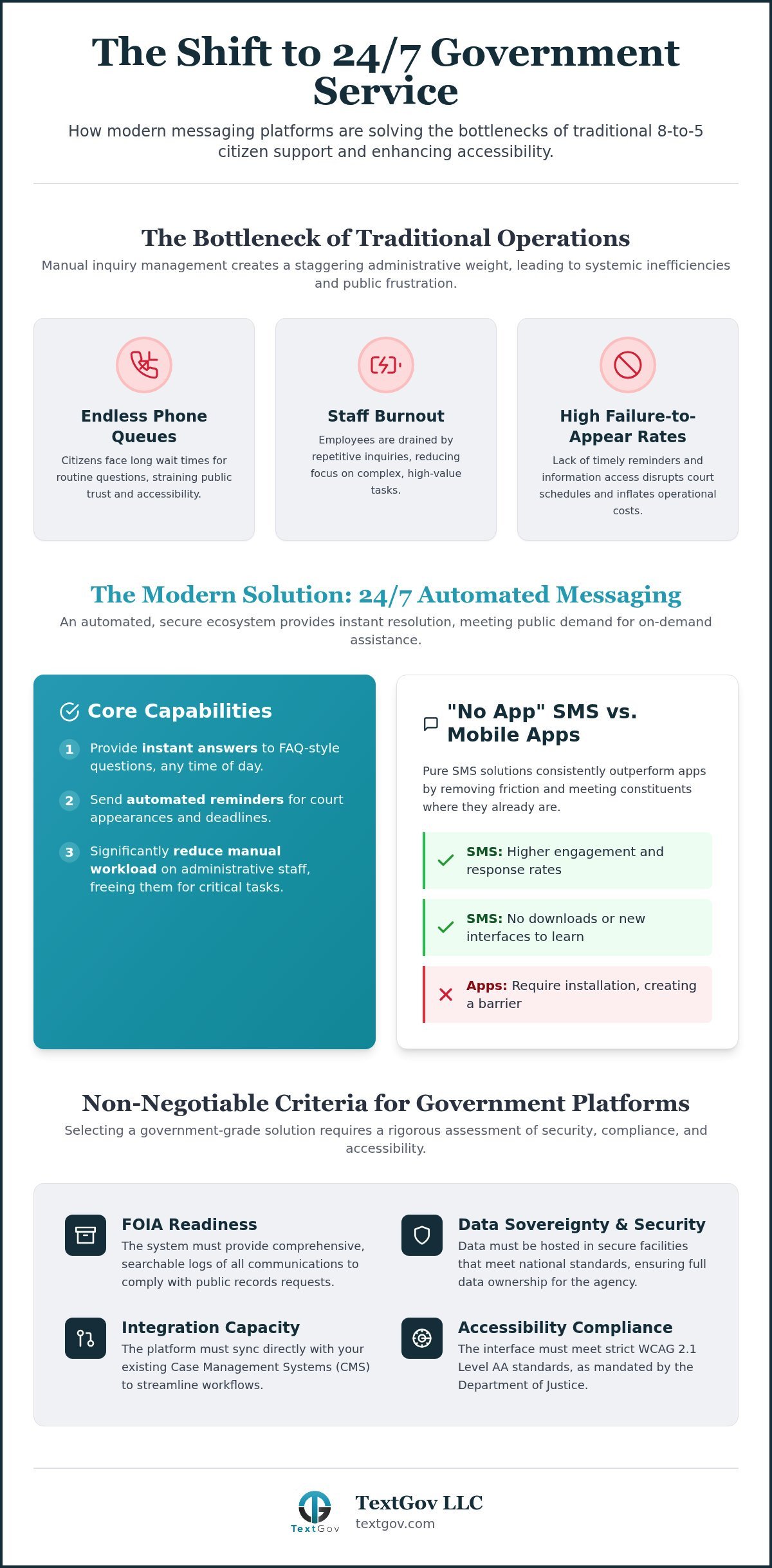
Integrating AI with SMS provides a robust bridge between restricted agency hours and the constant flow of citizen needs. SMS remains the most effective channel for this engagement because it reaches constituents where they already are, without requiring specialized apps. It’s a primary driver of digital transformation for courts. Implementing a dedicated 24/7 government messaging platform allows agencies to:
- Provide instant answers to FAQ-style questions.
- Send automated reminders for upcoming court appearances.
- Reduce the manual workload on administrative staff.
The Hidden Costs of Manual Inquiry Management
Managing routine inquiries manually creates a staggering administrative weight that slows down critical operations. When staff spend the majority of their day repeating instructions for jury duty or verifying court dates, it leads to systemic burnout. These inefficiencies contribute to high “failure to appear” rates, which disrupt court calendars and inflate operational budgets. The “after-hours gap” is the critical period outside of standard business hours when citizens seek information but find government offices inaccessible. By automating these interactions, agencies can reclaim hundreds of hours of staff time while ensuring that no constituent is left without an answer.
Essential Criteria for Evaluating Messaging Resources
Selecting a 24/7 government messaging platform requires a rigorous assessment of technical architecture and public accessibility. Government-grade solutions must prioritize security, scalability, and extreme ease of use to be effective. The most successful implementations in 2026 avoid the friction of mobile applications entirely. Pure SMS “no app” solutions consistently outperform app-based systems because they don’t require the citizen to download or learn a new interface. This immediacy is vital for high-stakes environments like courts and municipal offices where every second of engagement counts. For agencies evaluating their options, a thorough government messaging platform comparison can clarify which solutions best align with your department’s compliance and workflow requirements.
Automated FAQ responses are the engine of this operational efficiency. By handling repetitive inquiries instantly, a robust 24/7 government messaging platform allows clerks to focus on complex legal cases that require human intervention. For a detailed breakdown of these specific capabilities, consult our 2026 guide on government chatbots for FAQ management. If you’re ready to modernize your constituent outreach, you can explore specialized government messaging solutions tailored for your agency’s unique needs.
Prioritizing Security and Regulatory Compliance
Securing public data is a non-negotiable mandate for any public sector tool. Unlike consumer-grade apps that may utilize end-to-end encryption without administrative oversight, government platforms must ensure full data ownership and FOIA compliance. This means every interaction is archived and remains accessible for public records requests. Government-grade hosting involves dedicated, secure environments that exceed standard commercial encryption protocols. Administrators should use the following criteria when vetting SaaS providers:
- FOIA Readiness: Does the system provide comprehensive, searchable logs of all communications?
- Data Sovereignty: Is the data hosted in secure facilities that meet national standards?
- Integration Capacity: Can the platform sync directly with your existing Case Management Systems?
- Accessibility: Does the interface meet the latest WCAG 2.1 Level AA requirements?
Implementing Your 24/7 Messaging Ecosystem
Establishing a 24/7 government messaging platform marks a decisive move from reactive, phone-based support to a proactive, text-first communication strategy. This transition isn’t merely about adding a new channel; it’s about redefining the constituent experience through high-level automation. Specialized court chatbot software is engineered to navigate the complexities of legal inquiries, providing precise answers that generic tools often miss. To ensure total accuracy, professional implementation services are essential for configuring custom messaging scripts that align with local ordinances. This strategic alignment drives long-term ROI by slashing “no-show” rates through high-performance juror text reminder systems, which preserve court resources and maintain trial schedules.
Integrating Automation with Case Management Systems
Connecting your messaging ecosystem with existing Case Management Systems (CMS) is the technical foundation of a truly modern agency. This process involves establishing secure data bridges that allow the messaging platform to interact directly with municipal databases in real time. Such synchronization ensures that automated court date and jury summons reminders are always based on the most current records, eliminating the risk of sending outdated information. It’s a critical step in streamlining administrative workflows. When selecting a technology provider, prioritize partners that offer comprehensive technical support and frequent platform updates to ensure long-term stability. This collaborative approach ensures your digital tools remain as sophisticated as the judicial standards they support.
Modernizing Constituent Engagement for a Digital Era
The shift toward automated, accessible service is no longer optional for agencies seeking to maintain public trust. By prioritizing secure SMS architecture and seamless CMS integration, you can effectively eliminate the after-hours gap while reducing the administrative load on your team. Adopting a robust 24/7 government messaging platform ensures that every citizen receives an instant response, regardless of the time of day.
TextGov LLC stands ready as your expert guide in this transition, offering solutions specialized in judicial and municipal workflows that meet national US compliance standards. Our team provides expert integration with legacy Case Management Systems to ensure your modernization is both smooth and sustainable. Request a custom implementation plan for your agency from TextGov LLC and start redefining your engagement today. It’s time to build a more efficient, accessible future for your community.
Frequently Asked Questions
How does a 24/7 messaging platform handle complex legal questions?
A 24/7 government messaging platform manages complex legal questions by resolving routine inquiries through automated scripts and escalating nuanced cases to human staff. It delivers pre-approved, standardized information regarding court procedures or filing requirements. This ensures accuracy while protecting the agency from providing unauthorized legal advice. By filtering basic questions, it allows clerks to dedicate their expertise to complex matters.
Is automated government texting compliant with public record laws?
Automated government texting via a 24/7 government messaging platform is fully compliant with public record laws through comprehensive archiving and data ownership protocols. Every interaction is recorded in a searchable format to satisfy FOIA and state-level disclosure requirements. Unlike consumer apps, these platforms are engineered for transparency. This ensures that all digital communications remain part of the official public record.
Can these messaging platforms integrate with our current case management system?
These platforms are specifically designed to integrate with existing legacy case management systems through secure API connections. This integration allows for real-time data syncing, which is essential for sending automated court date reminders or juror summons updates. By connecting directly to your municipal database, the system ensures that every message sent is based on the most current and accurate information available.
What is the typical implementation timeline for a government chatbot?
The typical implementation timeline for a specialized government chatbot ranges from a few weeks to a few months. This duration depends on the complexity of your custom messaging scripts and the specific requirements of your case management system integration. A structured deployment plan ensures the technology is properly configured and tested. It’s a methodical approach that guarantees a seamless transition.