
Why is your most highly trained staff still spending hours every day answering the same questions about office hours, parking, and payment deadlines? It’s a common frustration in the public sector; skilled clerks are often tethered to phones while constituents feel the friction of limited access. You’ve likely realized that manual information dissemination is no longer a sustainable model, yet implementing a modern government chatbot for faq management offers a clear path forward. It’s a way to eliminate the drain on your budget and the weight on staff morale.
This 2026 guide demonstrates how these sophisticated digital assistants transform operational bottlenecks into seamless, automated interactions. You’ll discover how intelligent triage systems provide the public with 24/7 access to vital information without requiring a single minute of human intervention. We’ll explore the strategic shift from reactive phone support to proactive digital engagement, showing you exactly how to reduce call volumes and empower your team to focus on the high-level work they were actually hired to perform.
Key Takeaways
- Understand how the transition to Natural Language Processing allows digital tools to interpret constituent intent rather than relying on rigid, outdated menus.
- Learn the strategic process of auditing inquiry data to identify the most frequent repetitive questions for automated resolution.
- Discover how a modern government chatbot for faq management serves as a 24/7 digital assistant to significantly reduce manual call volumes and operational costs.
- Explore how integrating automated FAQ systems with juror text reminder platforms creates a proactive and holistic communication ecosystem for the public sector.
The Evolution of Government Chatbots for FAQ Management
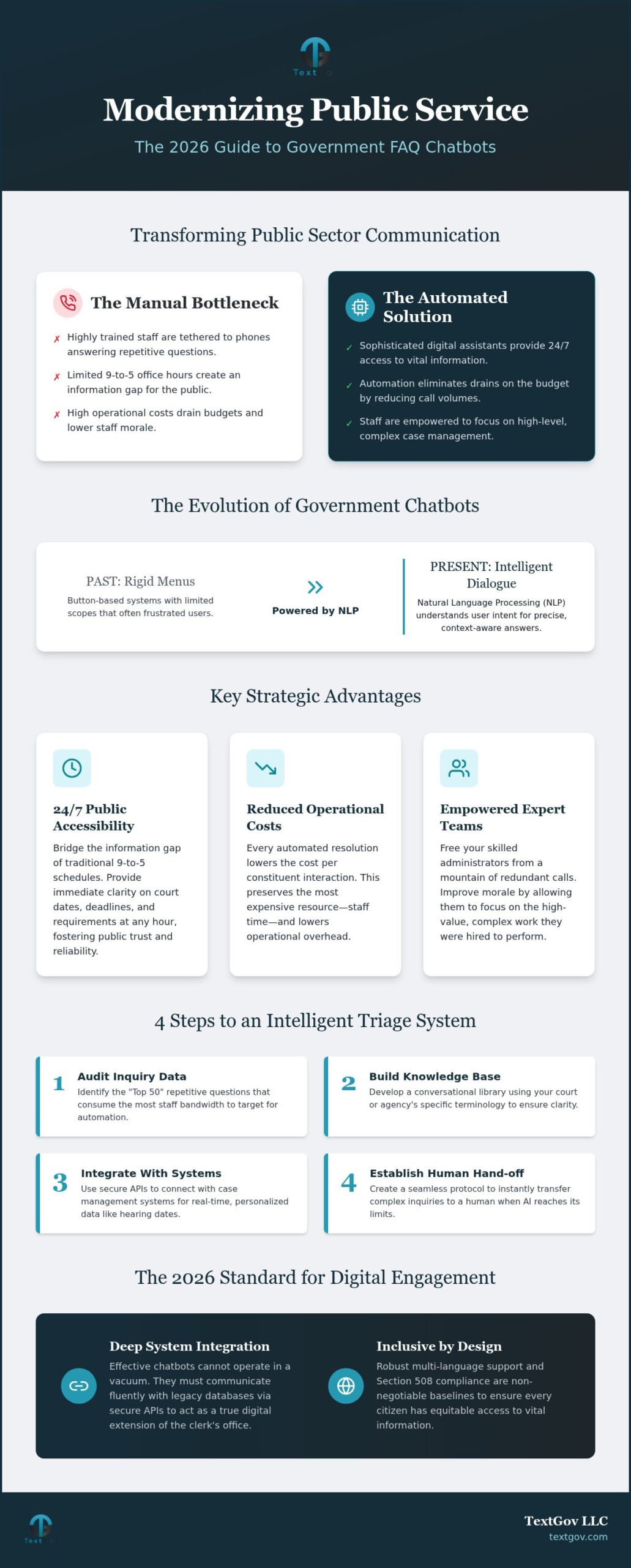
The landscape of public administration is undergoing a fundamental shift as agencies move away from static websites toward dynamic, conversational interfaces. A government chatbot for faq is no longer just a basic script; it’s a sophisticated, AI-driven interface engineered to resolve complex public inquiries without requiring human intervention. Early iterations of this technology relied on rigid, button-based menus that often frustrated users with their limited scope. Today, the standard has evolved into high-performance Natural Language Processing (NLP). These modern systems understand user intent, allowing constituents to ask questions in plain English and receive precise, context-aware answers. By modernizing judicial access and enhancing municipal transparency, these tools ensure that information is a utility, not a hurdle. Modern FAQ chatbots serve as the first line of defense for overextended public offices.
Why 24/7 Accessibility is the New Public Standard
Constituent expectations have shifted dramatically toward an “always-on” model of service. The traditional 9-to-5 office schedule creates a significant information gap for individuals working non-traditional hours or managing urgent legal deadlines. Automated messaging platforms bridge this divide by providing immediate clarity at any hour. When a resident can verify a court date or a permit requirement at midnight, the friction of government interaction vanishes. This constant availability fosters a deeper sense of trust and reliability in public institutions while ensuring no constituent is left behind due to their personal schedule. Agencies looking to meet this demand can explore a comprehensive 24/7 government messaging platform designed to slash call volumes and meet modern accessibility standards. For those who want to see how this spirit of public engagement is mirrored in citizen-led initiatives, learn more about Aux Armes Citoyens !.
The Economic Impact of Automated Public Inquiry
Every automated resolution represents a tangible reduction in the cost per constituent interaction. When a government chatbot for faq handles repetitive queries about payment locations or office directions, it preserves the most expensive resource in any agency: staff time. By utilizing an agentic contact-center platform like GraiaCX to automate these interactions across voice and chat, agencies can lower operational overhead while simultaneously freeing up clerks for high-value, complex case management tasks. The result is a more resilient organization where staff morale improves because they’re no longer buried under a mountain of redundant phone calls. Agencies seeking a broader modernization strategy will find that a comprehensive approach to automated messaging for government agencies addresses both the operational and citizen-experience dimensions of this challenge.
Strategic Implementation: From Static FAQs to Intelligent Triage
Transitioning from a static help page to an active intelligence hub requires a methodical approach. It’s not just about installing software; it’s about engineering a system that understands the specific nuances of public service. To build an effective government chatbot for faq, start by auditing your existing inquiry data. Identify the “Top 50” questions that currently consume your staff’s bandwidth. Once identified, develop a conversational knowledge base using the specific terminology of your court or agency. This ensures the bot speaks the language of your constituents rather than using generic corporate jargon. To support this infrastructure, Stratelegy offers the enterprise-grade UCaaS and CCaaS solutions necessary to manage these automated interactions at scale.
Success depends on moving beyond simple text responses. Integrate your chatbot with case management systems to provide real-time, personalized data such as hearing dates or payment balances. Automation shouldn’t be an island. You must establish a seamless hand-off protocol so that complex inquiries move instantly to a human administrator when the AI reaches its limit. If you’re ready to modernize your office, exploring a specialized messaging platform can help bridge this technological gap.
Integrating with Existing Government Infrastructure
Effective court chatbot software cannot operate in a vacuum. It must communicate fluently with legacy databases to provide accurate, up-to-date information. Secure APIs are the backbone of this connection; they ensure that data integrity and constituent privacy remain uncompromised while the system scales to meet demand. This technical synergy allows the government chatbot for faq to act as a true digital extension of the clerk’s office.
Designing for Inclusivity and Accessibility
True public service requires accessibility for everyone. Your digital assistant must include robust multi-language support to serve diverse populations equitably. Section 508 compliance is the non-negotiable baseline for all government digital assistants, ensuring that every citizen, regardless of ability, has equal access to vital information. Agencies seeking to meet the WCAG 2.1 Level AA standards now mandated by the Department of Justice will find that deploying a secure 24/7 government messaging platform is a critical step toward achieving full digital compliance. By prioritizing these standards, you create a digital environment that’s both powerful and inclusive.
Beyond digital assistants, specialized services also play a key role in accessibility; for example, families navigating UAE residency requirements can check out Goodhand to see how professional guidance simplifies essential government procedures.
Future-Proofing Public Service: The 2026 Standard for Digital Engagement
By 2026, the reactive model of public service has been replaced by a proactive, data-driven standard. A government chatbot for faq is no longer a luxury; it’s a foundational element of municipal and judicial infrastructure. These systems now anticipate constituent needs based on seasonal cycles. For instance, as tax deadlines approach or jury pools are summoned, the system initiates engagement rather than waiting for a phone call. This shift ensures that the public receives the right information at the exact moment they need it, which drastically reduces peak-season pressure on administrative staff. Understanding the broader context of digital transformation for courts reveals how these proactive strategies fit within a larger movement toward AI-driven, mobile-first judicial operations.
The true power of modern digital engagement lies in the synergy between different communication tools. When a government chatbot for faq works in tandem with juror text reminder systems, it creates a holistic ecosystem that minimizes no-show rates and streamlines the entire judicial experience. Agencies that want to go further can explore proven strategies to reduce failure to appear rates, leveraging automated technology and procedural justice to lower no-shows by 20% to 40%. TextGov LLC stands as the strategic partner for agencies ready to adopt this integrated approach, providing the specialized GovTech necessary to elevate public service to these new heights of efficiency and reliability.
The Rise of Agentic AI in the Public Sector
We’ve moved beyond the era of bots that simply answer questions. The 2026 standard introduces agentic AI, which possesses the capability to execute tasks directly within the conversation. This includes scheduling hearings, filing simple forms, or updating contact information in real-time. To maintain the highest levels of public trust, these agents operate within a secure government cloud environment, utilizing advanced encryption and strict security protocols. This ensures that while the system is highly capable and autonomous, data integrity and constituent privacy—often managed through compliance platforms like Conzent—remain the absolute priority in every transaction.
Embrace the Future of Public Sector Communication
The transition from static help pages to intelligent, proactive triage systems marks a definitive new era for public agencies. By moving beyond basic automation and embracing the sophisticated NLP standards discussed throughout this guide, your office can finally eliminate the burden of repetitive inquiries while providing constituents with the “always-on” service they expect. Implementing a government chatbot for faq management isn’t just a technical upgrade; it’s a strategic commitment to staff morale and organizational efficiency. This shift ensures that information is accessible, accurate, and available at the exact moment of need.
TextGov LLC serves as a dedicated partner, specializing in high-performance Court and Government Chatbots designed to integrate seamlessly with your existing infrastructure. Our 24/7 automated messaging solutions deliver a proven reduction in public inquiry call volumes, allowing your team to reclaim their bandwidth for complex case management. We invite you to Contact TextGov LLC to Modernize Your Public Communication and take the lead in this digital transformation. The path to a more streamlined, responsive, and visionary clerk’s office is ready for you to explore.
Frequently Asked Questions
What is the primary difference between a standard chatbot and a government-specific FAQ bot?
A government chatbot for faq is specifically engineered to handle the complex terminology and regulatory requirements unique to the public sector. While standard commercial bots focus on retail transactions, these specialized tools prioritize Section 508 accessibility compliance and secure information dissemination. They utilize Natural Language Processing tailored to judicial and municipal contexts, ensuring that constituents receive precise answers about court procedures or permit requirements rather than generic marketing responses.
How do government chatbots ensure the security of sensitive constituent data?
Security is maintained through rigorous end-to-end encryption and hosting within dedicated government cloud environments. These platforms are built to meet high-level compliance standards, protecting constituent data from unauthorized access at every point of the interaction. By utilizing secure APIs for all data exchanges, the system maintains the integrity of sensitive information while providing the public with a reliable, 24/7 digital assistant that agencies can trust.
Can a chatbot integrate with my agency’s existing case management system?
Modern government chatbots are designed for seamless integration with existing case management systems and legacy databases. This connectivity allows the bot to pull real-time data, such as hearing schedules or payment balances, directly into the conversation for the user. This technical synergy transforms the bot from a simple information provider into a high-performance extension of the clerk’s office, delivering personalized and accurate details without manual staff intervention. For a broader view of how these integrations fit within the evolving judicial landscape, the strategic trend analysis on digital transformation for courts offers valuable context on leveraging AI and SMS alongside existing Case Management Systems.
Will implementing a chatbot lead to staff layoffs in the clerk’s office?
Implementing a chatbot is a strategy for staff augmentation rather than replacement. These tools are designed to handle the overwhelming volume of repetitive, low-value inquiries that typically drain administrative resources. By automating these tasks, your team is empowered to focus on high-level case management and complex constituent needs. This transition improves staff morale by removing the burden of redundant phone calls and allowing clerks to perform the specialized work they were hired to do. Agencies that pair this automation with efforts to reduce failure to appear rates through proactive reminders and digital outreach will see the greatest overall gains in administrative efficiency.