
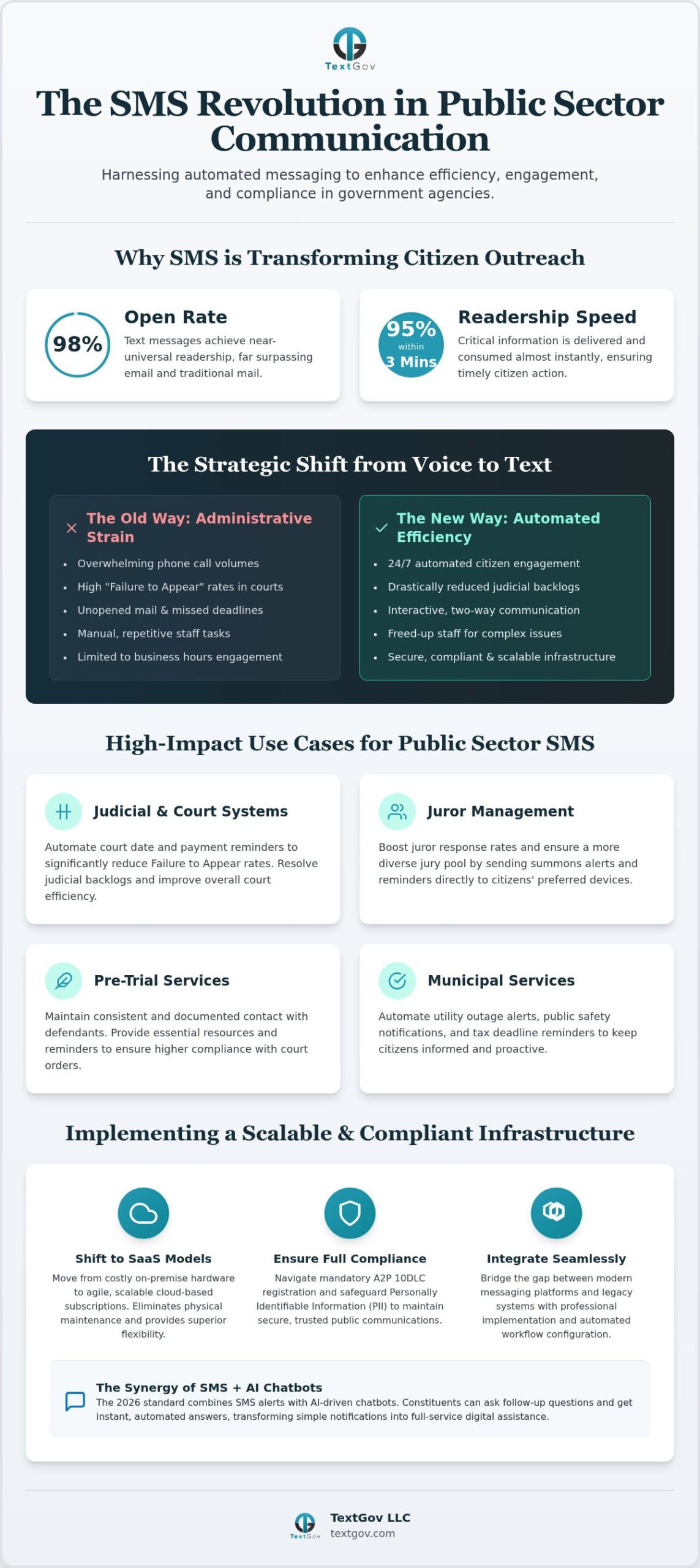
Did you know that 98% of SMS messages are opened, with 95% of those read within just three minutes of delivery? In an era where traditional mail often goes unopened and office phones ring incessantly with routine inquiries, these numbers represent a transformative opportunity for the public sector. You’ve likely felt the strain of managing overwhelming call volumes or the logistical headache caused by high failure to appear rates in your courts. It’s clear that the old methods of citizen engagement are no longer sufficient for a modern agency.
This guide reveals how a sophisticated government SMS notification service is revolutionizing public communication by automating 24/7 engagement and drastically reducing manual administrative tasks. We’ll explore how these tools improve judicial efficiency and juror response rates through high-impact, automated messaging. From navigating mandatory A2P 10DLC registration to integrating with legacy systems, you’ll discover the roadmap to a more efficient, responsive, and technologically advanced organization.
Key Takeaways
- Learn how transitioning from passive alerts to interactive, two-way automated messaging enables your agency to maintain 24/7 citizen engagement without increasing staff workload.
- Discover how a modern government SMS notification service drastically reduces failure to appear rates and judicial backlogs through high-impact, automated court date reminders.
- Understand the strategic advantages of SaaS-based messaging models over legacy on-premise systems to achieve superior scalability and measurable cost-efficiency in clerk offices.
- Gain a clear roadmap for navigating mandatory 2026 regulatory requirements, including 10DLC registration, to ensure your public communications remain secure and fully compliant.
Defining the Modern Government SMS Notification Service
A modern government SMS notification service is no longer a simple broadcasting tool; it is a secure, cloud-based platform engineered to automate citizen outreach with precision. While historical frameworks like the Wireless Emergency Alerts (WEA) system established the foundation for one-way public safety alerts, the 2026 standard has evolved into interactive, two-way automated messaging. This transition ensures that agencies don’t just push information; they facilitate meaningful engagement that drives constituent action.
The data supporting this shift is undeniable. Traditional channels are losing their efficacy, yet SMS maintains a staggering 98% open rate. By deploying these capabilities, agencies align with the government automated messaging 2026 modernization guide to build a cohesive digital infrastructure. The true power of 2026 technology lies in the synergy between SMS and AI-driven chatbots. Unlike basic notification tools, this combined approach allows constituents to ask follow-up questions and receive instant, automated answers directly within the text thread, bridging the gap between simple alerts and full-service digital assistance.
The Strategic Shift from Voice to Text in 2026
Modern agencies are aggressively prioritizing “text-first” communication to combat rising administrative overhead and lower court call volumes. This strategy directly addresses the 24/7 expectations of digital-native constituents who demand immediate access to information. By automating routine inquiries via a government SMS notification service, municipalities can redirect staff toward complex tasks while the system handles repetitive queries. It’s a fundamental upgrade to organizational utility that transforms how the public sector functions in a mobile-centric world.
High-Impact Use Cases for Public Sector Texting
Deploying a government SMS notification service allows agencies to move beyond generic alerts toward targeted, high-impact interactions. As government and public safety agencies accounted for over 41% of the mass notification systems market in 2025, the shift toward mobile-first infrastructure is a proven industry standard. In the judicial sector, automated court date reminders serve as a vital mechanism to reduce failure to appear rates and resolve chronic judicial backlogs. These systems don’t just inform; they prompt compliance through timely, persistent contact. For example, a Notify.gov effectiveness study highlights how structured messaging improves constituent response across various public services. Beyond the courtroom, municipalities use these platforms to automate utility outage alerts and tax deadline reminders. Pre-trial services also utilize SMS to maintain consistent contact with defendants, providing essential resources that ensure higher compliance with court orders.
Optimizing Judicial Outcomes with Automated Reminders
Modernizing juror management is essential for maintaining a functional legal system. Implementing specialized juror text reminder systems significantly improves response rates and helps ensure a more diverse jury pool by reaching citizens on their preferred devices. When these alerts are paired with court chatbot software , the synergy is truly transformative. Citizens can receive a summons alert and immediately text back to ask about parking or deferral processes, receiving instant, automated answers without ever calling the clerk’s office. This level of responsiveness builds public trust while simultaneously stripping away manual administrative burdens. If you’re looking to elevate your agency’s communication standards, exploring specialized judicial messaging solutions can provide the strategic edge your department needs to thrive.
Implementing a Scalable Messaging Infrastructure
Adopting a modern government SMS notification service necessitates a strategic shift from legacy on-premise hardware to agile SaaS subscription models. This transition eliminates the burden of physical maintenance while providing the flexibility to scale as constituent needs grow. To ensure long-term success, agencies must prioritize compliance by navigating mandatory A2P 10DLC registration and safeguarding Personally Identifiable Information (PII). Professional implementation services play a critical role here; they bridge the gap between new software and legacy systems by configuring automated workflows and custom messaging scripts. As documented in The Story of Notify.gov , a well-executed implementation facilitates a seamless experience for both staff and the public across diverse use cases.
Success isn’t measured simply by the number of texts sent. It’s about tangible outcomes. By tracking Net Promoter Scores (NPS) and documenting significant call volume reduction, administrators can provide the concrete data necessary to justify technological investments to stakeholders. These metrics prove that automated messaging isn’t just a convenience; it’s a fundamental optimization of public resources.
Integrating SMS with Existing Case Management Systems
Connecting your notification platform directly to judicial or municipal databases (CMS) is a technical necessity for real-time accuracy. Without this direct link, data silos lead to outdated alerts and administrative friction. Administrators should use the following checklist to evaluate vendor integration capabilities:
- API Flexibility: Does the system support robust REST APIs for custom data triggers?
- Bi-directional Sync: Can the CMS update automatically when a citizen interacts with a Court Chatbot or responds to a text?
- Security Protocols: Does the integration maintain high-level encryption standards for sensitive data?
- Scalability: Can the infrastructure handle peak loads during high-volume summons periods?
Leading the Future of Public Sector Communication
The transition to a sophisticated government SMS notification service represents a fundamental shift toward a more responsive and efficient public sector. By moving beyond passive alerts to interactive, 24/7 automated engagement, your agency can drastically reduce administrative call volumes while improving judicial outcomes. We’ve explored how these modern tools streamline juror management and ensure compliance through secure, 10DLC-registered infrastructure. This strategic upgrade is no longer optional; it’s the new standard for excellence.
Modernization is about becoming a strategic partner to the citizens you serve. TextGov offers solutions specifically tailored for judicial and public sector workflows, ensuring your team has the expert guidance needed for a seamless integration. It’s time to elevate your communication standards and embrace high-performance digital tools. Contact TextGov to Modernize Your Agency with Automated SMS and begin your journey toward operational excellence today.
Frequently Asked Questions
How does a government SMS notification service ensure data security and compliance?
A government SMS notification service ensures security by adhering to mandatory A2P 10DLC registration requirements and federal TCPA regulations. These platforms utilize advanced encryption to protect Personally Identifiable Information (PII) during transmission. By partnering with verified carriers, agencies maintain a secure communication loop. This prevents message filtering and protects sensitive constituent data against unauthorized access or fraudulent spoofing.
Can automated text reminders significantly reduce failure to appear (FTA) rates?
Automated text reminders are highly effective at reducing failure to appear (FTA) rates by providing timely, high-impact notifications directly to a mobile device. These reminders bridge the gap between court summons and the actual hearing date. This proactive engagement works. It leads to a measurable decrease in judicial backlogs and significantly improves overall court clerk office efficiency.
What is the typical implementation timeline for a court or municipal agency?
The typical implementation timeline ranges from a few weeks to several months, depending on the complexity of existing database integrations. Modern SaaS platforms allow for faster deployment compared to legacy on-premise systems. This process includes configuring automated workflows, developing custom messaging scripts, and ensuring seamless API connectivity with your current case management system to achieve immediate operational gains.
Do citizens need to opt-in to receive government text notifications?
Citizens generally must provide prior express consent to receive informational government text notifications, such as appointment reminders or service updates. While emergency alerts often fall under different regulatory categories, standard messaging must comply with the FCC’s “one-to-one consent” rule. This ensures that every government SMS notification service maintains high standards of transparency and respects constituent privacy through clear opt-in mechanisms.