
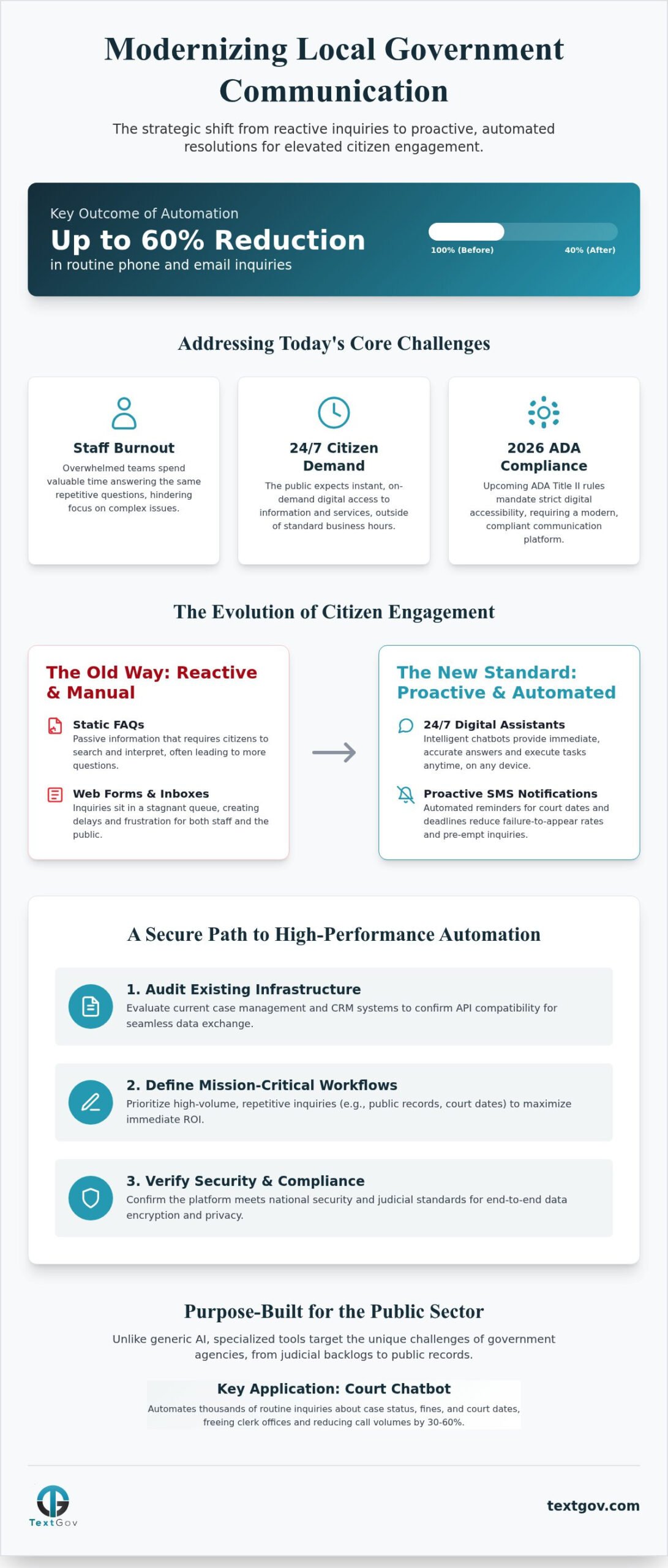
Local governments that implement a sophisticated local government automated response system can see a reduction of up to 60% in routine phone and email inquiries. You’ve likely felt the mounting pressure of staff burnout as they handle repetitive questions while citizens demand 24/7 digital access. It’s a challenging balance to strike, especially with the 2026 ADA Title II requirements mandating strict digital accessibility for public entities.
This guide demonstrates how modernizing your communication through intelligent assistants and SMS notifications elevates citizen engagement and slashes “Failure to Appear” rates. You’ll discover the practical path to integrating these tools with your existing software to achieve seamless, WCAG 2.2 AA compliant service. We will explore the strategic shift from manual processing to a proactive, technology-driven model that empowers both your team and the community you serve.
Key Takeaways
- Understand the critical shift from static FAQs to intelligent workflows that provide proactive, 24/7 resolution for complex constituent needs.
- Identify the essential technical requirements for a secure, cloud-based local government automated response framework that prioritizes high-performance digital engagement.
- Learn how specialized tools like Court Chatbots and Jury Texting directly address judicial backlogs by automating high-volume administrative inquiries.
- Discover the strategic path to integrating SMS and chatbot technology into your existing municipal software to elevate public satisfaction and operational efficiency.
The Evolution of Local Government Automated Response: Beyond Static FAQs
Modernizing public communication requires moving past the era of passive information. A true local government automated response system isn’t merely a list of answers; it’s an intelligent workflow engine that executes complex tasks. While traditional web forms wait for a citizen to find them, active 24/7 digital assistants engage users immediately to provide definitive resolutions. This shift toward civic technology ensures that inquiries don’t just sit in a stagnant inbox but reach a meaningful conclusion in seconds. By 2026, the baseline for public sector communication has evolved to require seamless, multi-channel accessibility across both web and SMS platforms.
Transitioning from Reactive to Proactive Citizen Engagement
The new standard for municipal excellence demands a proactive stance. Instead of waiting for a frustrated phone call, forward-thinking agencies now use automated messaging to pre-emptively address common friction points. For instance, courts are significantly reducing failure to appear rates by deploying automated text reminders that guide defendants through their next steps. This mobile-first approach isn’t just a convenience; it’s a strategic necessity that aligns with modern constituent expectations for instant, high-performance interactions.
These sophisticated systems do more than just talk; they listen and learn. Every automated interaction generates valuable data that helps municipal leaders identify service gaps and refine long-term policy. By providing consistent accessibility, agencies ensure they’re meeting residents where they already are. Implementing a robust local government automated response strategy turns every inquiry into an opportunity for organizational optimization. It’s a transformative leap from being a reactive service provider to becoming a sophisticated, data-driven partner in the community’s daily success.
Implementing a High-Performance Automated Response Framework
Establishing a high-performance local government automated response framework starts with a shift toward human-centered digital service delivery . This philosophy ensures that automated scripts aren’t just cold logic gates; they’re intuitive paths that mirror the natural way citizens seek help. Security remains the bedrock of this modernization. A cloud-based messaging platform must adhere to 2026 judicial standards for data encryption and privacy, ensuring every interaction remains compliant with federal regulations. While some fear that automation might compromise accuracy, a well-engineered system actually reduces human error by pulling directly from verified databases in real-time.
Key Integration Criteria for Municipal and Judicial Systems
To achieve a seamless upgrade, agencies should follow a methodical deployment strategy that prioritizes interoperability and security:
- Audit existing infrastructure: Evaluate current case management and CRM systems to confirm API compatibility for fluid data exchange.
- Define mission-critical workflows: Prioritize high-volume inquiries such as public records requests or specific court chatbot software queries to maximize immediate ROI.
- Verify security protocols: Confirm the platform meets national security standards for government data handling, protecting sensitive constituent information from end to end.
Success in this transition depends on choosing a partner who understands the unique rigors of the public sector. By refining your local government automated response strategy today, you bridge the gap between overwhelmed staff and escalating public expectations. If you’re ready to see this technology in action, exploring specialized messaging platforms is the logical next step for any forward-thinking agency.
Elevating Standards with TextGov: Integrated SMS and Chatbot Solutions
TextGov redefines the local government automated response by providing a unified, 24/7 messaging platform built specifically for the public sector. Unlike generic AI solutions, our Court Chatbot targets judicial backlogs by automating the thousands of routine inquiries that often paralyze clerk offices. This isn’t just theoretical speculation. An academic review on chatbot adoption highlights how these purposeful integrations bridge the gap between user needs and institutional capacity. By resolving queries instantly, agencies see call volumes drop by 30% to 60%, which directly correlates with higher public satisfaction scores.
Maximizing Accessibility through Omnichannel Government Messaging
True modernization relies on a seamless loop between different communication channels. Implementing automated messaging for government agencies ensures that a web inquiry can trigger an intelligent SMS follow-up, keeping the conversation active on the citizen’s preferred device. Our Jury Texting solution further elevates this standard by modernizing juror management and significantly improving summons response rates through timely, automated reminders. This omnichannel approach ensures no constituent is left behind, regardless of how they choose to engage.
Envision a “Digital Clerk Office” that operates with absolute precision around the clock. It never misses a query and never sleeps. By adopting a high-performance local government automated response system, your agency isn’t just installing software; you’re participating in a transformative upgrade of public service. This proactive model ensures every constituent feels heard while your internal workflows remain streamlined and effective. We invite you to lead this evolution and set a new benchmark for municipal excellence in your community.
Pioneering the Future of Public Sector Communication
Modernizing your agency isn’t just about adopting new software; it’s about redefining the constituent experience through proactive engagement. We’ve explored how transitioning from passive FAQs to intelligent workflows transforms a local government automated response into a strategic force-multiplier. By integrating secure, cloud-based messaging and specialized tools like Court Chatbots, you ensure that your municipality remains accessible and compliant in an increasingly digital landscape. These systems resolve public inquiries 24/7 and significantly reduce “Failure to Appear” rates through automated reminders. The path toward a more efficient, responsive government is clear and accessible today. Take the next step to upgrade your agency with a 24/7 TextGov messaging platform and experience the benefits of specialized technology designed for courts and municipal offices. It’s time to lead your community into a new era of excellence.
Frequently Asked Questions
How does an automated response system integrate with existing government software?
Integration is achieved through secure API protocols that link the messaging platform directly to your case management or CRM software. This synergy allows the system to retrieve real-time data for constituent queries, such as court schedules or application statuses. By functioning as an integrated layer, the technology provides accurate, instant resolutions without requiring manual data entry from your staff members.
Can a local government automated response handle complex legal or judicial inquiries accurately?
These systems are engineered to handle procedural inquiries with absolute precision by using structured, pre-verified workflows. A local government automated response provides immediate answers to common questions about filing fees, court locations, or hearing dates. While the system never offers legal representation, it ensures that residents receive consistent, reliable information that aligns with current municipal and judicial regulations.
What is the difference between a standard chatbot and a specialized government messaging platform?
Specialized platforms differ from standard bots by prioritizing security, accessibility, and public sector workflows. Retail chatbots don’t meet the 2026 ADA Title II digital accessibility rules or the WCAG 2.2 AA standards required for public entities. A specialized solution is built for high-stakes interactions, offering features like Jury Texting and seamless integration with complex judicial databases to ensure constitutional compliance. For a closer look at how modernizing judicial interactions translates into measurable results, a 2026 case study in digital court efficiency illustrates the real-world impact of these strategic integrations.
Is automated messaging secure enough for sensitive judicial and municipal data?
Modern messaging platforms are designed to exceed 2026 judicial standards for cloud-based data security and constituent privacy. These systems employ end-to-end encryption and rigorous protocols to protect sensitive municipal and judicial information. By adhering to federal security requirements, these platforms provide a reliable environment for handling court notifications and juror communications without compromising the integrity of government data.